Only two vehicles earn perfect child-seat scores for 2026

The family-car market is crowded with promises of space, safety and everyday versatility, yet a year-long assessment of child-seat compatibility has exposed how few new vehicles turn those promises into consistently effortless real-world use. Among 56 model-year 2025 and 2026 vehicles examined across SUVs, saloons, minivans, pick-up trucks, hybrids and electric cars, only the 2025 Mercedes-Benz GLS580 and the 2026 Volkswagen Tiguan achieved the highest grade in every category.
That outcome is striking not merely because the perfect-score group is so small, but because its two members occupy very different positions in the market. The GLS580 is a large, three-row luxury SUV with the price, size and engineering resources expected of a flagship. The Tiguan is a compact, five-seat family SUV aimed at a far broader audience.
Their shared result makes an important point. Good child-seat accommodation is not determined by vehicle size or prestige alone. It depends on careful packaging, visible anchor points, sensible seat geometry and controls that work without forcing parents to improvise.
A test of usability rather than advertising claims
The assessment was conducted over 12 months by certified child-passenger safety technicians. Each vehicle was evaluated with an infant carrier, a convertible seat in rear-facing and forward-facing form, and a high-back booster. The test also examined the LATCH system, including lower anchors and top-tether points, as well as the effect of a fitted child seat on front-passenger legroom. Booster-seat compatibility depended partly on whether a child could reach and operate the buckle independently.
For three-row vehicles, the programme went further by examining access to the rearmost seats, the position and clarity of third-row tether points, and the way a forward-facing seat and booster fitted in that space. The front seats were set for a six-foot driver and a shorter passenger, giving the test a consistent real-world reference rather than judging the cabin with the front row pushed unrealistically far forwards.
Because vehicles were tested as they became available during the assessment period, the 56-model field should not be interpreted as an exhaustive ranking of every new car on sale. It is nevertheless broad enough to reveal persistent differences in the way manufacturers design rear seats, anchor hardware and family access. The grades should not be confused with crash-test results. A vehicle can offer strong structural protection and sophisticated driver-assistance technology while still making a child restraint awkward to install. Conversely, a straightforward anchor layout does not by itself establish the vehicle’s overall crashworthiness.
The value of the assessment lies in measuring a frequently overlooked link in the safety chain: whether parents can secure the appropriate restraint correctly, repeatedly and without unnecessary difficulty.
The Mercedes-Benz GLS580 makes all three rows work
The Mercedes-Benz GLS580 earned its perfect result through a combination of generous space and unusually accessible hardware. The tested vehicle had second-row captain’s chairs and seating for six, although a seven-seat version with a bench is also available. In the second row, the lower anchors sit beneath easily removed covers, while the top-tether points are clearly marked and positioned where caregivers can reach them without searching beneath trim or confusing them with cargo fittings.
Rear-facing seats fitted without forcing the front passenger into an uncomfortable position. Forward-facing installations could be completed cleanly once the relevant head restraint was adjusted or removed. Stable buckle stalks also made the booster easier for a child to use independently. The third row was more than an afterthought. Both seating positions provided exposed lower anchors and clearly identified tether points. A powered one-touch system created a broad route into the rear compartment, and the mechanism could still be operated with an infant-seat base installed in the second row.
That detail matters because many three-row SUVs advertise flexibility but require a child seat to be removed before the rear seats can be reached conveniently. It is precisely the kind of obstacle that looks minor in a brochure but becomes frustrating during daily school runs, shopping trips and family journeys.
The GLS580 therefore succeeds not simply because it is large. Plenty of full-size SUVs have wide cabins but poorly located anchors, awkward head restraints or third rows that are technically present yet impractical for restrained children. Mercedes-Benz has used the available space in a way that supports each stage of child-seat use rather than treating family functionality as a secondary benefit.
The Volkswagen Tiguan proves that compact can be accommodating
The Tiguan’s perfect score is arguably the more disruptive result. Redesigned for the 2025 model year and developed as a two-row, five-seat SUV for the North American market, it combines manageable exterior dimensions with a genuinely useful rear compartment. The two sets of lower anchors are concealed beneath removable covers but remain simple to identify and connect. Three top-tether anchors are clearly labelled on the seatbacks, eliminating the uncertainty that often arises when tether points resemble luggage hooks or disappear beneath upholstery.
Both the infant carrier and rear-facing convertible fitted without compromising front-passenger comfort. The forward-facing seat sat properly against the backrest after the head restraint was removed, and the tether connection was uncomplicated. For booster users, tall and stable buckle stalks reduced the fiddling that can make independent fastening difficult. There is, however, an important boundary to the Tiguan’s achievement. It accommodated two child seats very well but did not fit three across the rear bench in the tested configuration. Families with three children still using restraints therefore need to look beyond the perfect overall grade and consider a wider two-row model or a three-row vehicle.
The result is a reminder that an excellent score describes how well the tested positions work. It does not mean that one vehicle will suit every household or every combination of child restraints. Even with that limitation, the Tiguan demonstrates that family-friendly design need not be reserved for expensive or oversized vehicles. Its success comes from unglamorous but valuable decisions: adequate rear legroom, uncomplicated anchors, compatible seat contours and buckles that remain usable once a booster is in place.
Ten near-perfect alternatives reveal the smallest weaknesses
A further ten vehicles came close to the leading pair, receiving no more than one B grade in any row assessed. They were the Acura ADX, Chevrolet Blazer EV, Honda CR-V Hybrid, Honda Passport, Hyundai Tucson Hybrid, Jeep Wagoneer S, Kia Sportage Hybrid, Lexus LX 700h, Subaru Outback and Volkswagen Atlas.
The group spans subcompact and full-size SUVs, petrol models, hybrids and electric vehicles, showing that strong child-seat compatibility is possible across powertrains and price levels.
Several also offer advantages that the two winners do not. The Honda Passport, Lexus LX 700h and Volkswagen Atlas can accommodate three restraints across the second row in their tested configurations. The Atlas adds a genuine third row and can be ordered with either a bench or captain’s chairs. For larger households, that capacity may be more decisive than an unblemished grade sheet. The small deductions are revealing because they generally arose from details that could have been resolved during interior development. In some vehicles, a tether point was hidden in a slit, placed in the ceiling or insufficiently labelled. Elsewhere, a short buckle stalk made booster use harder, or a centre-mounted belt interfered with visibility and spacing.
None of these problems necessarily renders a vehicle unsuitable for families, but each adds friction to a task that must be performed correctly every time. This is why a single B grade deserves attention rather than alarm. It tells buyers where to look during a showroom inspection. A family that never intends to use the centre position may be unaffected by a ceiling-mounted tether. Another household planning to carry three restrained children could find the same feature unacceptable.
Ease of installation is a genuine safety issue
The wider road-safety context gives these apparently modest design choices greater weight. Almost half of child restraints are estimated to be installed incorrectly. Properly used car seats can reduce the risk of fatal injury in a passenger-car crash by 71 per cent for infants and 54 per cent for toddlers. Yet 39 per cent of children killed in car crashes in the United States during 2024 were unrestrained. Vehicle design cannot solve every misuse problem. Parents must still select a restraint appropriate to the child’s age and size, follow both manuals, tighten the installation correctly and use the top tether whenever required. Lower anchors also have combined child-and-seat weight limits, after which the vehicle’s seat belt may need to be used instead.
Nevertheless, good design removes avoidable opportunities for error. An exposed anchor is less likely to be missed. A clearly marked tether is less likely to be confused with a cargo hook. A stable buckle is easier for a booster-age child to use. Sufficient rear space also makes it less tempting to alter the restraint angle or move a front seat into an unsafe or uncomfortable position. The practical and the protective are closely connected.
The showroom test families should never skip
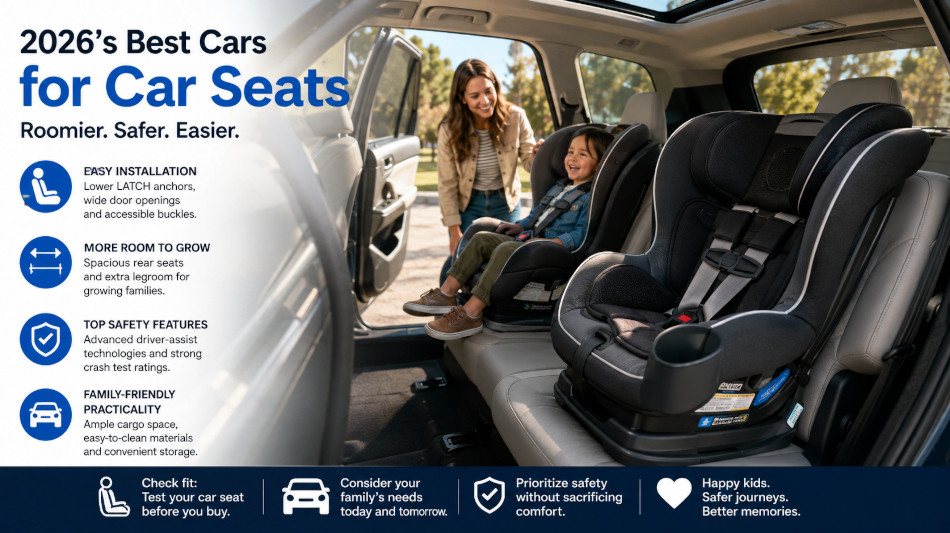
The most useful lesson from the 2026 results is that families should test their own equipment before signing a purchase agreement. Child seats differ substantially in width, height, base design and belt routing. Vehicle trim levels can also change upholstery, second-row configuration and access to the third row. A model that performs well with one restraint may interact differently with another. Even two child seats belonging to the same broad category can place their bases, support legs, belt paths and side-impact structures in different positions.
Prospective buyers should therefore take their infant carrier, convertible seat or booster to the dealership and install it in every position they expect to use. They should check whether the front passenger remains comfortable, whether the child seat sits flush against the backrest, whether the head restraint can be adjusted appropriately, whether the buckle remains reachable and whether the top tether can be identified without consulting a diagram. Families planning for another child should also test three-across capacity rather than judging the bench by sight. A rear seat can appear wide enough until fixed buckles, pronounced side bolsters and the shape of the child-seat bases consume the available space.
Cargo capacity deserves the same scrutiny. A three-row SUV may carry several child seats yet leave little room for a pushchair when every seat is occupied. A compact two-row SUV may provide excellent restraint fit but become restrictive once holiday luggage, sports equipment and everyday family gear are added.
The best choice is the vehicle that works not only for the child’s present stage, but for the household’s likely needs over the next several years.
A small honour roll with a large message
The 2026 findings expose a gap between the way family vehicles are marketed and the precision with which some are engineered for child restraints. Only two of the 56 tested vehicles achieved an entirely clean result, and they did so through a shared focus on accessibility rather than through a shared size, price or powertrain. Within the tested field, the Mercedes-Benz GLS580 offers the most complete answer for families requiring three usable rows and premium space. The Volkswagen Tiguan delivers the more attainable lesson, proving that a compact SUV can make two-seat installation exceptionally straightforward.
The near-perfect finishers broaden the choice further, particularly for households that need three restraints across or prefer a more affordable hybrid or electric option. For carmakers, the message is equally direct. Better labels, exposed anchors, stable buckles and usable tether positions are not costly headline technologies, but they can influence daily safety more profoundly than another screen or decorative trim package.
For parents, the conclusion is simpler still. The right family car is not merely the one with enough seats. It is the one in which those seats can be used properly, comfortably and without compromise.
M.Brown