Changan uses FILDA 2026 to accelerate its African expansion

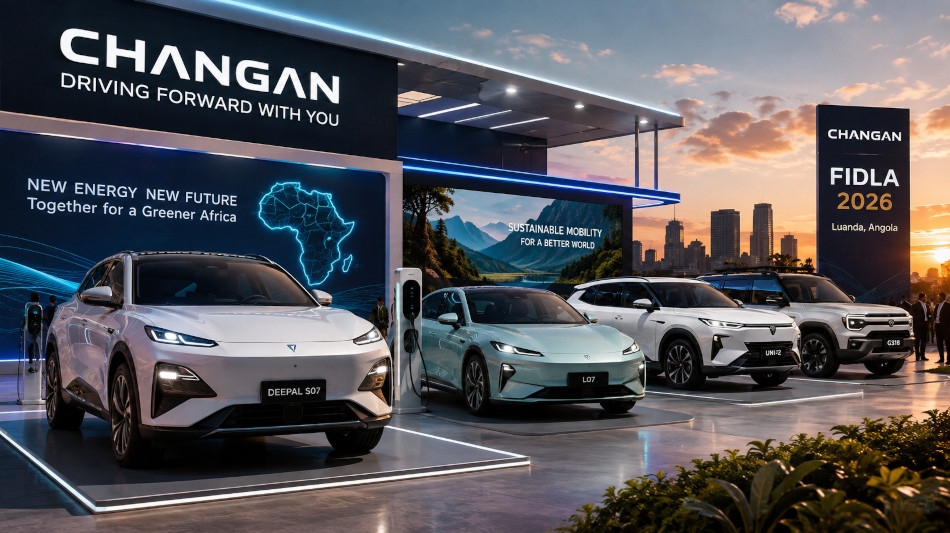
Changan’s appearance at the 41st Luanda International Fair was not simply a product display. By placing the all-electric DEEPAL S05 beside the range-extended DEEPAL G318, the CHANGAN CS75 PLUS and the new CHANGAN UNI-S, the Chinese manufacturer presented a deliberate picture of how it intends to grow in Africa: not through a single propulsion technology, but through a broad portfolio supported by dealers, spare parts, service capacity and increasingly localised operations.
Held from 21 to 26 July in the Luanda-Bengo Special Economic Zone, FILDA 2026 brought together 2,348 national and international exhibitors from 22 countries. Its theme of producing and innovating locally while competing globally gave the event a significance beyond the exhibition hall. For Changan, the fair offered access to customers and commercial partners, but it also provided a stage on which to align its expansion with Angola’s wider effort to diversify an economy that remains heavily associated with oil.
A mixed line-up shaped by market reality
The four vehicles at the centre of the stand were carefully chosen. The DEEPAL S05 represents Changan’s modern battery-electric proposition. In international specification, the compact SUV combines long-range capability, a software-led cabin, driver-assistance technology and a design developed through Changan’s global engineering network. It gives the company a credible product for urban buyers, corporate fleets and early adopters who are ready to move fully away from petrol.
The DEEPAL G318 addresses a different problem. Its wheels are driven electrically, while a petrol engine can generate power when the battery requires support. This range-extended architecture preserves much of the smoothness and immediate response associated with an electric vehicle while reducing dependence on a dense public charging network. In a country as geographically large as Angola, and across African markets where long-distance travel can quickly extend beyond major cities, that combination has a clear practical appeal. The CS75 PLUS and the new UNI-S complete the picture with more conventional powertrains, high levels of digital equipment and the kind of SUV packaging that has become central to Chinese manufacturers’ overseas growth. Their presence prevents the FILDA display from becoming an abstract statement about a fully electric future that has not yet arrived evenly. Instead, Changan is acknowledging that the transition will advance at different speeds according to purchasing power, electricity access, charging coverage, road conditions and the availability of finance.
This is not technological hesitation. It is market segmentation. Battery-electric models can establish the brand at the advanced end of the market, range-extended vehicles can bridge infrastructure gaps, and petrol models can provide the volume needed to support a viable dealer and service network. The strategy is especially relevant in Africa, where the mobility transition is taking place alongside rapid urbanisation, uneven infrastructure and strong demand for durable vehicles at competitive prices.
Angola offers opportunity, but also a demanding test
Angola is a logical place for Changan to make a more visible statement. Chinese vehicles have already gained recognition in the country, helped by their combination of equipment, design and price. At the same time, Angola is trying to rebuild local industrial capacity and reduce dependence on imported finished goods.
The opening of an operational vehicle assembly plant in Luanda in January 2026 illustrated that ambition. The facility has installed capacity for 22,000 light vehicles and 1,000 buses a year, with passenger vehicles supplied through partnerships involving Chinese manufacturers. Its operator has also expressed an intention to introduce electric vehicle production at a later stage.
Changan has not announced an Angolan assembly project, and FILDA should not be interpreted as proof that one is imminent. Even so, the direction of travel matters. The country’s automotive debate is gradually shifting from the import of completed vehicles towards assembly, skills, components and longer-term industrial participation. Charging infrastructure is also beginning to move from concept to deployment. Sonangol has set out plans for more than 100 electric vehicle charging points by 2028, including a substantial concentration in Luanda. That would still represent an early-stage network in a vast country, but it creates a foundation on which manufacturers and fleet operators can build. It also helps explain why Changan’s mixed powertrain strategy is more commercially realistic than an electric-only approach.
The challenge will be to turn infrastructure announcements into dependable daily use. Chargers must be operational, easy to locate, compatible with imported vehicles and supported by reliable payment systems. Electricity supply, maintenance and spare components matter as much as the number of points announced. For customers, confidence will depend not merely on whether a charger exists, but whether it works when required.
The real strategy lies behind the vehicles
Changan’s wider expansion plan is built around a shift from exporting cars to creating regional operating systems. Under its Vast Ocean Plan, launched in 2023, the manufacturer has been expanding sales channels, production partnerships, research capacity, warehouses and after-sales operations. It now reports a presence in 118 countries and regions, 22 manufacturing bases and a research and development workforce of around 24,000 people operating across six countries and ten locations.
Scale gives Changan the resources to enter new markets, but it does not guarantee acceptance. The company’s 2025 results underline both its momentum and its need to keep expanding internationally. Total sales reached 2.913 million vehicles, overseas sales rose to 637,000 and new-energy vehicle sales exceeded 1.1 million. Africa is therefore not a peripheral experiment. The Middle East and Africa form one of the five regional pillars of the global strategy.
Changan’s roots in the wider region already extend back more than three decades. By 2024 it reported cumulative Middle East and Africa sales above 400,000 vehicles and more than 100 network touchpoints. The next phase is intended to place greater emphasis on parts centres, technical support, customer service and local partnerships. That emphasis is important because African markets have repeatedly shown that an attractive launch price cannot compensate for weak after-sales support.
For many customers, the decisive questions begin several years after purchase. Will a replacement body panel be available? Can a technician diagnose a high-voltage fault? Is the software update supported locally? What happens to battery warranty coverage if the vehicle changes owner? How quickly can a damaged sensor or control unit be replaced? These issues determine residual values and brand reputation more powerfully than the excitement of an exhibition debut.
Chinese electric vehicles are reshaping emerging markets
Changan is entering Africa at a moment when Chinese manufacturers are becoming increasingly influential across emerging electric vehicle markets. Outside Europe and the United States, vehicles imported from China accounted for more than half of electric car sales in 2025, while many countries in Latin America, the Middle East and Africa sourced more than four-fifths of their electric cars from China.
That momentum accelerated further in the first half of 2026, when Chinese electric car exports nearly matched the total recorded during the whole of 2025. The figures show the strength of China’s manufacturing base, but they also reveal the intensity of competition. Large export volumes, crowded domestic markets and pressure on margins are encouraging manufacturers to seek growth abroad. Africa is consequently attracting more brands, more distributors and a wider range of products.
The opportunity is substantial. Electric cars are expected to approach three in every ten new cars sold globally during 2026, while emerging economies are becoming increasingly important to future industry leadership. Yet Africa cannot be treated as a single, uniform market. Regulatory systems, import duties, electricity supply, household income, road quality and customer expectations differ sharply from one country to another. A strategy that works in South Africa or Egypt cannot simply be copied into Angola without adaptation.
This is where Changan’s global engineering structure may become useful. Products intended for Angola need cooling systems suited to heat, sealing that can cope with dust, suspension calibration for varied surfaces and durable air-conditioning. Navigation, connectivity and voice functions must operate reliably with local networks. Driver-assistance systems must be calibrated for road markings and traffic conditions that may differ from those in China or Europe. Localisation is not limited to language or advertising. It reaches into hardware, software, logistics and workshop training.
FILDA was a signal, not the final result
The enlarged Changan stand at FILDA 2026 demonstrated intent. It showed that the company sees Angola as part of a broader African growth programme and that it is prepared to present advanced electric products alongside vehicles designed for today’s market conditions. It also placed service and parts support at the centre of the commercial message.
The more difficult work begins after the exhibition. Changan must convert interest into a dealer network with sufficient geographic reach, transparent pricing, suitable finance and dependable warranty handling. It must ensure that parts arrive before vehicles begin to accumulate workshop time. It must train technicians in both combustion and high-voltage systems. It must also establish a credible used-car proposition, because resale confidence strongly influences purchasing decisions in price-sensitive markets. Partnerships will be essential. Dealers bring local knowledge, but banks, insurers, charging companies, fleet operators and public authorities will also shape the pace of adoption. Electric vehicles may gain their earliest scale through corporate fleets, government use, urban delivery services and customers able to charge at home or work. Range-extended vehicles can broaden that audience, while petrol models can support the network during the transition.
A pragmatic African bet
Changan’s FILDA appearance is significant because it avoids the false choice between immediate electrification and continued reliance on combustion engines. The company is instead building a ladder of technologies that can serve customers at different stages of the transition. That approach reflects the reality that Africa’s automotive future will be cleaner and more digital, but it will not develop everywhere at the same speed.
Angola offers Changan a market in which those assumptions can be tested. It has an emerging charging network, renewed interest in vehicle assembly, a strong need for reliable mobility and a wider economic policy focused on diversification. It also presents the obstacles that separate a successful long-term market entry from a temporary wave of imports.
The decisive advantage will therefore not be the number of vehicles displayed in Luanda, nor the size of Changan’s global research team. It will be the company’s ability to make advanced technology dependable, repairable and financially accessible in local conditions. If Changan can deliver that combination, FILDA 2026 may be remembered not as a showcase, but as one of the points at which its African strategy began to acquire genuine commercial depth.
S.Schulz