'Lucky tiger': Fukushima fishermen pin hopes on pufferfish / Photo: © AFP

The pufferfish filling nets in Fukushima are a delicacy that can kill if wrongly prepared. But to a community devastated by a 2011 nuclear disaster, they are also a lifeline.
In the 12 years since the meltdown at the Fukushima Daiichi plant caused by a deadly tsunami in northeastern Japan, "there hasn't been much good news", fisherman Masahiro Ishibashi told AFP.
The cooperative he belongs to has faced tight fishing restrictions, and consumers have avoided produce from the region over radiation concerns.
And as the plant operator prepares to release wastewater treated to remove radioactive elements into the sea, the fishing community fears further reputational damage.
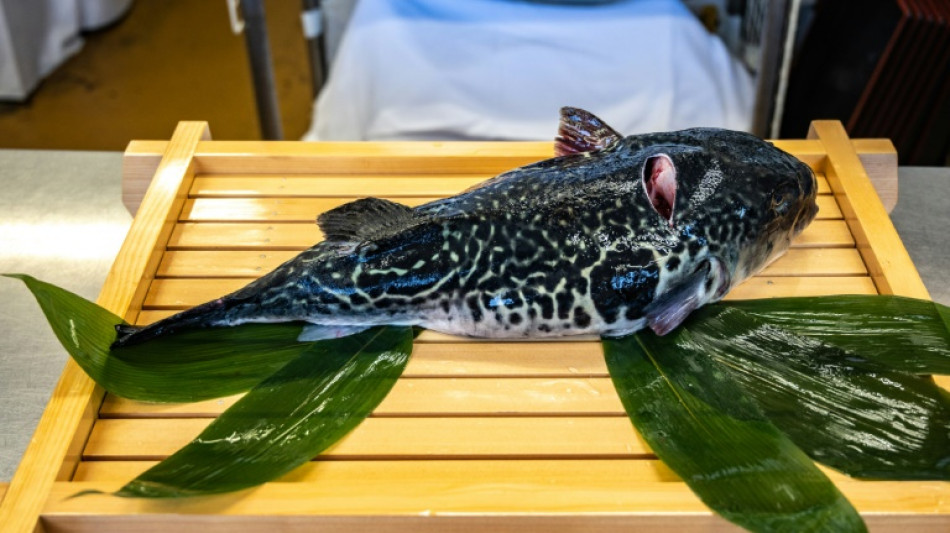
So when tiger pufferfish -- an expensive variety of the notorious "fugu" -- began to appear in their catch, they saw an opportunity.
Fugu is often served raw at high-end restaurants in Japan, where chefs must hold a licence proving they can safely slice around organs that contain a lethal poison.
Now, each morning at Matsukawaura port, 50 kilometres (30 miles) north of Fukushima Daiichi, boat crews heave buckets overflowing with fat, dark-spotted tiger pufferfish into the arms of waiting family members.
For 43-year-old Ishibashi, the fish marketed as "fukutora" -- meaning "lucky tiger" -- lives up to its name.
"We're catching new, attractive species, and drawing attention from consumers. We can show them that fish from Fukushima is safe and delicious," he said.
Five years ago, not much tiger pufferfish was caught off Fukushima, but local authorities say warmer-than-usual water temperatures may have helped the species thrive.
The increased catch is, however, mainly down to the employment of longline techniques learnt from fugu fishermen in southwestern Yamaguchi, which helped the region's fisheries bring in nearly three tonnes of tiger pufferfish in 2019.
That figure soared ten-fold in 2022, after official restrictions on fishing were lifted following extensive radiation testing.
- Water release controversy -
But there are new worries for the community as the Fukushima Daiichi operator prepares to begin releasing treated wastewater into the sea this year.
More than a million tonnes of treated water is stored in tanks at the plant, where a tsunami triggered by an undersea earthquake on March 11, 2011, led to the world's worst nuclear accident since Chernobyl.
The liquid is a combination of contaminated groundwater, seawater, rainwater, and water used for cooling, all filtered to remove various radioactive elements.
Storage space for the water is running out, and the International Atomic Energy Agency has endorsed the release plan.
The water still contains radioactive tritium, but at levels that the government, plant officials and the IAEA say are safe, because it will be diluted before being released over several decades through a kilometre-long pipe.
An IAEA task force will monitor the release "until we are absolutely sure that it's finished as expected, in line with the IAEA safety standards", task force chair Gustavo Caruso said in January.
Plant operator TEPCO has also started trials to keep fish in the filtered water to demonstrate safety.
Still, neighbours South Korea and China have expressed alarm at the possible environmental impact, and Ishibashi fears consumers will be spooked again.
"We're worried that the reputation of our produce could become even more tarnished," he said.
"But the government has decided to allow the water release. We really cannot accept this. We feel so helpless."
- Fugu boom -
An unofficial arrangement allowing Fukushima fishermen to sail to waters outside the prefecture, and vice versa, has been abandoned since the disaster.
Because of this, and with fewer fishermen at work, Matsukawaura's total annual catch remains just 20 percent of pre-2011 levels.
Although radiation testing rules for Fukushima seafood were relaxed in 2021, the region's fisheries still check their produce voluntarily, sticking to stricter limits than the national standard.
The testing regime also applies to the newly abundant tiger pufferfish, which hotel operators like Yoshimasa Kanno, 48, hope will help attract tourists back to Fukushima.
Kanno, also an experienced seafood chef, is "very happy" about the fugu boom.
"We used to serve snow crab in the winter. This place was famous for it. But since the disaster, fishermen haven't been able to catch as much" because they can't leave Fukushima waters, he told AFP.
Having carefully removed the deadly parts of a tiger pufferfish, he rustled up the classic dishes of crispy fried fish and thinly sliced, translucent raw sashimi.
Kanno says the delicacy "is delicious and can be served at a good price".
But he fears the fallout from the upcoming water release.
"I'm very worried about whether the fishing industry in this region will ever make a comeback if the water is released," he said.
A.Kwok--ThChM