'No toilets': Hygiene nightmare in Turkey's quake ruins / Photo: © AFP

Sedef's relief at surviving Turkey's deadly earthquake is quickly giving way to fears she could succumb to diseases that threaten to take hold across shattered regions now devoid of basics including toilets.
Last week's tragedy killed nearly 40,000 people across swathes of southeast Turkey and northwest Syria, becoming the area's deadliest natural disaster in centuries.
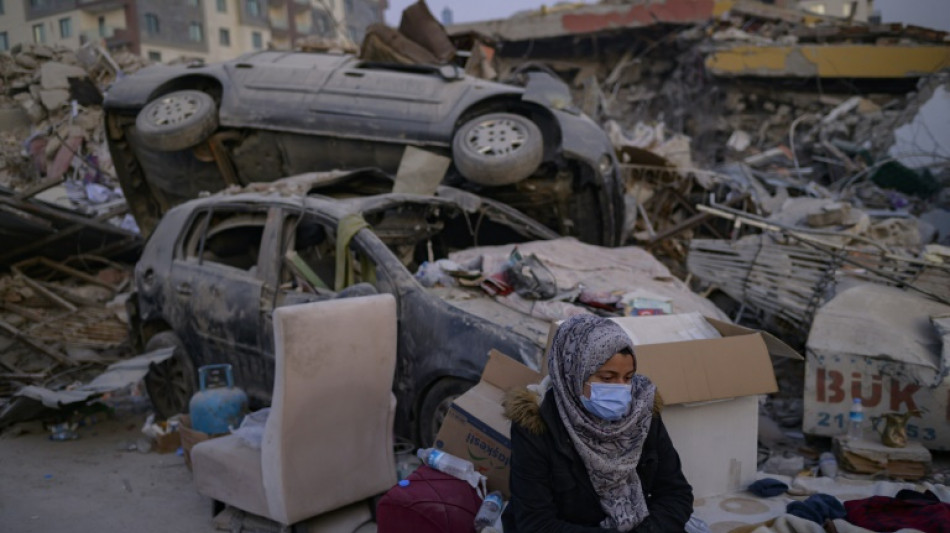
Erasing entire towns, it displaced millions of people and left millions more who stayed behind living in rubble, huddling around bonfires in the freezing weather and facing shortages of medicine.
Few buildings have survived unscathed, and amenities such as toilets and showers all but vanished when the first tremor struck before dawn on February 6.
"There are no toilets," said Husne Duz, a 53-year-old woman from Kahramanmaras, a city near the initial quake's epicentre.
"People are urinating near the tents. We need toilets. We need to be able to take a shower. We need washing machines for clothes."
Sedef, an 18-year-old in Antakya -- an ancient city of nearly 500,000 people, entire blocks of which were razed to the ground -- said the lack of sanitation was becoming desperate.
"Maybe we didn't die from the earthquake, but we will certainly die from diseases," she told AFP, declining to give her family name.
- 'Our biggest issue' -
Portable cabin lavatories have begun to spring up across the quake zone, but demand far outstrips supply.
"That is our biggest issue," said Nurhan Turunc, 42, who was picking up medicine for relatives at a temporary pharmacy set up by volunteers in Antakya.
"Early morning, we manage, but (the toilets) are really bad, they are in a disastrous state. There is no water."
One set of 15 portable blue and white WCs on a bridge in central Antakya was completely overwhelmed by use, with excrement overflowing onto the pavement.
Sedef said she had been forced to use the filthy facilities because those in the surviving school where she had sought refuge were worse.
A plea written on one portable lavatory in the city implored visitors to "please use as a human", to encourage proper lavatory etiquette.
Sedat Akozcan, who heads the region's chamber of pharmacists, said that where "hygiene conditions are bad, of course there will be contagious diseases".
- 'A lot of diseases' -
"But from the medicine requests coming up until now, that risk of contagious diseases has not materialised."
Operating out of a car park of a destroyed public health building, a group of young volunteers have been dispensing free treatment and advice to Antakya's survivors.
Their goal is to keep the health and sanitation situation manageable until more government help and international humanitarian relief arrives.
There are more than a dozen similar temporary pharmacy setups across the affected region, with some 30 pharmacists on site at each one.
The service said it had seen more than 1,000 patients a day in Antakya who had been unable to visit their usual dispensary since last week's earthquake.
"A lot of people here are elderly, who didn't want to leave," said Doctor Onur Karahanci of the Turkish Medical Association.
"They have a lot of diseases... especially hypertension and psychiatric diseases, diabetes -- that is very widespread," he said alongside his organisation's mini field clinic in a riverside park dotted with displaced people.
- 'Very cold' -
Akozcan, the pharmacists' representative, warned that conditions in Antakya, where temperatures drop to 0 degrees Celsius (32 degrees Fahrenheit) at night, were also causing issues for infants.
"The winter is very cold and so there has started to be a lot of upper respiratory infections -- especially with small children," he said.
At the impromptu pharmacy, a child collected a box of pills and was called back by a pharmacist to be given an additional tube of cream and pointers on its use.
Medics have warned about the risks of skin conditions such as scabies spreading because of the poor sanitary conditions.
Hundreds of pharmacists across Turkey have donated boxes of pills, bandages and other medical essentials.
There is also high demand for masks to help combat the pervasive clouds of dust thrown up by the collapse of hundreds of buildings.
They also shield wearers from the smell of decaying bodies as well as asbestos, a flame-resistant material once widely used in construction but now seen as highly dangerous because its fibres can cause cancer when inhaled.
D.Wang--ThChM