Climate, ice sheets & sea level: the news is not good / Photo: © BRITISH ANTARCTIC SURVEY/AFP/File

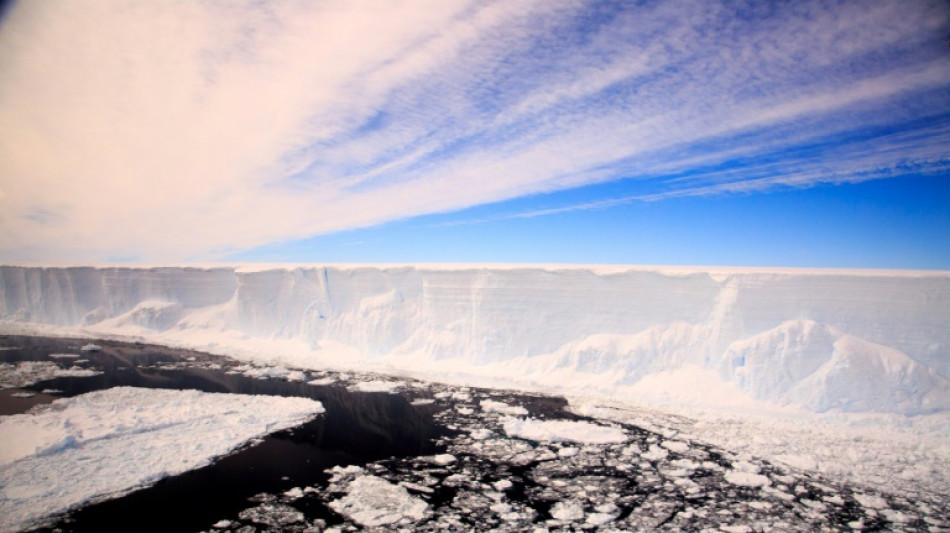
Parts of Earth's ice sheets that could lift global oceans by metres will likely crumble with another half degree Celsius of warming, and are fragile in ways not previously understood, according to new research.
The risk, which will play out over centuries, may also be greater than expected for a significant portion of the world's population in coastal regions.
New research suggests that the number of people threatened by sea level rise has been underestimated by tens of millions because of poorly-interpreted satellite data and a lack of scientific resources in developing countries.
Ice sheets in Greenland and Antarctica have shed more than half-a-trillion tonnes annually since 2000 -- six icy Olympic pools every second.
These kilometres-thick ice cubes have replaced glacier melt as the single biggest source of sea level rise, which has accelerated three-fold over the last decades compared to most of the 20th century.
A 20 centimetres increase since 1900 has boosted the destructive wallop of ocean storms made more powerful and wide-ranging by global warming, and is driving salt water into populous, low-lying agricultural deltas across Asia and Africa.
Up to now, climate models have underestimated how much ice sheets will add to future sea level rise because they mostly looked at the one-way impact of rising air temperatures on the ice, and not the complicated interaction between atmosphere, oceans, ice sheet and ice shelves.
Using so-called active ice sheet models, scientists from South Korea and the US projected how much ice sheets would raise global oceans by 2150 under three emissions scenarios: swift and deep cuts as called for by the UN's IPCC advisory panel, current climate policies, and a steep increase in carbon pollution.
Looking only at a 2100 horizon is misleading, because oceans will continue to rise for hundreds of years no matter how quickly humanity draws down emissions.
If rising temperatures -- up 1.2C above preindustrial levels so far -- can be capped at 1.5C, the additional impact of ice sheets will remain very small, they found.
- Doomsday glacier -
But under current policies, including national carbon-cutting pledges under the 2015 Paris Agreement, Greenland and Antarctica would add about half-a-metre to the global watermark.
And if emissions increase -- from human or natural sources -- under a "worst case" scenario, enough ice would melt to lift oceans 1.4 metres.
Perhaps the most striking finding from the study, published this week in Nature Communications, was a red line for runaway ice-sheet disintegration.
"Our model has a threshold between 1.5C and 2C of warming -- with 1.8C as a best estimate -- for acceleration of ice loss and sea level increase," co-author Fabian Schloesser from the University of Hawaii, told AFP.
Scientists have long known that the West Antarctic and Greenland ice sheets -- which together could lift oceans 13 metres -- have "tipping points" beyond which complete disintegration is inevitable, whether in centuries or millennia. But pinpointing these temperature trip wires has remained elusive.
A pair of studies this week in Nature, meanwhile, showed that Antarctica's Thwaites "doomsday glacier" -- a slab the size of Britain sliding toward the sea -- is fracturing in unsuspected ways.
Thwaites is one of the fastest moving glaciers on the continent, and has retreated 14 kilometres since the 1990s. Much of it is below sea level and susceptible to irreversible ice loss.
But exactly what is driving the march to the sea has been unclear for lack of data.
- Misinterpreted data -
An international expedition of British and US scientists drilled a hole the depth of two Eiffel towers (600 metres) through the thick tongue of ice Thwaites has pushed out over the Southern Ocean's Amundsen Sea.
Using sensors and an underwater robot, called Icefin, threaded through the hole, they examined the ice shelf's hidden underbelly.
There was less melting than expected in some places, but far more in others.
The stunned scientists discovered up-side-down staircase formations -- like an underwater Escher drawing -- with accelerated erosion, along with long fissures being forced open by sea water.
"Warm water is getting into the cracks, helping wear down the glacier at its weakest point," said Britney Schmidt, lead author of one of the studies and an associate professor at Cornell University in New York.
A fourth study, published last week in the American Geophysical Union journal Earth's Future, found that rising oceans will destroy farmland, ruin water supplies and uproot millions of people sooner than thought.
"The time available to prepare for increased exposure to flooding may be considerably less than assumed to date," Dutch researchers Ronald Vernimmen and Aljosja Hooijer concluded.
The new analysis shows that a given amount of sea level rise -- whether 30 or 300 centimetres -- will devastate twice the area projected in most models to date.
Remarkably, a misinterpretation of data is mostly to blame: radar measurements of coastal elevations used until recently, it turned out, often mistook tree canopy and rooftops for ground level, adding meters of elevation that were not in fact there.
Most vulnerable will be tens of millions of people in the coastal areas of Bangladesh, Pakistan, Egypt, Thailand, Nigeria and Vietnam.
Earlier research taking into account more accurate elevation readings found that areas currently home to 300 million people will be vulnerable by mid-century to flooding made worse by climate change, no matter how aggressively emissions are reduced.
J.Liv--ThChM