The China Mail - Across Zimbabwe, British scones are the taste of home

USD -
AED 3.672503
AFN 64.999645
ALL 81.389895
AMD 361.2932
ANG 1.789785
AOA 916.999783
ARS 1512.999978
AUD 1.436555
AWG 1.80125
AZN 1.697632
BAM 1.743992
BBD 2.01427
BDT 123.014493
BGN 1.747831
BHD 0.377794
BIF 2993.226401
BMD 1
BND 1.282569
BOB 11.726198
BRL 5.096302
BSD 1.000134
BTN 95.013601
BWP 13.749894
BYN 3.018725
BYR 19600
BZD 2.011416
CAD 1.415855
CDF 2313.500733
CHF 0.823205
CLF 0.024943
CLP 981.679588
CNY 6.691199
CNH 6.68672
COP 3177.15
CRC 455.208273
CUC 1
CUP 24.002354
CVE 98.341137
CZK 21.62785
DJF 178.095875
DKK 6.644301
DOP 61.31577
DZD 134.536969
EGP 53.446302
ERN 15
ETB 163.359658
EUR 0.88889
FJD 2.26765
FKP 0.754433
GBP 0.750083
GEL 2.589865
GGP 0.754433
GHS 11.63612
GIP 0.754433
GMD 73.498559
GNF 8798.177043
GTQ 7.64058
GYD 209.177258
HKD 7.847905
HNL 26.852294
HRK 6.701703
HTG 130.962733
HUF 322.962495
IDR 18007
ILS 3.08915
IMP 0.754433
INR 94.85275
IQD 1515.163677
IRR 1795877.439107
ISK 121.070583
JEP 0.754433
JMD 159.02858
JOD 0.708993
JPY 157.955498
KES 129.89022
KGS 87.449938
KHR 4061.592797
KMF 439.999983
KPW 899.999961
KRW 1331.730068
KWD 0.31078
KYD 0.833434
KZT 453.247002
LAK 22495.12827
LBP 89534.463932
LKR 331.054657
LRD 170.517331
LSL 16.527044
LTL 2.95274
LVL 0.60489
LYD 6.424972
MAD 9.801026
MDL 17.972147
MGA 4504.813845
MKD 54.969013
MMK 2099.795777
MNT 3598.409679
MOP 8.083816
MRU 40.074203
MUR 47.230455
MVR 15.459769
MWK 1733.876182
MXN 18.3853
MYR 4.082797
MZN 63.934506
NAD 16.526602
NGN 1331.44034
NIO 36.807299
NOK 9.449045
NPR 152.022083
NZD 1.76328
OMR 0.384497
PAB 1.000134
PEN 3.440357
PGK 4.539556
PHP 62.995942
PKR 276.852798
PLN 3.88168
PYG 5695.429208
QAR 3.645574
RON 4.744396
RSD 104.379903
RUB 83.475362
RWF 1475.681051
SAR 3.752178
SBD 8.064647
SCR 13.873593
SDG 601.500902
SEK 9.89135
SGD 1.279475
SHP 0.754745
SLE 24.67971
SLL 20969.504398
SOS 571.596752
SRD 37.641501
STD 20697.981008
STN 21.850516
SVC 8.750831
SYP 13001.999685
SZL 16.520847
THB 33.398503
TJS 9.216088
TMT 3.51
TND 3.003166
TOP 2.40776
TRY 49.527399
TTD 6.787869
TWD 32.386502
TZS 2640.050663
UAH 44.862452
UGX 4024.972129
UYU 40.223504
UZS 11961.649944
VES 878.910598
VND 25889.5
VUV 119.436793
WST 2.780879
XAF 583.073938
XAG 0.017266
XAU 0.00023863273
XCD 2.70255
XCG 1.802429
XDR 0.707052
XOF 583.073938
XPF 106.363434
YER 236.150096
ZAR 16.42746
ZMK 9001.203539
ZMW 19.926867
ZWL 321.999592
SSP 5790.440039
MXV 2.075882
  • RYCEF

    0.4000

    19.71

    +2.03%

  • CMSC

    0.0000

    20.4

    0%

  • BTI

    0.4200

    56.05

    +0.75%

  • BP

    0.2800

    44.43

    +0.63%

  • RBGPF

    1.6000

    67

    +2.39%

  • RIO

    -0.1500

    94.41

    -0.16%

  • AZN

    -0.4300

    166.15

    -0.26%

  • GSK

    0.4600

    49.7

    +0.93%

  • BCE

    -0.4100

    20.56

    -1.99%

  • NGG

    -0.2500

    75.24

    -0.33%

  • VOD

    -0.0400

    16.58

    -0.24%

  • RELX

    -0.4500

    33.07

    -1.36%

  • BCC

    -0.5500

    76.59

    -0.72%

  • CMSD

    -0.0300

    20.27

    -0.15%

  • JRI

    -0.2500

    10.77

    -2.32%

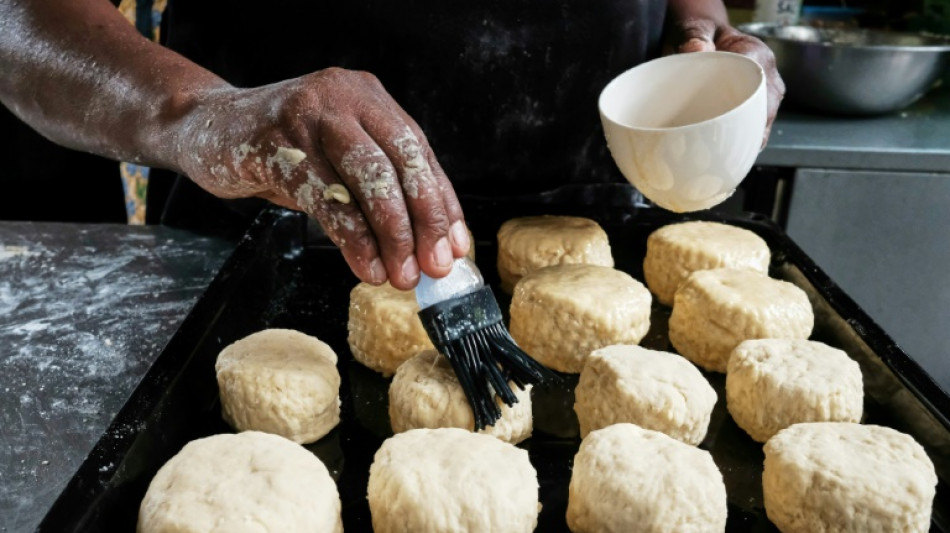
Across Zimbabwe, British scones are the taste of home
Across Zimbabwe, British scones are the taste of home / Photo: © AFP

Across Zimbabwe, British scones are the taste of home

A sweet doughy treat from Britain has become a beloved part of Zimbabwe's national cuisine, where despite the country's colonial past, mothers and chefs alike now claim the pastry as their own.

Text size:

The scone, which Brits normally enjoy with afternoon tea, is ubiquitous in Harare, the southern African country's capital.

A breakfast favourite in these parts, it can be found everywhere from high-end eateries to the market stalls of impoverished townships.

"We love scones. They are not British, they are ours, our local scones," Nyari Mashayamombe, a rights activist, says as she leaves an upmarket restaurant in Harare's Belgravia district, its garden dotted with open umbrellas.

Dense yet airy, Zimbabwean scones are the result of the intercultural mix that came with colonisation, says Mashayamombe, a red-haired 42-year-old who is also a singer and media personality.

In "fancy places like here... a beautiful scone goes as high as six bucks," she said, referring to the American dollars that have become Zimbabwe's parallel and preferred currency.

"It's worth it."

A few kilometres away at a market in Harare's oldest township of Mbare, scones are impossible to find after midday.

"We sold them all this morning. They move quickly," one vendor says.

- Yeast and buttermilk -

The main communal bakery in Mbare, a bustling working-class district, opens at dawn.

Tawanda Mutyakureva, 26, arrives at around five in the morning to his work station, measuring two square metres, where he has to bend over to spread the dough on a knee-height countertop.

Every day he cranks out around 200 scones in an overheated room with cinder-block walls, lit by two bulbs hanging from a wire.

Brandishing a cookie cutter, he works quickly to whip out one batch after another, with each scone selling for 25 American cents.

In the hot, humid atmosphere redolent of yeast, his wife -- with their baby strapped to her back -- helps him with buttering the pastries and clearing plates.

Resellers come in to buy 10 or 20 pieces that will be sold at small grocery stores.

Memory Mutero, 46, was at the bakery to buy bread, since she makes her own scones at home.

"I make scones for my three kids. It takes about 45 minutes," she tells AFP.

Her ingredients are simple: flour, salt, yeast, sugar, butter and milk.

But at the Bottom Drawer, an upscale tearoom in Harare, cook Veronica Makonese is unimpressed after tasting a scone brought back from the township.

"There is no milk in those, they used water!" the 46-year-old claims.

A white kerchief on her head, Makonese says she makes her own buttermilk for her scones, to control temperature and acidity levels, and uses only real butter to ensure the proper taste and softness.

Her boss, Sarah Macmillan, a 53-year-old Zimbabwean, says she longs for the scones she would eat as a child.

Back then, two shops in the centre of Harare, now closed, competed for the crown of best scone in the country, and Macmillan wanted her tearoom to make some that are "just as good".

Macmillan says the secret of the little cake's enduring success, in a country struggling with endemic poverty, is simple: "It's very filling and affordable."

X.So--ThChM