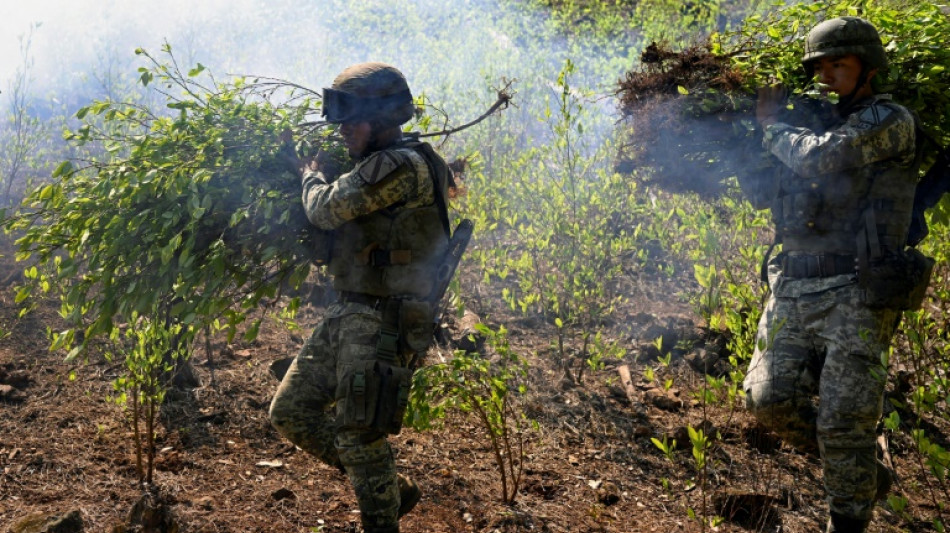
Coca crops take root in Mexico as opium demand wanes / Photo: © AFP

An army helicopter flies over verdant mountains in southern Mexico, the scene of unusual coca crop discoveries that suggest drug cartels are adapting to shifts in the multimillion-dollar narcotics trade.
For years, poppies -- the raw material for heroin -- and marijuana have provided a livelihood for thousands of small farmers in the impoverished state of Guerrero.
But in recent years the growing US addiction crisis surrounding the potent synthetic drug fentanyl has caused opium demand and prices to fall.
The result is that Mexican traffickers are now experimenting with growing coca leaves, whose production has historically been dominated by Bolivia, Peru and Colombia.
"It's an activity that hadn't been detected here before," said Colonel Carlos Javier Perez, who heads the unit in charge of destroying coca in Guerrero.
"In a month and a half, we've found 27 plantations," he told AFP.
Mexico's coca fields are in their infancy, with a surface area of around 360,000 square meters (3.9 million square feet) eradicated in the past four years -- a drop in the ocean compared with Colombia.
"Organized crime groups are trying to diversify their activities and experiment with coca planting," Perez said, as soldiers uprooted the bushes by hand and burned them in the town of Atoyac de Alvarez.
Cocaine is hugely profitable: In Europe, for example, a kilo can sell for around $40,000.
It is a sum most farmers could only dream of in Guerrero, one of Mexico's poorest states, which has endured years of violence linked to turf wars between drug cartels.
- 'No coincidence' -
Mexican cartels have come to control almost the entire cocaine trafficking chain in Colombia.
Now coca crops are also flourishing in Honduras and Guatemala, once just transit points for the drug from South America.
In the Mexican case, "it is linked to the production of fentanyl," said Libertad Arguello, an expert at the Colegio de Mexico institute of higher education.
"It's no coincidence that coca leaves began to be cultivated."
The Mexican government reported the first coca plantation discoveries in February 2021. President Andres Manuel Lopez Obrador said that criminal groups were experimenting with the crop.
The one-hectare (2.5-acre) field found in Guerrero had a small irrigation system.
A few meters (yards) away, the soldiers also found an improvised laboratory, tools, chemicals, gasoline and clothing left behind by those in charge.
To reach the crops, the military traveled nearly an hour in off-road vehicles and on foot through dense vegetation, according to AFP reporters who accompanied them.
The soldiers must explore the area on foot because it is almost impossible to spot the coca plants from the air, Perez said.
In the laboratory where the coca paste was produced, a sleeping bag, blankets and a cap were seen abandoned by workers, who according to the military fled when they saw the troops.
The paste, obtained by mixing chopped leaves with lime, cement, gasoline, and ammonium sulfate, is usually taken elsewhere to be turned into cocaine, Perez said.
According to Insight Crime, a non-profit investigative organization, Mexican criminal groups could be experimenting with new growing techniques to adapt the plants to higher altitudes than in Colombia and Peru.
"Despite the increased discoveries, Mexico's coca cultivation remains far from scalable. And there is no indication that the country will soon become a significant player in coca production," it said in a report.
"But while coca cultivation levels remain low, the incremental increase and Guerrero's history of illicit crop cultivation could eventually lead to trouble," it added.
Y.Parker--ThChM