Governments vet crucial UN climate science report / Photo: © AFP/File

Diplomats from nearly 200 nations and top climate scientists began a week-long huddle in Switzerland on Monday to distil nearly a decade of published science into a 20-odd-page warning about the existential danger of global warming and what to do about it.
The United Nations' Intergovernmental Panel on Climate Change's synthesis report -- to be released on March 20 -- will detail observed and projected changes in Earth's climate system; past and future impacts such as devastating heatwaves, flooding and rising seas; and ways to halt the carbon pollution pushing Earth toward an unliveable state.
"It's a massive moment, seven years since the Paris Agreement and nine years since the last IPCC assessment report," Greenpeace Nordic senior policy advisor Kaisa Kosonen, an official observer at IPCC meetings, told AFP.
Since its creation in 1988, the IPCC -- an intergovernmental body staffed by hundreds of scientists who work for it on a volunteer basis -- has released six three-part assessments, the most recent in 2021-2022.
"It is scientists telling governments how they are doing during these crucial defining years," Kosonen said.
The report card is not good. Global greenhouse gas emissions have continued to grow, even as science has cautioned that deadly consequences are coming sooner and at lower levels of warming than previously thought.
Since the late 19th century, Earth's average surface temperature has risen more than 1.1 degrees Celsius, enough to amplify a crescendo of weather catastrophes on every continent.
- Carbon budgets -
This warming, the IPCC has concluded, is overwhelmingly caused by burning oil, gas and coal. In a video message on Monday UN secretary general Antonio Guterres urged world leaders who will gather in December at the COP28 climate summit "to accelerate the phasing out of fossil fuels".
Under the 2015 Paris treaty, nations promised to collectively cap the rise in the planet's average temperature at "well below" 2C, and at 1.5C if possible.
An IPCC special report in 2018 made it alarmingly clear that the more ambitious aspirational goal -- since adopted by governments and business as a hard target -- was a better bet for a climate-safe world.
But an already narrow pathway has become a tightrope. Humanity's "carbon budget" for staying under the 1.5C barrier is less than 300 billion tonnes of CO2, barely seven times current yearly emissions, according to the IPCC.
Two other special reports -- one on oceans and Earth's frozen zones, the other on forests and land use -- will also be covered in the summary for policymakers under review in Interlaken.
"The synthesis report matters because it will be the last IPCC product for some years, and one of the major sources of knowledge to be considered in the first global stocktake under the Paris Agreement," Oliver Geden, one of report's lead authors and a senior fellow at the German Institute for International Security Affairs, told AFP.
To be unveiled ahead of COP28 in Dubai, the global stocktake will confront nations with the deep inadequacy of their Paris pledges to cut emissions, which would allow global temperatures to rise 2.8C above the preindustrial benchmark.
Among the IPCC findings that could be highlighted in the synthesis report is the looming threat of deadly heat.
- 'More politicised' -
Even in a 1.8C world -- an optimistic scenario, according to some scientists -- half of humanity could, by 2100, be exposed to periods of life-threatening climate conditions arising from the coupled impacts of extreme heat and humidity.
There are similarly dire projections for health, the global food system and economic productivity.
"What is at stake matters to everyone on the planet -- our ability to have healthy, nutritious and affordable food, both now and in the future," said Rachel Bezner Kerr, a professor at Cornell University and an IPCC lead author for the most recent report on climate impacts.
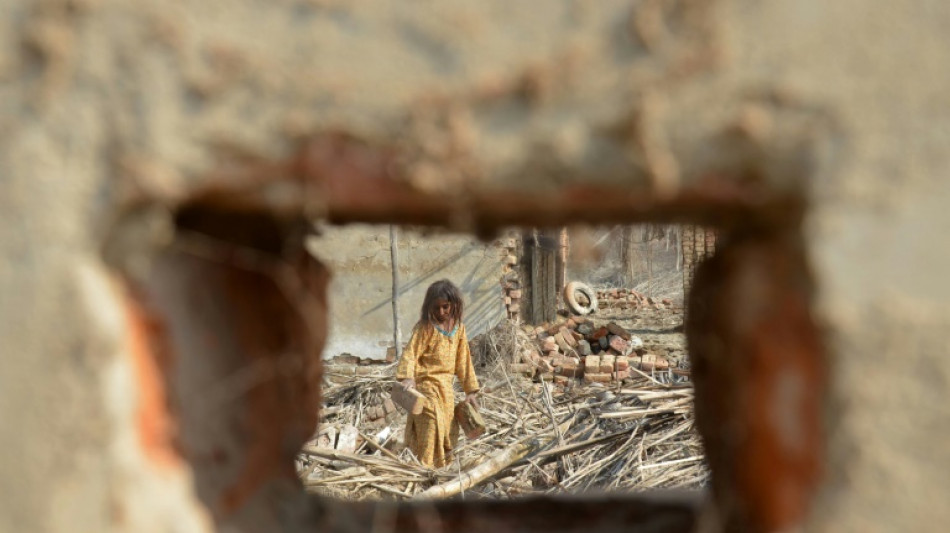
Floods last year that covered large swathes of Pakistan and ongoing drought in East Africa both bear the fingerprint of climate change.
The synthesis report will also reflect debate over the best way to decarbonise the global economy, with some emphasising the need to rapidly phase out fossil fuel use and reduce consumer demand, and others the potential of technological solutions.
Diplomats in Interlaken vetting the text line by line cannot change the science in the underlying 10,750 pages of reports but they can decide what to leave in or out and can highlight -- or obscure -- things through wording.
"Over time, IPCC meetings became more politicised as government representatives -- mainly, but not exclusively, from oil-producing states -- interfered in the scientists' discussions," the journal Nature said in a recent editorial.
Despite that, "the main IPCC studies have an extraordinary reach, informing everything from global climate agreements ... to the school climate strikes movement Fridays of Future", the journal said.
C.Mak--ThChM