Philippine fishermen struggle as oil spill keeps them ashore / Photo: © AFP

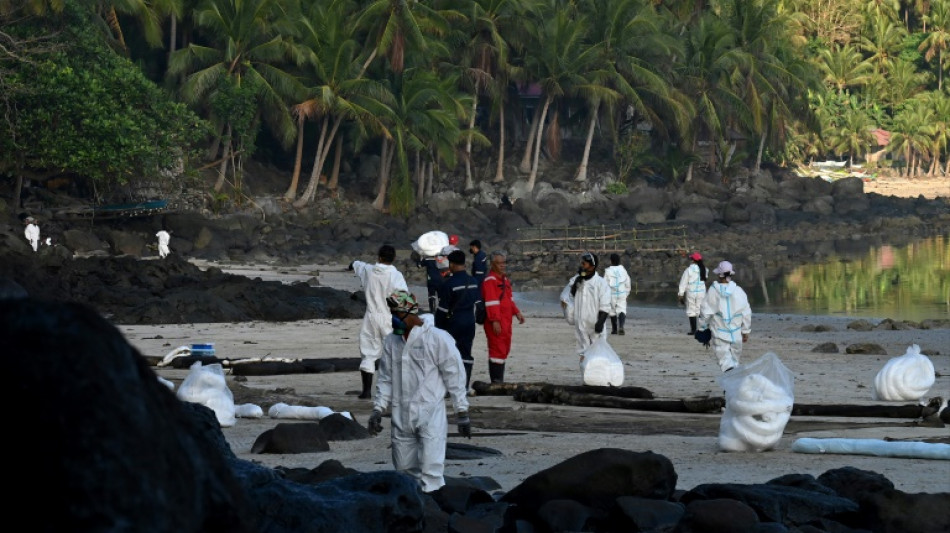
A crab covered in oil creeps across the sand as Philippine fishermen wearing white protective suits, rubber gloves, and respirator masks scrape toxic sludge from the rocks along the shore.
Four weeks after a Philippine tanker loaded with 800,000 litres (210,000 gallons) of thick oil sank off the central island of Mindoro, the vessel is still leaking.
More than half the oil has been discharged and dispersed over hundreds of kilometres of waters famed for having some of the most diverse marine life in the world.
Experts estimate the two main slicks northwest and southeast of the tanker could span 162 square kilometres (62 square miles).
It took two days for the spill to reach Buhay na Tubig, a remote village in Pola, one of the island's worst-affected municipalities.
Some villagers got sick after oil smeared the shoreline, turning rocks black and leaving dark globs on the beach.
Authorities have banned fishing and swimming indefinitely, leaving thousands of fishermen wondering how long they can survive.
"They say this might take six months, but what if we are unable to fish for an entire year?" asked Arvie Anonuevo, 32, who has three children.
For more than two weeks, Anonuevo and other fishermen have spent four hours a day cleaning up oil in exchange for a daily wage of 355 pesos ($6.50) from the government -- a little over half what they used to make from fishing.
The fishermen use trowels and sheets of thin, absorbent material to clean the rocks.
By the following day, more oil has washed up on the shore.
"It's annoying that the oil keeps coming back the next day no matter how much you clean them (rocks)," Anonuevo said.
The government estimates at least 5,000 hectares (12,400 acres) of coral reefs, seaweed and mangroves have been affected.
Mangroves can suffocate if oil covers their roots, while corals -- breeding grounds for many fish species -- can die or struggle to grow and reproduce if exposed.
It will take at least six months to clean up the spill but the recovery could be years long, said Irene Rodriguez, an associate professor at the University of the Philippines Marine Science Institute.
One of the worst spills in the Philippines was in 2006, when a tanker carrying two million litres of oil sank off the central island of Guimaras.
Rodriguez said 500,000 litres of oil leaked into the sea in that incident.
This time, she hoped "it can be contained as soon as possible".
"If (the oil) is not removed properly and not treated properly... this will have a significant impact," Rodriguez told AFP.
- Living 'hand-to-mouth' -
The Princess Empress was found last week by a Japanese remotely operated underwater vehicle, at a depth of nearly 400 metres (1,300 feet).
It had suffered "extensive structural damage" after sinking on February 28, the Philippine Coast Guard said.
Seven out of eight cargo tanks have leaked. Of those, four are already empty.
About 60 percent of the oil has spilled into the sea, Philippine Coast Guard spokesman Armando Balilo told AFP.
Rough seas initially delayed the deployment of floating barriers to contain the spill.
Oil has been found as far away as the western island of Palawan, more than 350 kilometres (220 miles) from where the tanker went down.
Some oil has also drifted north to the Verde Island Passage, between Mindoro and the Philippines' main island of Luzon.
The passage is near the top of the Coral Triangle, an area of water spanning down to Indonesia, Papua New Guinea and East Timor that is called the "Amazon of the Seas" because of its rich marine life.
The Philippine Coast Guard said the vessel's insurers were looking for experts to patch the leaks and remove the oil.
Several countries, including the United States, Japan and South Korea, are helping the Philippines respond to the disaster.
The owner of the tanker said anyone affected by the spill could seek compensation.
Financial help can't come fast enough for many of the fishermen, who would normally turn their hands to picking bananas or coconuts to supplement their incomes.
But banana trees were damaged by a strong storm last year and the next coconut harvest is months away.
Pola Mayor Jennifer Cruz is worried about how families will make ends meet once government assistance dries up.
"These are people who live hand-to-mouth," Cruz told AFP, warning it could be a year before fishing is allowed to resume.
Anonuevo is already struggling, having used half the money earned from the first week of cleaning rocks to pay off debts from buying food for his family and petrol for his motorbike.
Fellow fisherman Marlon Fabrero, 46, said he was considering pulling one of his four children out of school to cut expenses.
"Where would I get the 50-peso daily allowance for each of them?" he asked.
Y.Parker--ThChM