The China Mail - Rooted in war and symbol of peace: Jordan's national dish

USD -
AED 3.672504
AFN 65.000368
ALL 81.093924
AMD 362.340403
ANG 1.789785
AOA 917.000367
ARS 1509.516079
AUD 1.437815
AWG 1.80125
AZN 1.70397
BAM 1.737184
BBD 2.014096
BDT 123.013106
BGN 1.747831
BHD 0.378215
BIF 2992.951961
BMD 1
BND 1.279251
BOB 11.674683
BRL 5.063104
BSD 0.999987
BTN 94.90991
BWP 13.69981
BYN 3.011418
BYR 19600
BZD 2.0112
CAD 1.41545
CDF 2313.50392
CHF 0.82413
CLF 0.024996
CLP 983.780396
CNY 6.691204
CNH 6.68613
COP 3183.72
CRC 454.426349
CUC 1
CUP 23.999751
CVE 97.94238
CZK 21.645304
DJF 177.720393
DKK 6.651204
DOP 61.341138
DZD 134.55904
EGP 53.161945
ERN 15
ETB 163.338263
EUR 0.889904
FJD 2.26765
FKP 0.754433
GBP 0.7503
GEL 2.590391
GGP 0.754433
GHS 11.677347
GIP 0.754433
GMD 73.503851
GNF 8797.182486
GTQ 7.640687
GYD 209.212677
HKD 7.84855
HNL 26.844726
HRK 6.703804
HTG 130.951694
HUF 323.310388
IDR 18053
ILS 3.09465
IMP 0.754433
INR 94.95905
IQD 1515.928036
IRR 1795877.503816
ISK 121.180386
JEP 0.754433
JMD 158.956162
JOD 0.70904
JPY 158.00504
KES 129.760385
KGS 87.450384
KHR 4064.466561
KMF 440.00035
KPW 899.999961
KRW 1334.740383
KWD 0.31082
KYD 0.833322
KZT 452.525504
LAK 22500.033308
LBP 89547.588277
LKR 331.200064
LRD 170.494162
LSL 16.438047
LTL 2.95274
LVL 0.60489
LYD 6.422014
MAD 9.715273
MDL 17.939255
MGA 4500.539585
MKD 54.760329
MMK 2099.795777
MNT 3598.409679
MOP 8.084042
MRU 39.978149
MUR 47.230378
MVR 15.460378
MWK 1733.994173
MXN 18.492904
MYR 4.083204
MZN 63.903729
NAD 16.437609
NGN 1331.210377
NIO 36.800007
NOK 9.427704
NPR 151.850816
NZD 1.767097
OMR 0.382647
PAB 0.999951
PEN 3.43973
PGK 4.540711
PHP 62.986038
PKR 276.827454
PLN 3.88825
PYG 5711.26576
QAR 3.65521
RON 4.730604
RSD 105.038038
RUB 82.631321
RWF 1475.944949
SAR 3.752528
SBD 8.064647
SCR 14.026038
SDG 601.503676
SEK 9.912404
SGD 1.282204
SHP 0.754745
SLE 24.680371
SLL 20969.504398
SOS 571.476789
SRD 37.794504
STD 20697.981008
STN 21.762012
SVC 8.750105
SYP 13001.999685
SZL 16.431068
THB 33.403646
TJS 9.214897
TMT 3.51
TND 2.983182
TOP 2.40776
TRY 49.514038
TTD 6.788709
TWD 32.453604
TZS 2639.998038
UAH 44.854439
UGX 4130.267757
UYU 40.255282
UZS 12055.266629
VES 878.910604
VND 25894.5
VUV 119.436793
WST 2.780879
XAF 583.738825
XAG 0.017551
XAU 0.000240063761
XCD 2.70255
XCG 1.80225
XDR 0.707052
XOF 583.738825
XPF 105.932147
YER 236.150363
ZAR 16.49391
ZMK 9001.203584
ZMW 20.019452
ZWL 321.999592
SSP 5790.440039
MXV 2.088032
  • RYCEF

    0.4000

    19.71

    +2.03%

  • CMSC

    0.0000

    20.4

    0%

  • BTI

    0.4200

    56.05

    +0.75%

  • BP

    0.2800

    44.43

    +0.63%

  • RBGPF

    1.6000

    67

    +2.39%

  • RIO

    -0.1500

    94.41

    -0.16%

  • AZN

    -0.4300

    166.15

    -0.26%

  • GSK

    0.4600

    49.7

    +0.93%

  • BCE

    -0.4100

    20.56

    -1.99%

  • NGG

    -0.2500

    75.24

    -0.33%

  • VOD

    -0.0400

    16.58

    -0.24%

  • RELX

    -0.4500

    33.07

    -1.36%

  • BCC

    -0.5500

    76.59

    -0.72%

  • CMSD

    -0.0300

    20.27

    -0.15%

  • JRI

    -0.2500

    10.77

    -2.32%

Rooted in war and symbol of peace: Jordan's national dish
Rooted in war and symbol of peace: Jordan's national dish / Photo: © AFP

Rooted in war and symbol of peace: Jordan's national dish

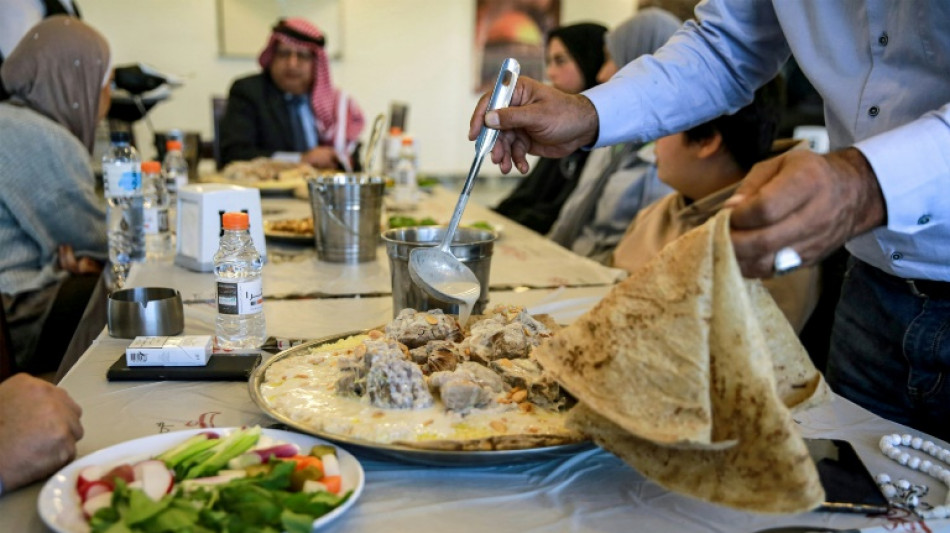
In Jordan, a sumptuous dish that has its roots in an ancient war has evolved over the centuries to be widely cherished as a symbol of peace and hospitality.

Text size:

Mansaf -- the kingdom's national dish of lamb cooked in dried yogurt, served with rice and nuts -- is "the king of the Jordanian table", says Ashraf Al-Mubaideen, 47, who runs a traditional restaurant in Amman.

"If you want to honour your guest, there's nothing finer than mansaf," agrees his business partner Tamer al-Majali, 42, about the custom of greeting guests with huge platters piled high.

Mansaf was inscribed on UNESCO's list of intangible cultural heritage late last year, highlighting the "deep sense of identity and social cohesion" it evokes.

Long before it became a symbol of peace -- traditionally shared to mark the end of tribal feuds -- mansaf was born on the eve of battle, according to one version of history.

In the 9th century BC, King Mesha of the Moab Kingdom -- located on the eastern shore of the Dead Sea -- wanted to test his people's loyalty in a war against the Kingdom of Israel, said historian George Tareef.

"The king knew that the Torah forbade Jews from eating meat cooked with milk," and so he instructed his people to cook a rudimentary version of the non-kosher dish ahead of battle, said Tareef.

In modern-day Amman, Mubaideen and Majali's restaurant is called "Manasef Moab", a nod to the dish's ancient origins.

- 'Authenticity and heritage' -

Jordan's most popular dish -- regularly served at wedding banquets and in households for large families -- bears little resemblance to Mesha's culinary allegiance tests.

The dish underwent thousands of years of "evolution as a result of economic and agricultural conditions", according to researcher Hassan Mubaideen.

In an Amman restaurant, the 58-year-old academic -- donning a red keffiyeh scarf and tucking into a plate of mansaf -- said rice came to replace bread and cracked wheat, as a way to feed more people with less, though shows of generosity remain integral.

"There are special rituals and hospitality protocols linked to the meal -- like how you greet guests, in what order you serve them, where the head of the animal goes, and how you say goodbye," Mubaideen told AFP.

Large platters are traditionally shared between around a dozen people, using only the right hand, while the left is placed behind the back.

Customs have changed, and individual plates and utensils are now often used, as younger generations adopt the age-old tradition.

Sharing mansaf with her classmates, 14-year-old school pupil Zeina Elyan expressed pride in the symbol of "Jordan's ancient heritage" and the health benefits of the dish's whole foods.

Her teacher, Duha Saleh, 31, said she brought her students to the restaurant to teach them "the social culture" behind the dish, and the inherited values of generosity and hospitality.

"There's a pleasure to it," she said, "in how it connects us to who we are, our authenticity and our heritage."

N.Lo--ThChM