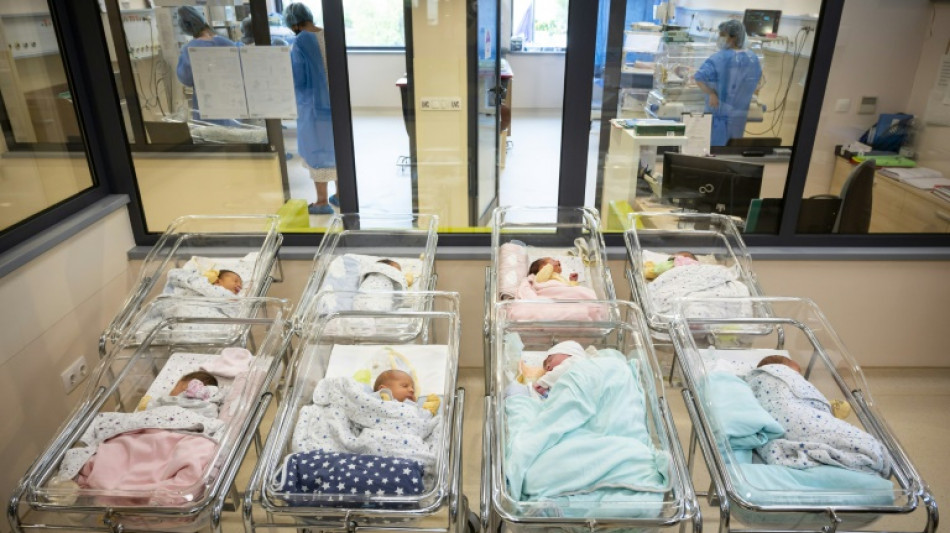
Focus on reproductive rights rather than population numbers, UN urges / Photo: © AFP

Rather than fixating on the impact of the world's soaring population, the world should look at women's reproductive rights to shore up "demographic resilience," the UN said Wednesday.
The United Nations Population Fund (UNFPA) -- the UN's sexual and reproductive health agency -- acknowledged there was widespread anxiety over the size of the world's population, which is expected to peak at around 10.4 billion during the 2080s.
But the UNFPA said the focus should be on giving women more power to control when and how they have children.
"The question is: 'Can everyone exercise their fundamental human right to choose the number and spacing of their children?'. Sadly, the answer is a resounding no," said UNFPA chief Natalia Kanem.
She said that "44 percent, almost half of women, are unable to exercise bodily autonomy. Unable to make choices about contraception, healthcare and whether or with whom to have sex. And globally, nearly half of all pregnancies are unintended."
She said countries with the highest fertility rates contribute the least to global warming and suffer the most from its impact.
In its flagship annual "State of World Population" report, the UNFPA found the most commonly-held view is that the world's population is too big.
But it said that passing the eight billion mark "should be a reason to celebrate. It is a milestone representing historic advances for humanity in medicine, science, health, agriculture and education".
"It is time to put aside fear, to turn away from population targets and towards demographic resilience -- an ability to adapt to fluctuations in population growth and fertility rate," it said.
- India overtaking China -
"The world population is rapidly reordering itself," Kanem told a press conference.
While the population is now the largest ever seen, "the global average fertility rate is the lowest in living memory".
Kanem said the ranking of the world's most populous countries would change significantly over the next 25 years, with India currently overtaking China at the top.
Eight countries will account for half the projected growth in global population by 2050: the Democratic Republic of Congo, Egypt, Ethiopia, India, Nigeria, Pakistan, the Philippines and Tanzania.
The report said two-thirds of people were living in countries with low fertility.
"This is the first time in human history where not every country is getting bigger," said Kanem.
The countries with the highest fertility rates were all in Africa: Niger (6.7), Chad (6.1), DR Congo (6.1) Somalia (6.1) and Mali and the Central African Republic (5.8).
The territories with the lowest birth rates were Hong Kong (0.8), South Korea (0.9), Singapore (1.0), Macau and San Marino (1.1) and Aruba and China (1.2).
Europe is the only region projected to experience an overall population decline between now and 2050.
The report said the world fertility rate per woman was currently 2.3. Life expectancy is 71 for men and 76 for women.
"All populations are ageing largely because we're living longer lives. Since 1990, the average life expectancy has increased by about a decade," said Kanem.
Twenty-five percent of the world's population is aged 14 or under; 65 percent are aged 15-64 and 10 percent are aged 65 and over.
The report found anxious governments were increasingly adopting policies aimed at raising, lowering or maintaining fertility rates. However, such efforts are very often ineffective.
"Half a million births every year take place among girls aged 10-14... girls too young to consent to sex, girls married off, abused, or both," Kanem added.
D.Peng--ThChM