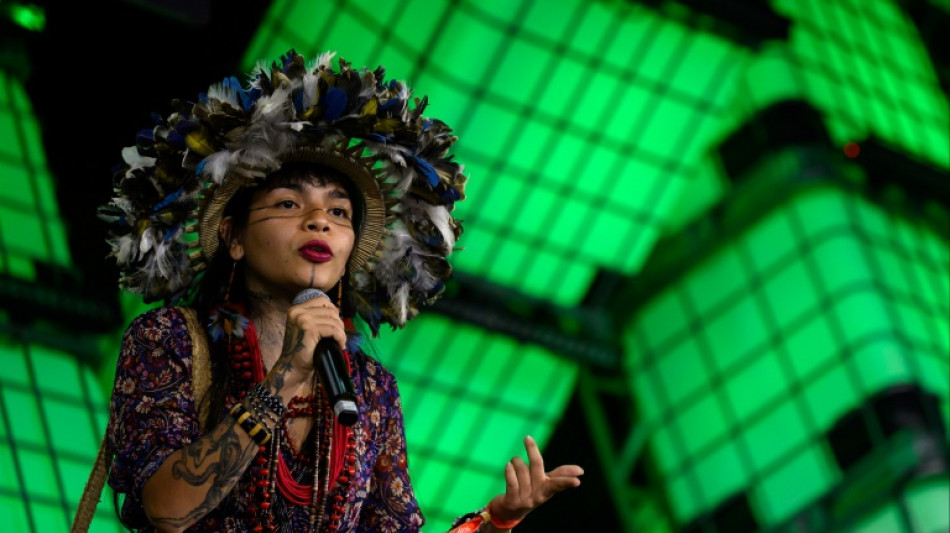
Indigenous youths use tech as 'weapon' to protect Amazon / Photo: © AFP

Her grandfather defended native lands in the Brazilian Amazon with bows and arrows. Today, the weapon of choice for Txai Surui and many young Indigenous activists like her is technology.
The 26-year-old Brazilian is one of the stars of Web Summit Rio, the world's biggest annual technology conference, which was held for the first time outside Europe this week, gathering more than 20,000 entrepreneurs and investors in Brazil.
"Today, technology is like a weapon for us... We use technology and ancestral knowledge as a form of resistance, to protect our land" against illegal logging and mining, Txai told AFP on the sidelines of the conference in Rio de Janeiro.
Using video cameras, drones, GPS, cell phones and social networks, a group of young people from her community monitors land invasions, using an application to report them, says Txai, who stands out in the high-tech conference venue with her feather headdress and traditional face paint.
"But technology can also be used for evil," adds the young activist, the coordinator of the Kaninde Ethno-Environmental Defense Association, which represents 21 Amazon Indigenous peoples.
"The same satellites we use to protect our territory are used by land invaders to destroy it. There are people who use Facebook to sell protected Indigenous lands."
Brazil is home to around 800,000 Indigenous people, according to the latest census.
Numerous studies have found that protecting their lands -- 13.75 percent of the country's territory -- is one of the best ways to defend forests like the Amazon, a key resource in the race to curb climate change.
- Family of activists -
Txai is following in the footsteps of her parents, both activists who received death threats for fighting illegal logging.
Her mother, the environmentalist and Indigenous expert Ivaneide Bandeira, has spent decades fighting to protect native lands.
She played a central role in the documentary "The Territory" -- produced by Txai, and released by National Geographic last year -- which follows the Uru-eu-wau-wau people's fight to protect their land in the northern state of Rondonia.
Txai's father, the Indigenous chief Almir Surui, was the first to use technology to defend the forest, she says: in 2007, he visited Google headquarters in California and convinced the US tech giant to help his people create the "Surui Cultural Map," an interactive experience on Google Earth.
Almir, whom Txai calls a "visionary," was also the first to organize an Indigenous group to sell credits on the carbon market.
Barefoot in the conference hall, Txai urges the international technology jet set to visit the rainforest.
"We need people who work with technology to reconnect with nature," says the activist, who is studying for a law degree.
"When they tell me they want to help me with new apps, I tell them: 'Come get to know us, and see what we need.'"
- Lingering 'prejudice' -
Txai, who also attended the UN climate talks in Glasgow in 2021, said she regrets being the only Indigenous representative at Web Summit Rio.
"There's still a lot of prejudice, a lot of racism," she said.
But there are signs of change.
Brazilian President Luiz Inacio Lula da Silva, who took office in January, has vowed to make protecting the Amazon a priority. Last week, the veteran leftist created Brazil's first protected Indigenous reservations in five years.
His predecessor, far-right ex-army captain Jair Bolsonaro, made good on his vow not to allow "one more centimeter" of reservation land during his presidency.
Under Bolsonaro (2019-2022), average annual deforestation in the Brazilian Amazon surged by more than 75 percent from the previous decade.
"A lot has changed" under the new administration, Txai said. "But we know we still have a long road ahead."
"My role is to pressure, to demand results. There are still a lot of Indigenous lands to protect."
The biggest obstacle is Brazil's current Congress, which is "very conservative, even more than during the (Bolsonaro) administration," she said.
At the global scale, she urged people to think of climate change in more than just economic terms.
"We're almost at the point of no return," she said.
"We have to stop just thinking about the economy and think about people."
H.Ng--ThChM