Last artisanal fishermen of Brazil's Copacabana seek revival / Photo: © AFP

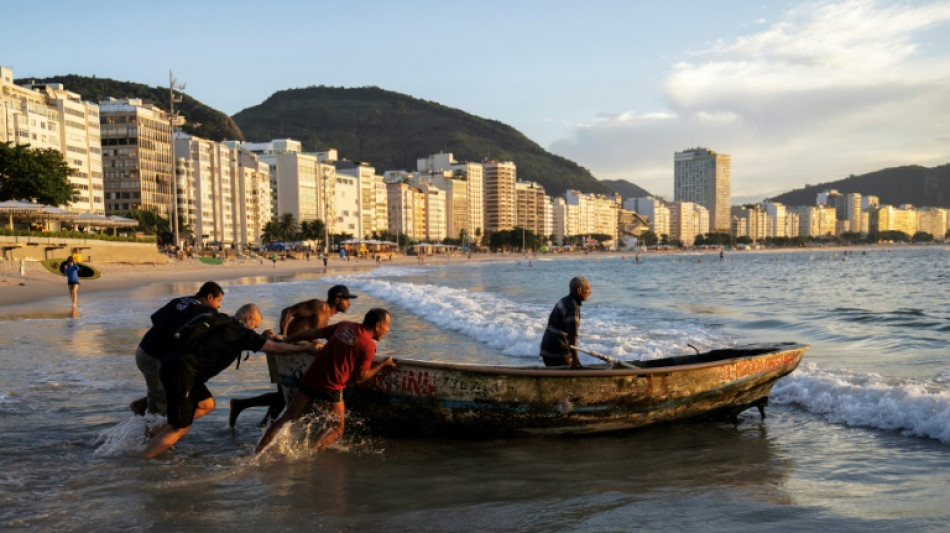
Each day at dawn, Manoel Reboucas launches his small motor boat into the sea off Copacabana, a reminder of the century-old fishing collective established here long before it became Rio de Janeiro's most famous beach.
But these days Reboucas and his colleagues are struggling to keep their livelihood afloat in the face of industrial fishing and a waning interest from young people.
After sailing a few kilometers and scanning the horizon, Reboucas turns off the engine and begins to collect the net that he has placed the day before, where several croakers and anchovies have been trapped.
"The shoals have decreased a lot, they are no longer coming like before," laments Reboucas, 63, president of the Z13 Copacabana fishermen's collective, founded in 1923.
Unsustainable fishing practices from both artisanal fishers and commercial trawlers, combined with difficulty attracting young people, is threatening the profession, says Reboucas -- though not for his son Manasi, 34.
Even when the fishing is poor, "the feeling of being here is renewing," he says.
On the boat, the noise of Rio is but a distant murmur, as the surrounding hills paint a panoramic postcard.
But Manoel and Manasi are not there to appreciate the dazzling sight.
"We have to quickly bring the fish to land for the customers, who buy it for lunch," explains Manoel.
- The story of a neighborhood -
Back on the beach, they unload a box containing several kilos of fresh fish, which they will sell at the Z13 headquarters, where some 50 fishermen work.
Mauricio Thompson, a rowing instructor who works on the beach, is a regular customer.
"We know that they leave early and come back with something fresh, good. You are already sure of the quality," Thompson said.
The fishmongers' tuna, tilapia, octopus, and mussels are also sold on their website, which boasts of supplying "the best restaurants" in the city.
The fishermen of Z13, numbering about 500 in total, have long worked the 36 kilometers (22 miles) of coastline along the iconic Rio neighborhood, founded more than 130 years ago.
"When Copacabana was created, the fishermen were already here," says Reboucas.
- Young apprentices -
In addition to the presence of large industrial fishing boats, artisanal fishing is also hemmed in by waste from the city and oil exploration in the region, says sociologist Lara Mattos, from the NGO Nucleo Canoas.
Together with the fishermen's collective, the group is coordinating a training course for new, young fishermen, a project that is part of a compensation agreement signed between the prosecutor's office of Rio de Janeiro and the US oil company Chevron (whose share was later acquired by Brazil's PRIO oil company) after a spill of more than 3,000 barrels of crude oil in an offshore field off the coast of Rio state, in 2011 and 2012.
The objective is to keep alive a trade that contributes to -- rather than harms -- environmental preservation.
The fishermen's knowledge "takes into account the cycles of marine life, the maintenance of biodiversity and the guarantee of resources for the next generations," explains Mattos.
The first 20 students in the project will graduate this month.
Among them is 19-year-old Izabely Albuquerque, who expertly sews a fishing net, never letting it get tangled in her long, sculpted fingernails.
"If it's unstitched, the fish escapes," she explains.
Gilmar Ferreira, 39, seeks to make official a job that he has always done informally.
"My father is a fisherman and we've been fishing since we were kids, my brother and I. We had the opportunity to take a course to get a fisherman's license and we're doing it," he says.
N.Wan--ThChM