What's next for Israel's divisive judicial reforms? / Photo: © AFP/File

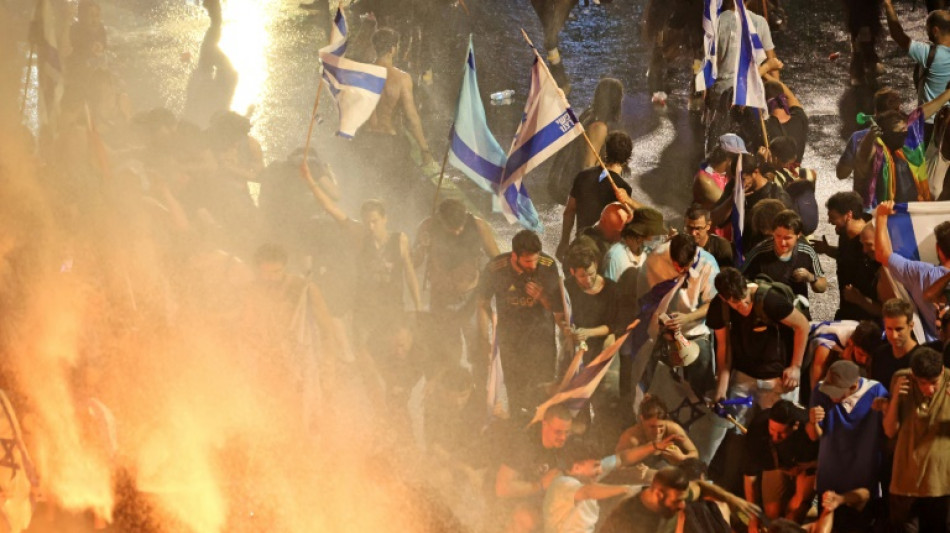
Mass protests and strikes rocked Israel this week in the face of the hard-right government's decision to push through a controversial legal reform weakening the powers of the Supreme Court.
As opponents of the legislation vow to rally again, here's a recap of the latest events and a look ahead to what comes next:
- What happened this week?
Lawmakers allied to Prime Minister Benjamin Netanyahu on Monday threw their support behind an amendment which scraps the "reasonableness" clause, used by the Supreme Court to overturn government decisions which are deemed unconstitutional.
The law passed with 64 votes in the 120-seat chamber, after opposition lawmakers stormed out shouting "shame".
The measure was a key part of Netanyahu's broader judicial reform package, which the government argues is necessary to rebalance powers between elected officials and the Supreme Court.
Critics have taken issue with the draft legislation for months, fearing it could pave the way to a more authoritarian government without judicial oversight.
They also accuse Netanyahu, who is on trial for corruption charges he denies, of trying to use the reforms to quash possible judgements against him.
He rejects the accusation.
- What new powers does it give?
Netanyahu's coalition has a parliamentary majority, meaning it does not need opposition support to pass legislation.
As Israel does not have an upper house of parliament, the "reasonableness" law was put in place to allow judges to determine whether a government had overreached its powers.
"The decision to overturn (the law) is seriously extreme, because the government or a minister can now appoint who they want without checks," said Claude Klein, emeritus professor at the law department of Jerusalem's Hebrew University.
"It gives unlimited powers to a government."
- How was the law used?
The "reasonableness" law has only been used a handful of times against government decisions.
It is a tool used "only when decisions are extremely unreasonable", according to Suzie Navot, a constitutional law professor at the Israel Democracy Institute think tank.
"If they (government) take a decision that is corrupted, then the court will intervene."
The measure was used recently in a high-profile ruling which barred a Netanyahu ally, Aryeh Deri, from serving in the cabinet because of a previous tax evasion conviction.
- Can the vote be challenged?
There have already been numerous petitions filed with the Supreme Court against Monday's legislation, including by the Israel Bar Association.
Navot says it is possible the country's highest court will strike down the legislation which has been classified as a Basic Law -- forming part of the country's quasi-constitution.
"A Basic Law cannot revoke or infringe on the core values of Israel as a Jewish and democratic state," she said.
"The Knesset (parliament) is not empowered to change the essence of the country and if it does so, then the court will be able to declare even a Basic Law unconstitutional," she added.
But Supreme Court justices have never before made such a ruling.
The court on Wednesday announced it would take on the case and not freeze the legislation while legal proceedings are underway.
Hearings are set to be heard in September and are likely to be televised, giving the public a chance to see all parties present their arguments.
- What's next for the wider reforms?
With parliament entering its summer recess, the next piece of Netanyahu's legal overhaul is not expected to hit the chamber floor for months.
The premier on Monday promised talks with the opposition.
Julia Elad-Strenger, a politics lecturer at Israel's Bar-Ilan University, said this week's vote was a "big win" for the government and its overhaul plans.
"Because once the first law has passed with such protest, it will be easier to pass the next," she said.
Other items on the agenda include handing the government a greater say in the appointment of judges and downgrading the status of legal advisers attached to ministries.
"The most important part of the project is the process of nominating judges, not that which was voted on Monday," said Klein.
- Will Israel's divisions deepen?
Opposition leaders and protesters, who have taken to the streets in their tens of thousands every week since January, are sceptical of the government's sincerity in holding talks.
"This is a gesture of winners, not of losers," said Elad-Strenger.
Divisions are only expected to deepen in the coming months, as the government presses ahead with its reform package.
For Klein, the situation is no less than "the greatest legislative crisis in the history of the country."
P.Ho--ThChM