The China Mail - Costa Rica coffee farmers innovate as rainfall plummets

USD -
AED 3.672498
AFN 64.519396
ALL 80.857725
AMD 361.450153
ANG 1.789785
AOA 918.000331
ARS 1525.2916
AUD 1.427073
AWG 1.8
AZN 1.695576
BAM 1.74449
BBD 2.013379
BDT 123.649824
BGN 1.747831
BHD 0.37738
BIF 3000.936538
BMD 1
BND 1.278292
BOB 11.691144
BRL 5.01401
BSD 0.999639
BTN 94.927772
BWP 13.724852
BYN 2.981492
BYR 19600
BZD 2.010606
CAD 1.40533
CDF 2315.000191
CHF 0.825715
CLF 0.024828
CLP 977.179718
CNY 6.67915
CNH 6.675605
COP 3178.17
CRC 454.01635
CUC 1
CUP 23.991865
CVE 98.353418
CZK 21.617501
DJF 178.020792
DKK 6.648395
DOP 61.501822
DZD 134.43865
EGP 54.400501
ERN 15
ETB 163.29086
EUR 0.889402
FJD 2.258096
FKP 0.751528
GBP 0.747145
GEL 2.59502
GGP 0.751528
GHS 11.651005
GIP 0.751528
GMD 73.505074
GNF 8848.21564
GTQ 7.639477
GYD 209.088355
HKD 7.848545
HNL 26.832455
HRK 6.701702
HTG 130.906561
HUF 323.760035
IDR 17969.05
ILS 3.089355
IMP 0.751528
INR 94.695012
IQD 1515.558311
IRR 1795727.487009
ISK 121.150139
JEP 0.751528
JMD 158.652431
JOD 0.709024
JPY 158.072496
KES 129.850182
KGS 87.450325
KHR 4065.631676
KMF 438.999859
KPW 899.999961
KRW 1326.860026
KWD 0.30965
KYD 0.833107
KZT 449.788164
LAK 22492.98683
LBP 89521.677274
LKR 331.534585
LRD 170.447906
LSL 16.46702
LTL 2.95274
LVL 0.60489
LYD 6.412395
MAD 9.796548
MDL 17.934092
MGA 4549.083271
MKD 54.989163
MMK 2099.540776
MNT 3598.083246
MOP 8.081669
MRU 40.095438
MUR 47.260033
MVR 15.449753
MWK 1733.468319
MXN 18.42105
MYR 4.082497
MZN 63.910099
NAD 16.467681
NGN 1328.779853
NIO 36.78366
NOK 9.40705
NPR 151.877982
NZD 1.758565
OMR 0.384497
PAB 0.999728
PEN 3.447086
PGK 4.473086
PHP 63.095025
PKR 276.67627
PLN 3.884602
PYG 5737.960807
QAR 3.633745
RON 4.737798
RSD 104.445982
RUB 82.799975
RWF 1476.043725
SAR 3.762651
SBD 8.058149
SCR 13.784653
SDG 601.496659
SEK 9.88735
SGD 1.27736
SHP 0.750188
SLE 24.68022
SLL 20969.504398
SOS 571.288409
SRD 37.661499
STD 20697.981008
STN 21.853439
SVC 8.747581
SYP 13001.999685
SZL 16.463453
THB 33.594977
TJS 9.232052
TMT 3.5
TND 2.982527
TOP 2.40776
TRY 49.574946
TTD 6.78527
TWD 32.62301
TZS 2644.649936
UAH 45.054454
UGX 4169.008054
UYU 40.102397
UZS 12040.315747
VES 879.788901
VND 25876
VUV 119.358066
WST 2.773115
XAF 583.409516
XAG 0.017214
XAU 0.000241307792
XCD 2.70255
XCG 1.801632
XDR 0.707052
XOF 583.409516
XPF 106.372921
YER 236.149615
ZAR 16.384898
ZMK 9001.212855
ZMW 20.018642
ZWL 321.999592
SSP 5816.545442
MXV 2.079425
  • RYCEF

    0.4000

    19.71

    +2.03%

  • CMSC

    0.0000

    20.4

    0%

  • BTI

    0.4200

    56.05

    +0.75%

  • BP

    0.2800

    44.43

    +0.63%

  • RBGPF

    1.6000

    67

    +2.39%

  • RIO

    -0.1500

    94.41

    -0.16%

  • AZN

    -0.4300

    166.15

    -0.26%

  • GSK

    0.4600

    49.7

    +0.93%

  • BCE

    -0.4100

    20.56

    -1.99%

  • NGG

    -0.2500

    75.24

    -0.33%

  • VOD

    -0.0400

    16.58

    -0.24%

  • RELX

    -0.4500

    33.07

    -1.36%

  • BCC

    -0.5500

    76.59

    -0.72%

  • CMSD

    -0.0300

    20.27

    -0.15%

  • JRI

    -0.2500

    10.77

    -2.32%

Costa Rica coffee farmers innovate as rainfall plummets
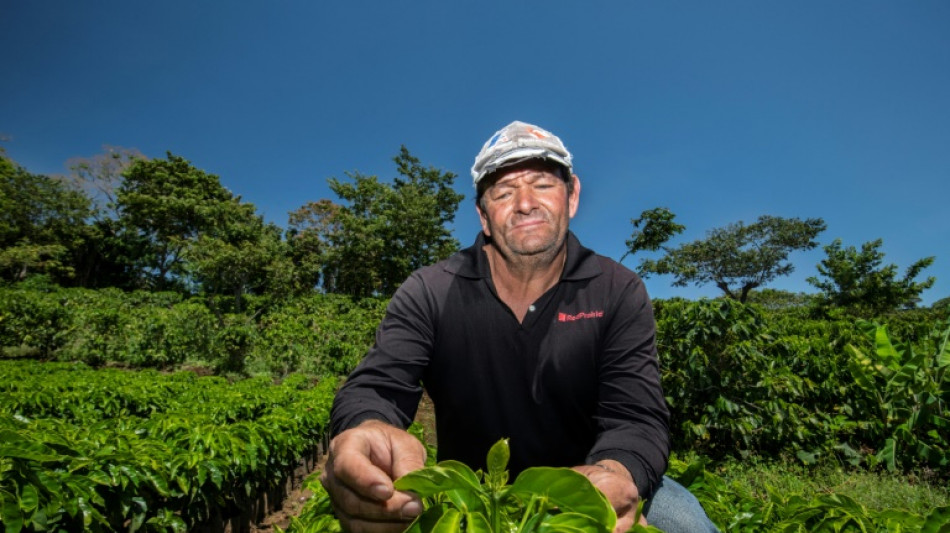
Costa Rica coffee farmers innovate as rainfall plummets / Photo: © AFP

Costa Rica coffee farmers innovate as rainfall plummets

Costa Rican coffee farmers were once blessed with abundant rains but as precipitation grows fickle they are being forced to innovate to keep producing one of the world's favorite brews.

Text size:

The country's lush Central Valley has long boasted the ideal climate conditions for growing the arabica coffee beans, its most emblematic export -- but farmers report this is rapidly changing.

Jesus Valverde, who owns a family plantation in the town of Naranjo, is trying to adapt by planting fruit trees that provide shade and maintain humidity around his coffee plants.

"We have increased production" with this "microclimate," the 59-year-old farmer told AFP.

In addition, the dry leaves that fall from the trees fertilize the soil and reduce heat, a kind of "biological technology" that maintains the humidity of the soil.

"I was ahead of climate change," the coffee farmer says proudly.

The Inter-American Development Bank estimates that rising temperatures could wipe out half of the world's coffee crops by 2050.

While the country is one of the world's smaller coffee producers, the bean has been one of Costa Rica's top exports since the 19th century. Last year, the country shipped 60,000 tons at a value of $350 million.

The industry supports more than 25,000 families.

-'The challenges are constant' -

Data from the University of Costa Rica shows that annual rainfall has steadily dropped from 2,907 millimeters (114 inches) in 2010 to 1,759 millimeters in 2023.

However some years stand out as particularly dry, such as 2016, when only 952 millimeters fell.

With climate change "the challenges are constant," as pests and fungi evolve, said Harold Gamboa, a specialist at the Inter-American Institute for Cooperation on Agriculture.

The Coffee Institute of Costa Rica (Icafe) is working on developing coffee plant hybrids that are more resistant.

"By studying the DNA of different plants, we can speed up the development of the best characteristics in a single plant," said biotechnology engineer Erika Mendez, 28.

In the past, farmers like Johel Alvarado needed to do little more than plant and wait for the country's once-consistent rains.

Now he has had to install a drip irrigation system on his four-hectare coffee plantation.

"Each year it gets a bit harder to produce the same amount," but "by innovating, we see that climate change does not affect us as much," the 52-year-old farmer told AFP.

Eduardo Rojas, who manages a 50-hectare coffee plantation in the town of Sarchi, managed to boost production after investing over $200,000 in irrigation systems and other upgrades.

In 2023, he harvested 43.5 bushels of coffee per hectare, more than double the national average.

"I didn't believe it could be done," said Rojas, who has been in the business for more than 40 years.

"People who have farms like this in very harsh climates... need to get involved in these projects," he said.

C.Smith--ThChM