The China Mail - Japan space rocket explodes seconds after launch

USD -
AED 3.673023
AFN 64.485566
ALL 80.675004
AMD 361.450114
ANG 1.789785
AOA 916.999953
ARS 1524.901699
AUD 1.428367
AWG 1.80125
AZN 1.705219
BAM 1.74449
BBD 2.013379
BDT 123.649824
BGN 1.747831
BHD 0.37725
BIF 2996
BMD 1
BND 1.278292
BOB 11.691144
BRL 5.032099
BSD 0.999639
BTN 94.927772
BWP 13.724852
BYN 2.981492
BYR 19600
BZD 2.010606
CAD 1.405925
CDF 2316.000068
CHF 0.825303
CLF 0.024778
CLP 975.198113
CNY 6.67805
CNH 6.67451
COP 3172.64
CRC 454.01635
CUC 1
CUP 23.991865
CVE 98.49938
CZK 21.624205
DJF 177.720239
DKK 6.651603
DOP 61.549749
DZD 134.430549
EGP 54.503597
ERN 15
ETB 161.149943
EUR 0.889895
FJD 2.253796
FKP 0.751528
GBP 0.74771
GEL 2.59015
GGP 0.751528
GHS 11.625013
GIP 0.751528
GMD 73.507307
GNF 8794.999743
GTQ 7.639477
GYD 209.088355
HKD 7.848296
HNL 26.832455
HRK 6.705301
HTG 130.906561
HUF 323.949944
IDR 17984
ILS 3.089355
IMP 0.751528
INR 94.76635
IQD 1513
IRR 1832374.999726
ISK 121.219818
JEP 0.751528
JMD 158.652431
JOD 0.709007
JPY 158.176993
KES 129.850313
KGS 87.450107
KHR 4069.999877
KMF 439.503622
KPW 899.999961
KRW 1334.840047
KWD 0.309694
KYD 0.833107
KZT 449.788164
LAK 22525.000136
LBP 89549.999792
LKR 331.534585
LRD 171.075018
LSL 16.389772
LTL 2.95274
LVL 0.60489
LYD 6.415004
MAD 9.798999
MDL 17.934092
MGA 4562.458051
MKD 54.989163
MMK 2099.540776
MNT 3598.083246
MOP 8.081669
MRU 40.225015
MUR 47.260554
MVR 15.459958
MWK 1741.999826
MXN 18.426703
MYR 4.082501
MZN 63.904623
NAD 16.389756
NGN 1330.805616
NIO 36.82962
NOK 9.40295
NPR 151.877982
NZD 1.75945
OMR 0.384503
PAB 0.999728
PEN 3.426983
PGK 4.504989
PHP 63.108997
PKR 276.75005
PLN 3.88665
PYG 5737.960807
QAR 3.645498
RON 4.739802
RSD 104.493988
RUB 82.815309
RWF 1475.5
SAR 3.762651
SBD 8.07458
SCR 13.968579
SDG 601.495747
SEK 9.891495
SGD 1.277601
SHP 0.7473
SLE 23.920291
SLL 20969.504398
SOS 571.499858
SRD 37.6615
STD 20697.981008
STN 21.95
SVC 8.747581
SYP 13001.999685
SZL 16.389585
THB 33.584608
TJS 9.232052
TMT 3.51
TND 2.994981
TOP 2.40776
TRY 49.59498
TTD 6.78527
TWD 32.630196
TZS 2644.650335
UAH 45.054454
UGX 4169.008054
UYU 40.102397
UZS 12019.999549
VES 879.7889
VND 25876
VUV 119.358066
WST 2.773115
XAF 583.732855
XAG 0.017241
XAU 0.000242415133
XCD 2.70255
XCG 1.801632
XDR 0.707052
XOF 583.732855
XPF 106.484664
YER 236.10636
ZAR 16.393802
ZMK 9001.212009
ZMW 20.018642
ZWL 321.999592
SSP 5816.545442
MXV 2.080063
  • RYCEF

    0.4000

    19.71

    +2.03%

  • CMSC

    0.0000

    20.4

    0%

  • BTI

    0.4200

    56.05

    +0.75%

  • BP

    0.2800

    44.43

    +0.63%

  • RBGPF

    1.6000

    67

    +2.39%

  • RIO

    -0.1500

    94.41

    -0.16%

  • AZN

    -0.4300

    166.15

    -0.26%

  • GSK

    0.4600

    49.7

    +0.93%

  • BCE

    -0.4100

    20.56

    -1.99%

  • NGG

    -0.2500

    75.24

    -0.33%

  • VOD

    -0.0400

    16.58

    -0.24%

  • RELX

    -0.4500

    33.07

    -1.36%

  • BCC

    -0.5500

    76.59

    -0.72%

  • CMSD

    -0.0300

    20.27

    -0.15%

  • JRI

    -0.2500

    10.77

    -2.32%

Japan space rocket explodes seconds after launch
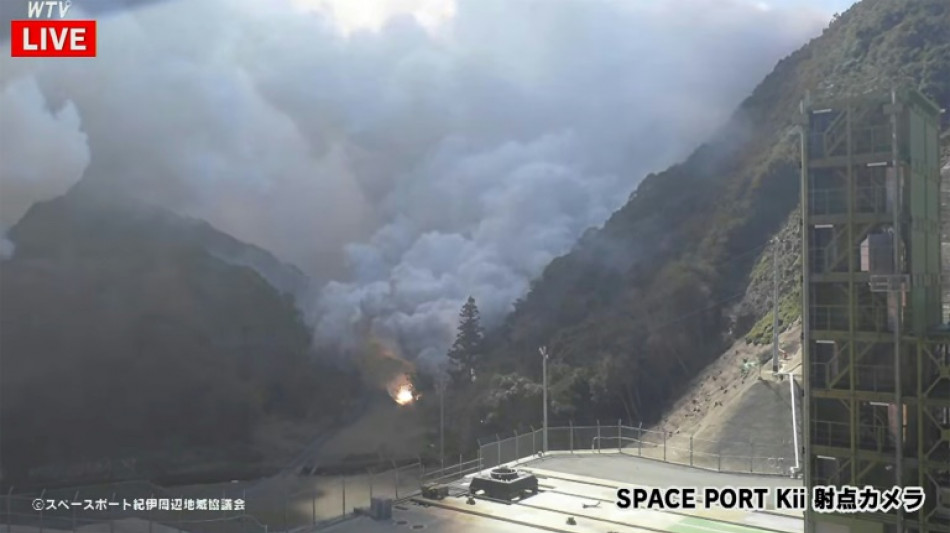
Japan space rocket explodes seconds after launch / Photo: © AFP

Japan space rocket explodes seconds after launch

A rocket made by a Japanese company exploded seconds after launch on Wednesday, in a spectacular failure for the start-up's bid to put a satellite into orbit.

Text size:

Tokyo-based Space One's 18-metre (60-foot) Kairos rocket blasted off in the coastal Wakayama region of western Japan, carrying a small government test satellite.

But around five seconds later, the solid-fuel rocket erupted in fire, sending white smoke billowing around the remote mountainous area as orange flames raged on the ground, live footage showed.

"The launch of the first Kairos rocket was executed, but we took a measure to abort the flight," Space One said in a statement, adding that "details are being investigated".

Burning debris fell onto the surrounding slopes as sprinklers began spraying water in dramatic scenes watched by hundreds of spectators young and old gathered at public viewing areas including a nearby waterfront.

"I had high hopes for this, so I'm disappointed. I want to know what happened," one elderly man told public broadcaster NHK.

The fiery failure marks a blow to Japan's efforts to enter the potentially lucrative satellite-launch market.

Space One is hoping to become the nation's first private firm to put a satellite into orbit, and the plan had been for Kairos -- an ancient Greek word meaning "the right moment" -- to do so around 51 minutes after take-off.

Parts shortages and other problems had reportedly led Space One to postpone the launch of Kairos five times before Wednesday's attempt, most recently on Saturday.

- 'Didn't even imagine' -

The mayor of Kushimoto, the town of 15,000 residents in Wakayama where the failed launch took place, voiced his surprise and disappointment.

"I didn't even imagine an outcome like this," Katsumasa Tashima told reporters shortly after the explosion.

But the town "will continue to support Space One, and we want to continue to offer our help so that the first rocket will have a successful launch", he said.

Space One was established in 2018 by a team of major Japanese tech businesses, including Canon Electronics, IHI Aerospace, construction firm Shimizu and the government-owned Development Bank of Japan.

Last July, another Japanese rocket engine exploded during a test around 50 seconds after ignition.

The solid-fuel Epsilon S was an improved version of the Epsilon rocket that had failed to launch the previous October.

The malfunction came after Tokyo in March 2023 failed a second attempt to launch its next-generation H3 rocket.

The H3 has been mooted as a rival to SpaceX's Falcon 9, and could one day deliver cargo to bases on the Moon.

Last month, Japan's space agency managed a successful blast-off for the new flagship rocket.

That followed Japan's successful landing in January of an unmanned probe on the Moon -- albeit at a wonky angle -- making it just the fifth country to achieve a "soft landing" on the lunar surface.

In April last year, another Japanese start-up, ispace, tried in vain to become the first private company to land on the Moon -- losing communication with its craft after what it described as a "hard landing".

V.Fan--ThChM