The China Mail - In south China, silkworm farmers reel from deadly floods

USD -
AED 3.672502
AFN 64.491655
ALL 80.734582
AMD 360.878684
ANG 1.789785
AOA 917.000345
ARS 1524.77039
AUD 1.425899
AWG 1.80125
AZN 1.696241
BAM 1.741872
BBD 2.010322
BDT 123.466466
BGN 1.747831
BHD 0.376821
BIF 2996.486509
BMD 1
BND 1.276346
BOB 11.673339
BRL 5.024019
BSD 0.998116
BTN 94.783201
BWP 13.703949
BYN 2.976965
BYR 19600
BZD 2.007472
CAD 1.40623
CDF 2316.000465
CHF 0.826105
CLF 0.024779
CLP 975.239836
CNY 6.67805
CNH 6.67741
COP 3182.74
CRC 453.324902
CUC 1
CUP 23.955861
CVE 98.204067
CZK 21.66335
DJF 177.749674
DKK 6.66289
DOP 61.408157
DZD 134.548997
EGP 54.501937
ERN 15
ETB 163.042175
EUR 0.89142
FJD 2.253797
FKP 0.747587
GBP 0.748215
GEL 2.589901
GGP 0.747587
GHS 11.633261
GIP 0.747587
GMD 73.507217
GNF 8834.937189
GTQ 7.628149
GYD 208.769922
HKD 7.847905
HNL 26.791591
HRK 6.714502
HTG 130.707196
HUF 325.010498
IDR 17980.9
ILS 3.09331
IMP 0.747587
INR 94.720304
IQD 1513.250179
IRR 1832375.000178
ISK 121.393319
JEP 0.747587
JMD 158.414343
JOD 0.708977
JPY 158.197027
KES 129.950237
KGS 87.450104
KHR 4059.43989
KMF 439.496752
KPW 899.999961
KRW 1324.279851
KWD 0.30963
KYD 0.831838
KZT 449.121182
LAK 22457.930899
LBP 89472.254266
LKR 331.042959
LRD 170.188321
LSL 16.442016
LTL 2.95274
LVL 0.60489
LYD 6.402658
MAD 9.782021
MDL 17.906141
MGA 4542.155208
MKD 54.902188
MMK 2099.21541
MNT 3597.533576
MOP 8.069361
MRU 40.034198
MUR 47.309916
MVR 15.460115
MWK 1730.82832
MXN 18.469301
MYR 4.081964
MZN 63.899549
NAD 16.442602
NGN 1330.970029
NIO 36.729114
NOK 9.40548
NPR 151.652766
NZD 1.762565
OMR 0.384497
PAB 0.998205
PEN 3.441974
PGK 4.465916
PHP 63.337497
PKR 276.265992
PLN 3.89379
PYG 5729.145794
QAR 3.628291
RON 4.7447
RSD 104.682981
RUB 82.500067
RWF 1473.795772
SAR 3.751186
SBD 8.07458
SCR 14.062256
SDG 601.505413
SEK 9.916955
SGD 1.278035
SHP 0.7473
SLE 23.919688
SLL 20969.504398
SOS 570.441257
SRD 37.661504
STD 20697.981008
STN 21.820157
SVC 8.734297
SYP 13001.999685
SZL 16.439039
THB 33.668993
TJS 9.217992
TMT 3.51
TND 2.978051
TOP 2.40776
TRY 49.602797
TTD 6.774936
TWD 32.456004
TZS 2645.348013
UAH 44.986841
UGX 4162.751655
UYU 40.042215
UZS 12022.461403
VES 879.788902
VND 25877
VUV 119.136032
WST 2.774679
XAF 584.733502
XAG 0.017453
XAU 0.000242977938
XCD 2.70255
XCG 1.798961
XDR 0.707052
XOF 584.733502
XPF 106.215182
YER 236.10032
ZAR 16.414697
ZMK 9001.201691
ZMW 19.987443
ZWL 321.999592
SSP 5787.554334
MXV 2.084748
  • RYCEF

    0.4000

    19.71

    +2.03%

  • CMSC

    0.0000

    20.4

    0%

  • BTI

    0.4200

    56.05

    +0.75%

  • BP

    0.2800

    44.43

    +0.63%

  • RBGPF

    1.6000

    67

    +2.39%

  • RIO

    -0.1500

    94.41

    -0.16%

  • AZN

    -0.4300

    166.15

    -0.26%

  • GSK

    0.4600

    49.7

    +0.93%

  • BCE

    -0.4100

    20.56

    -1.99%

  • NGG

    -0.2500

    75.24

    -0.33%

  • VOD

    -0.0400

    16.58

    -0.24%

  • RELX

    -0.4500

    33.07

    -1.36%

  • BCC

    -0.5500

    76.59

    -0.72%

  • CMSD

    -0.0300

    20.27

    -0.15%

  • JRI

    -0.2500

    10.77

    -2.32%

In south China, silkworm farmers reel from deadly floods
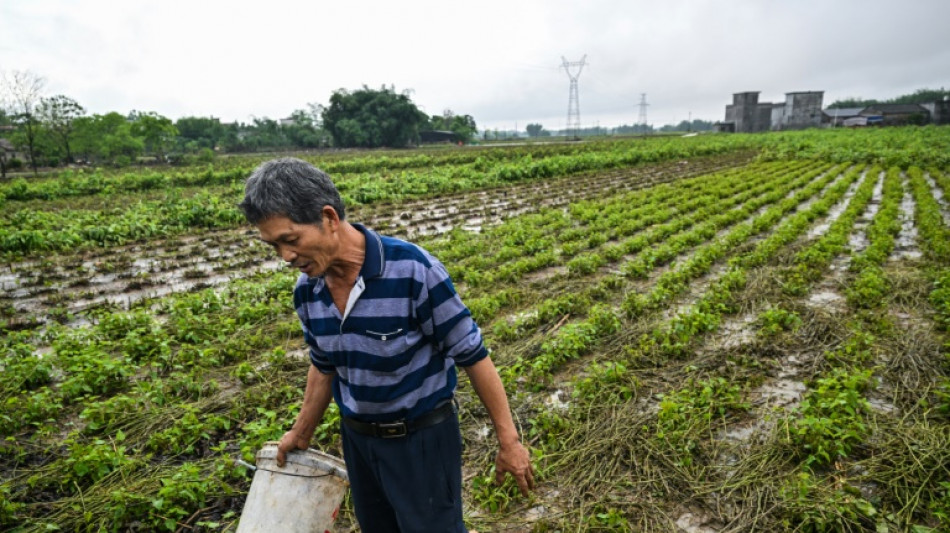
In south China, silkworm farmers reel from deadly floods / Photo: © AFP

In south China, silkworm farmers reel from deadly floods

Hose in hand, 40-year-old Zhu Huangyi cleans a small concrete room once home to his silkworms, two thirds of which were lost in deadly floods hitting southern China this week.

Text size:

Just two hours from the economic powerhouse and megacity of Guangzhou, surrounded by lush subtropical vegetation, lies the village of Sancun, one of the worst hit by the recent bad weather.

Around a quarter of households in the village make their living from raising silkworms, insects that secrete precious fibres essential to the textile industry.

Although the water levels had dropped by the time AFP arrived, it reached two metres in some areas -- with devastating consequences for residents and the tiny creatures.

"We placed the worms high up but that wasn't enough," Zhu Huangyi told AFP, holding up a smartphone showing images of his cocoons floating sadly on the surface of the water.

"It hurts my heart," he said.

"It's an old family business, my mother got into this 30 years ago," says the breeder, whose property was also flooded in 2022.

Behind him, his mother Huang Xiuying scatters white detergent powder on the concrete floor of the enclosures to disinfect the area.

"We continued to feed our worms, even after receiving the weather alert," she says.

"We couldn't come to grips with reality," she explains.

Breeders sell their worms in their cocoon state, when they are most valuable, for around 40 to 50 yuan for a kilo ($5.50 to $7).

Zhu was able to save a third of them.

"After the flood, prices fell," he says.

"We were able to sell those that remained at 34 yuan a kilo."

That was their only way to curb their losses -- like many in the village, he had no insurance.

"Basically, it will cost us 40,000 to 50,000 yuan in losses," he explains -- a huge amount in rural China.

- 'I lost all my cocoons' -

Adding to the pain is the loss in the floods of the village's mulberry trees, the silkworms' only source of food.

"The other problem is our mulberry trees," Zhu said.

The only solution is to cut the heads of the plants once the water level returns to normal, then wait about two weeks for usable leaves to grow back.

Only after that will farmers be able to buy new silkworm eggs to replenish their breeding stock, which Zhu estimates will cost 5,000 yuan.

Another breeder Lan Zhukui is even less fortunate.

"I lost all my cocoons, around 150 kilos of them" with a market value of around 6,000 yuan, he explains to AFP as he cleans the floor of his enclosure.

"There's not much to do at the moment except wait at home."

At her breeding station, Huang is more philosophical.

"We're used to it!" she says. "Before, we were flooded every eight to ten years. Now it's more like every two years."

E.Lau--ThChM