Japan lifts 'megaquake' warning / Photo: © AFP/File

Japan lifted on Thursday a week-old warning that a "megaquake" potentially causing colossal damage and loss of life could strike, with the government telling people their lives could now "go back to normal".
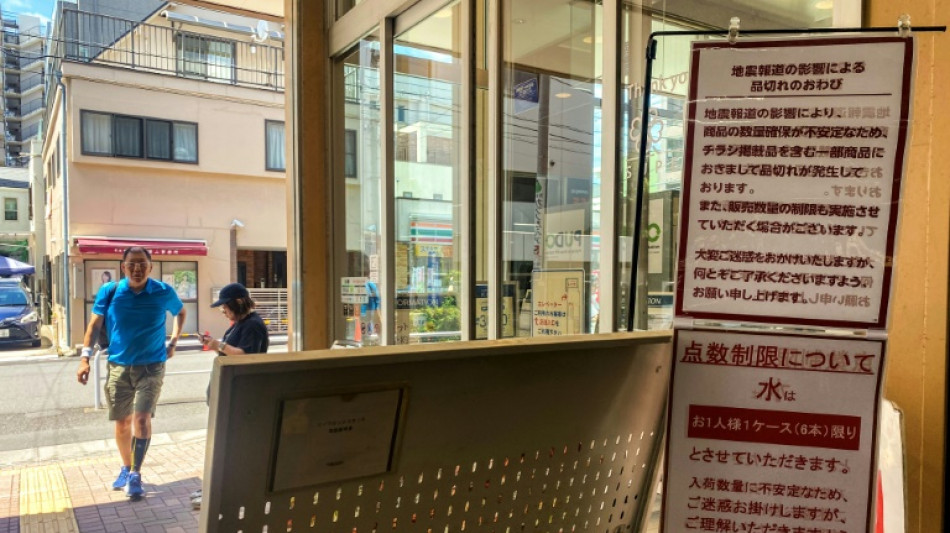
The alert that such a catastrophe might hit the archipelago of 125 million people prompted thousands of Japanese to cancel holidays and stock up on essentials, emptying shelves in some stores.
"Since there were no abnormalities detected in seismic activity and crustal deformation, the special call for attention ended at 5:00 pm (0800 GMT)," disaster management minister Yoshifumi Matsumura said.
"But it doesn't mean the risk (of a major earthquake) has been eliminated," Matsumura told reporters.
"We have been asking for special precautions, such as sleeping while being prepared to evacuate immediately. But we will no longer ask for these steps, and the people of Japan are free to go back to normal lifestyles."
Last Thursday, Japan's weather agency said the likelihood of a megaquake was "higher than normal" following a magnitude 7.1 jolt earlier in the day that injured 15 people.
That was a particular kind of tremor known as a subduction megathrust quake, which in the past has occurred in pairs and can unleash massive tsunamis.
The advisory concerned the Nankai Trough between two tectonic plates in the Pacific Ocean.
The 800-kilometre (500-mile) undersea gully runs parallel to Japan's Pacific coast, including off the Tokyo region, the world's biggest urban area and home to around 40 million people.
In 1707, all segments of the Nankai Trough ruptured at once, unleashing an earthquake that remains the nation's second-most powerful on record.
That quake -- which also triggered the last eruption of Mount Fuji -- was followed by two powerful Nankai megathrusts in 1854, and one each in 1944 and 1946.
- Slower trains -
Japan's government has previously said the next magnitude 8-9 megaquake along the Nankai Trough has a roughly 70 percent probability of striking within the next 30 years.
In the worst-case scenario, 300,000 lives could be lost, experts estimate, while some engineers say the damage could reach $13 trillion, with infrastructure wiped out.
Experts, however, said the risk was still low, and the agriculture and fisheries ministry urged people on Saturday "to refrain from excessively hoarding goods".
The statement came after supermarkets put limits on purchases including bottled water, and as demand for emergency items such as portable toilets and preserved food soared online.
The megaquake warning even prompted Prime Minister Fumio Kishida to cancel a four-day trip to Central Asia due to take place last weekend.
Some bullet trains reduced their speed as a precaution, and nuclear plants were instructed by authorities to double-check their disaster preparations.
- 'Convincingly scary' -
Sitting on top of four major tectonic plates, Japan sees around 1,500 quakes every year, most of them minor.
Even with larger tremors, the impact is generally contained thanks to advanced building techniques and well-practised emergency procedures.
The Japan Meteorological Association (JMA) warning was the first under new rules drawn up after a 2011 quake, tsunami and nuclear disaster that left around 18,500 people dead or missing.
The 2011 tsunami sent three reactors into meltdown at the Fukushima nuclear plant, causing Japan's worst post-war catastrophe and the world's most serious nuclear accident since Chernobyl.
"The history of great earthquakes at Nankai is convincingly scary," geologists Kyle Bradley and Judith A. Hubbard wrote in their Earthquake Insights newsletter last week.
But there was only a "small probability" that last week's magnitude 7.1 earthquake was a foreshock, according to Bradley and Hubbard.
"One of the challenges is that even when the risk of a second earthquake is elevated, it is still always low," they said.
W.Cheng--ThChM