The China Mail - Deadly floods bring relief to Moroccan farmers

USD -
AED 3.673002
AFN 64.499619
ALL 80.857725
AMD 361.449674
ANG 1.789785
AOA 917.999787
ARS 1524.887501
AUD 1.42801
AWG 1.80125
AZN 1.696166
BAM 1.74449
BBD 2.013379
BDT 123.649824
BGN 1.747831
BHD 0.37725
BIF 2996
BMD 1
BND 1.278292
BOB 11.691144
BRL 5.0122
BSD 0.999639
BTN 94.927772
BWP 13.724852
BYN 2.981492
BYR 19600
BZD 2.010606
CAD 1.406075
CDF 2315.000231
CHF 0.825099
CLF 0.024815
CLP 976.640141
CNY 6.67915
CNH 6.67481
COP 3172.14
CRC 454.01635
CUC 1
CUP 23.991865
CVE 98.353418
CZK 21.626951
DJF 177.72018
DKK 6.65276
DOP 61.501822
DZD 134.476003
EGP 54.444632
ERN 15
ETB 163.29086
EUR 0.89008
FJD 2.258099
FKP 0.751528
GBP 0.74735
GEL 2.594978
GGP 0.751528
GHS 11.624971
GIP 0.751528
GMD 73.500615
GNF 8848.21564
GTQ 7.639477
GYD 209.088355
HKD 7.84855
HNL 26.832455
HRK 6.706199
HTG 130.906561
HUF 324.0035
IDR 17986
ILS 3.089355
IMP 0.751528
INR 94.72615
IQD 1515.558311
IRR 1795727.499323
ISK 121.229935
JEP 0.751528
JMD 158.652431
JOD 0.708981
JPY 158.177498
KES 129.849832
KGS 87.450318
KHR 4065.631676
KMF 438.999785
KPW 899.999961
KRW 1325.850123
KWD 0.309699
KYD 0.833107
KZT 449.788164
LAK 22492.98683
LBP 89521.677274
LKR 331.534585
LRD 170.447906
LSL 16.46702
LTL 2.95274
LVL 0.60489
LYD 6.412395
MAD 9.796548
MDL 17.934092
MGA 4549.083271
MKD 54.989163
MMK 2099.540776
MNT 3598.083246
MOP 8.081669
MRU 40.224979
MUR 47.259675
MVR 15.450124
MWK 1733.468319
MXN 18.412805
MYR 4.082499
MZN 63.909848
NAD 16.467681
NGN 1328.000432
NIO 36.78366
NOK 9.40406
NPR 151.877982
NZD 1.759185
OMR 0.384496
PAB 0.999728
PEN 3.447086
PGK 4.473086
PHP 63.117966
PKR 276.67627
PLN 3.88627
PYG 5737.960807
QAR 3.633745
RON 4.740897
RSD 104.507993
RUB 82.799989
RWF 1476.043725
SAR 3.762651
SBD 8.058149
SCR 13.975198
SDG 601.496166
SEK 9.90106
SGD 1.277697
SHP 0.750188
SLE 24.679494
SLL 20969.504398
SOS 571.288409
SRD 37.661499
STD 20697.981008
STN 21.853439
SVC 8.747581
SYP 13001.999685
SZL 16.463453
THB 33.586503
TJS 9.232052
TMT 3.5
TND 2.982527
TOP 2.40776
TRY 49.575399
TTD 6.78527
TWD 32.646902
TZS 2644.99797
UAH 45.054454
UGX 4169.008054
UYU 40.102397
UZS 12040.315747
VES 879.788904
VND 25876
VUV 119.358066
WST 2.773115
XAF 583.854391
XAG 0.017268
XAU 0.000242350215
XCD 2.70255
XCG 1.801632
XDR 0.707052
XOF 583.854391
XPF 106.372921
YER 236.149737
ZAR 16.38434
ZMK 9001.214547
ZMW 20.018642
ZWL 321.999592
SSP 5816.545442
MXV 2.078495
  • RYCEF

    0.4000

    19.71

    +2.03%

  • CMSC

    0.0000

    20.4

    0%

  • BTI

    0.4200

    56.05

    +0.75%

  • BP

    0.2800

    44.43

    +0.63%

  • RBGPF

    1.6000

    67

    +2.39%

  • RIO

    -0.1500

    94.41

    -0.16%

  • AZN

    -0.4300

    166.15

    -0.26%

  • GSK

    0.4600

    49.7

    +0.93%

  • BCE

    -0.4100

    20.56

    -1.99%

  • NGG

    -0.2500

    75.24

    -0.33%

  • VOD

    -0.0400

    16.58

    -0.24%

  • RELX

    -0.4500

    33.07

    -1.36%

  • BCC

    -0.5500

    76.59

    -0.72%

  • CMSD

    -0.0300

    20.27

    -0.15%

  • JRI

    -0.2500

    10.77

    -2.32%

Deadly floods bring relief to Moroccan farmers
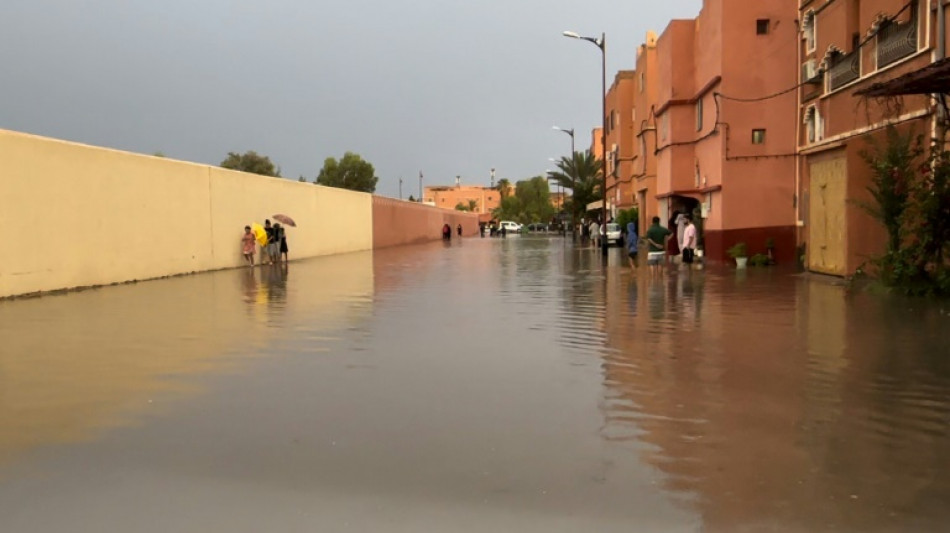
Deadly floods bring relief to Moroccan farmers / Photo: © AFP/File

Deadly floods bring relief to Moroccan farmers

When powerful thunderstorms hit Morocco's arid south, they brought deadly floods but also provided some relief to farmers as the country grapples with its worst drought in nearly 40 years.

Text size:

The torrential rains at the weekend triggered floods that killed at least 18 people in areas of southern Morocco that straddle the Sahara desert.

While the rain was devastating in part, it also brought some relief to farmers growing crops like almonds, dates and cereals.

"These rains will bring a breath of fresh air" to the south, said agronomist Mohamed Taher Srairi.

"But it has not rained elsewhere, and the country remains under a heavy structural drought."

The unusual rainfall resulted from a tropical air mass shifting northward, according to Lhoussaine Youabd, spokesman for Morocco's General Directorate of Meteorology.

Experts say climate change is making extreme weather, such as storms and droughts, more frequent and intense.

Morocco is one of the world's most water-stressed nations, with frequent droughts affecting a third of the population employed in agriculture.

Near areas of the northwest African country lashed by the weekend's rain, water levels in dams have risen and groundwater is expected to replenish.

The four Draa Oued Noun dams, which supply areas impacted by the floods in the Ouarzazate region, saw water levels increase by 19 percent to 191 million cubic metres, according to Youssef Ben Hamou, director of the agency managing the barrages.

The region of Ouarzazate, located in Morocco's south, sits between the Atlantic Ocean, the Atlas Mountains and the Sahara.

Water levels of the large Ouarzazate dam climbed to 69 million cubic metres, roughly 70 percent of its capacity, while levels at the Fask dam rose by 10 million cubic metres in just 24 hours.

- Rains bring hope -

"The rains have proved to be a boon for the region, because these reserves will be able to ensure drinking water supply which remains a priority," said Ben Hamou.

Mohamed Jalil, a water resources consultant, said the downpours would help to replenish soil saturation levels, although that usually requires rainfall over time after a long drought.

"This will bring respite to the oases, particularly for agriculture," he said.

The psychological impact of the long-awaited rains was also significant, he said, especially after a harsh, dry summer.

The massive rainfall had "brought hope" to the drought-hit area, he said.

The Moroccan government has pledged financial aid to the flooded areas.

During a visit to Ouarzazate this week, Agriculture Minister Mohammed Sadiki announced the allocation of $4.1 million to repair damaged infrastructure, support agriculture and help those affected by the floods.

Although no further downpours are expected in the immediate future, climatologists warn that Morocco must better prepare for weather disasters driven by global warming.

Moroccans should be ready "for new phenomena whose frequency and violence are unknown, given the effects of climate change", said Mohamed Said Karrouk, a climatology professor at Hassan II University in Casablanca.

O.Yip--ThChM