Vulnerable Afghans struggle as Taliban rebuild Kabul roads / Photo: © AFP

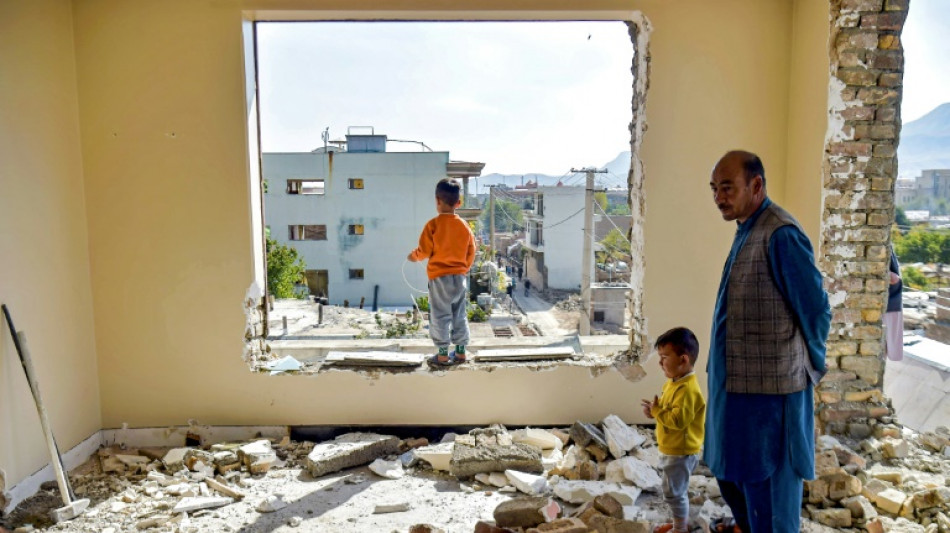
Mohammed Naeem knew the Kabul street where he and his brothers built matching apartment buildings was too narrow, but he was still in disbelief as their homes were reduced to rubble to widen the road.
He had received notice 10 days earlier that he would have to destroy three-quarters of his building immediately, one of thousands affected by road development works spearheaded in Kabul by the Taliban authorities since they swept to power in 2021.
Afghanistan's largest city, Kabul has seen rapid and unruly urban development in the past decades, with side effects of snarled traffic and unregulated building.
While authorities and some residents praise the city's road improvements as long overdue, many in the country -- one of the poorest in the world -- have been devastated by the loss of homes and businesses.
"We are pleased the government is constructing the road, the country will be built up," said 45-year-old Naeem, perched on a pile of bricks in his gutted house in western Kabul, but he is desperate for the compensation the government promised.
"I'm in debt and I don't have money, otherwise I could take my children somewhere away from the dust and all the noise... I could restart my life."
Unemployed for years and having lost his tenants, Naeem and his family had no option but to stay in the shorn-off building -- even as the harsh winter approaches -- with its spacious apartments reduced to two rooms and a kitchen cordoned off by tarpaulin at the top of a broken staircase.
His toddler son, the youngest of six, swings a hammer against jagged bricks, imitating the labourers his father hired to dismantle their home of a decade.
For now, it's a game, his mother told AFP, but sometimes he asks, "Why are you breaking the house down, dad?" she said, tears in her eyes. "Will you build another one?"
- 'Approved and essential' -
Some residents told AFP they were rushed to leave, with nowhere else to go, or did not receive any support from the government.
The municipality says those whose homes and businesses were completely or partially destroyed would be compensated and given "more than enough" time to move out and find new residences.
Kabul municipality representative Nematullah Barakzai said the government had paid out two billion Afghanis (nearly $30 million) in compensation this year, with road construction accounting for more than half of 165 projects.
"If you want a city to be organised and city services to reach to everyone equally, you need a planned city... all these roads are approved and essential," Barakzai said.
While Kabul's roads are paved, they are often narrow, without traffic lights or markers, with chaotic bumper-to-bumper traffic and accidents a daily occurrence.
The Land Grabbing Prevention and Restitution Commission recovered nearly 33,000 acres of state land in Kabul in two years "from usurpers, power abusers and illegitimate descendants", justice ministry spokesman Barakatullah Rasuli told AFP.
"This process is continuing rapidly in all of Afghanistan's provinces," he said.
This month, the authorities announced work had started on a construction project to tackle population growth and lack of housing in the capital.
Widowed Najiba -- not her real name -- lost all but one of the eight rooms of the mud-brick home she built for herself and her four children to road expansion.
After a year and a half she has not received compensation, she said.
"I want either that they give me my money or new land so I could build a house, I don't have anything else," she told AFP.
"They say these lands belong to the government, if it was government land they should have told us at first."
- Most vulnerable -
Some residents have praised the demolition of homes belonging to former warlords that had blocked roads in central Kabul since a construction boom after the end of the first Taliban rule in 2001.
The removal of barriers and opening of the street at the US embassy, closed after the Taliban's return to power, has also been met with approval.
But the most vulnerable people have been the hardest hit by the clearances, such as the many internally displaced by Afghanistan's decades of war, non-governmental groups said.
Sources familiar with the Kabul evictions told AFP 3,515 families were forced from their homes between April and October when seven informal settlements were demolished to make way for development plans, 70 percent of them dispersing around Kabul.
In June, the Norwegian Refugee Council (NRC) reported that around 6,000 people became homeless when authorities demolished internally displaced people's settlements in the capital and called for evictions to halt "until legal safeguards, due process, and the provision of alternative housing are in place".
E.Lau--ThChM