Mayotte faces environment, biodiversity crisis after cyclone / Photo: © AFP

Mayotte has changed beyond recognition since a cyclone devastated the Indian Ocean territory, sparking an environment and biodiversity crisis that could last for a decade or more, scientists say.
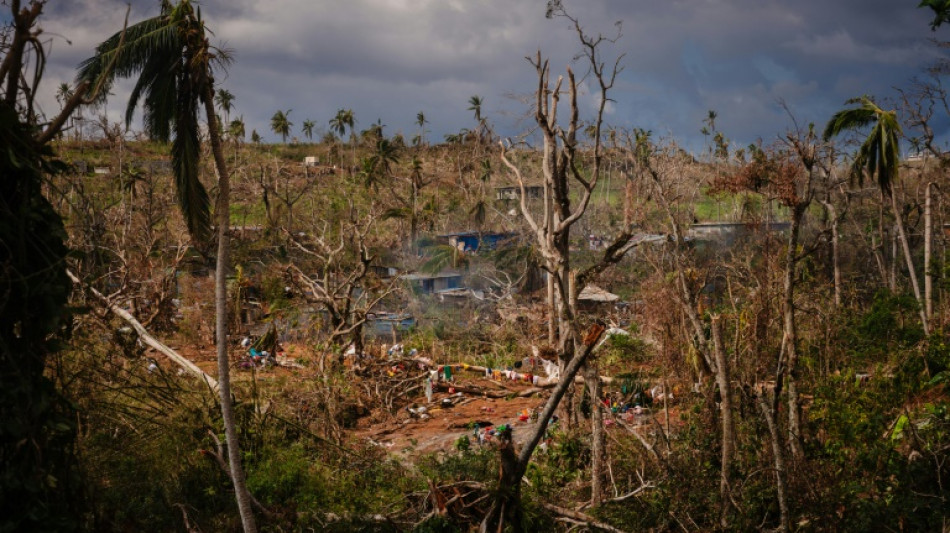
After barrelling into the archipelago at 200 kilometres per hour (125 mph), Cyclone Chido left behind scenes of desolation: Trees mowed down as far as the eye can see, sturdy tree trunks blown apart as if struck by mortars, the previous green of the foliage replaced by a sad brown.
"It's an environmental disaster," said Raima Fadul, a biologist. "There are no more trees. Those still standing have lost their tops... The cyclone flattened the vegetation."
A gigantic baobab over 300 years old collapsed onto a restaurant. Part of the mangrove is now completely bare and black. A three-metre (10-feet) earth mound looms where an acacia tree, half a century old, was uprooted by the violent storm.
One effect of the vegetation's sudden disappearance is that Mayotte's slums, formerly hidden by lush greenery, are now starkly apparent, making visible their number, and their sprawl.
- 'We never realised' -
"All we saw before were mango trees, coconut trees and a forest," said Rouchdat Mourchidi, an education counselor checking on what remains of a family plot on the island's heights. "We never realised there were metal shacks there because they were hidden in vegetation."
Trees have always played the crucial role of channelling rain and slowing down potential floods. Now that they are gone, any torrential downpour will wash soil into the lagoon below, covering the seabed in mud.
As a result, part of the lagoon's coral reef will be killed off, said Fadul, leading to the loss of some of the 300 species of fish, corals, vertebrates and mollusks present in the reef's ecosystem.
On land, wildlife is already suffering from the loss of forest cover. Small dark lemurs called makis are now being spotted increasingly in urban areas where they come in search of food, and where they will probably die.
Bats, pollinators with an important role to play in future reforestation, are also becoming rarer after losing their nesting spots in trees.
There are also grave concerns for lizards, insects and flowering plants that used to proliferate on Mayotte.
- 'In 10 years' time' -
One ray of hope is that Mayotte's tropical climate will help accelerate future tree growth, said Benoit Loussier, regional director of the National Forestry Office.
"In 10 years' time, plantations may have restored a forest cover" of eight metres (26 feet) high, he said.
But this can happen only if the population resists the obvious temptation to convert destroyed forest zones into farmland.
This illegal activity was already in evidence before the cyclone, notably due to desperately poor illegal immigrants practicing subsistence farming.
In 2020, the International Union for Conservation of Nature estimated that 6.7 percent of Mayotte's woodland had been cleared between 2011 and 2016, a deforestation proportion comparable to that seen in Argentina or Indonesia.
The risk of illicit replanting is all the more acute as crops were also destroyed by Cyclone Chido.
Another looming risk is "subsistence poaching" of turtles, warned Lamya Essemlali at Sea Shepherd, a wildlife preservation NGO, as Mayotte's poorest go hungry while food aid is still slow to arrive.
Officially Mayotte has 320,000 inhabitants -- with unregistered undocumented migrants probably adding another 100,000 -- packed into a territory of 374 square kilometres (144 square miles), resulting in a population density eight times that of mainland France.
The median income in Mayotte is 260 euros ($271) a month, according to the national statistics institute Insee, six times less than in mainland France.
Y.Parker--ThChM