Cocaine Canyon: Inside Colombia's guerrilla-run micro-state / Photo: © AFP

Drug-running guerrillas have repelled military efforts to retake a slice of southwest Colombia -- a virtual microstate where the rifle rules.
No one enters or leaves without the guerrillas' say-so, state-issued IDs are worthless and cocaine production is not just tolerated, but encouraged.
Welcome to Micay Canyon, a lush mountain-fringed valley in southwest Colombia where the self-styled Estado Mayor Central (Central General Staff) are the law.
On dirt roads leading into the valley, rifle-wielding rebels -- some in camouflage, some in civilian clothes -- stop every bike, car or truck trying to enter.
The men at the checkpoints demand to see a rebel-issued ID card, which must be renewed every year and also serves as an entry permit.
Outsiders are rarely allowed access. But once through the barricades, Micay has the trappings of a state within a state.
Residents pay $17 a year for access to ambulance care. Miners pay a cut of their illicit profits to local committees. Sex workers must get rebel-mandated health checks.
There are no police to be seen and no evidence of government-run schools, hospitals or municipal services.
In October, Colombian President Gustavo Petro launched Operation Persius to retake control of the area and capture EMC leaders.
Their grip on Micay had become a direct challenge to the primacy of the state, a symbol of Petro's failed promises to bring peace, and a security threat to a UN climate summit happening in nearby Cali.
But Operation Persius suffered a series of humiliating and deadly setbacks.
On Saturday, AFP reporters inside EMC territory witnessed 28 captured police and one soldier being marched out of the territory under a hail of abuse.
"Get out!" a furious mob shouted as the captives walked with heads bowed.
Among them was Army Major Nilson Bedoya.
"I'm thinking of my family, my wife, my son Nicolas. They are waiting for me at home," he said testily amid the jeers.
On Tuesday, five soldiers were killed by a bomb buried in a road embankment.
They had been trying to reinstall a bridge destroyed by rebels.
- 'Bringing war instead' -
Life in Micay Canyon is dangerous and expensive, and poverty is pervasive -- despite being a center for one of the world's most lucrative crops.
Locals quietly express unease about both the government and the rebels.
"We are scared, fearful, desperate, hopeless, and sad. That is what we feel in our hearts," a 67-year-old, who asked for anonymity for fear of reprisals, told AFP.
The guerrillas have convinced many that government troops will burn down homes and spray the coca crop, leaving them with no work and no income.
In reality, Petro's government has sworn off forced coca eradication.
But the midnight din of military flights followed by booming explosions does little to convince locals that the state is friendly.
Some locals, speaking in hushed tones, wearily confess that they have been ordered by the guerrillas to confront and help expel the military.
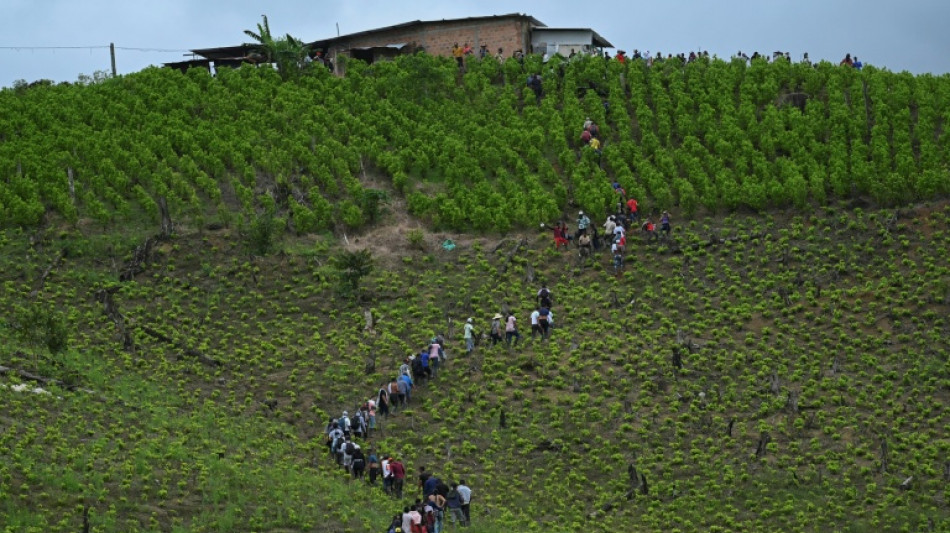
AFP reporters witnessed swaths of empty coca fields, with workers redeployed to drive the army out of two nearby areas.
Scores of locals were seen confronting a group of soldiers, shouting at them to leave the area.
Outnumbered and not willing to shoot unarmed civilians, the soldiers were forced to retreat.
There is deep disillusion with the government and Petro in particular.
A former guerrilla himself, Petro won 81 percent of the votes in the broader province surrounding Micay.
"It was supposed to be the government of change, and look at how it attacks us, bringing war instead," said one 37-year-old coca harvester.
Petro claims that the locals are being "instrumentalized" by armed groups.
For researcher Juana Cabezas of the NGO Indepaz, "Colombia has not returned to the old days" of a decades-long conflict that killed hundreds of thousands across the country.
But since the main guerrilla group, the FARC, disbanded in 2017 there has been a fracturing and reconfiguration of armed groups.
For residents in Micay Canyon, those hopes for peace are a distant memory.
"Our dreams are dashed," says one woman, widowed after her husband's murder.
"The only thing left for us is death."
E.Lau--ThChM