'We will preserve them': saving Cambodia's crocodiles / Photo: © Fauna and Flora/AFP

A motorbike rider inches slowly over bumpy terrain deep in Cambodia's Virachey national park, carefully adjusting the basket strapped behind him. Inside is precious cargo -- a critically endangered Siamese crocodile.
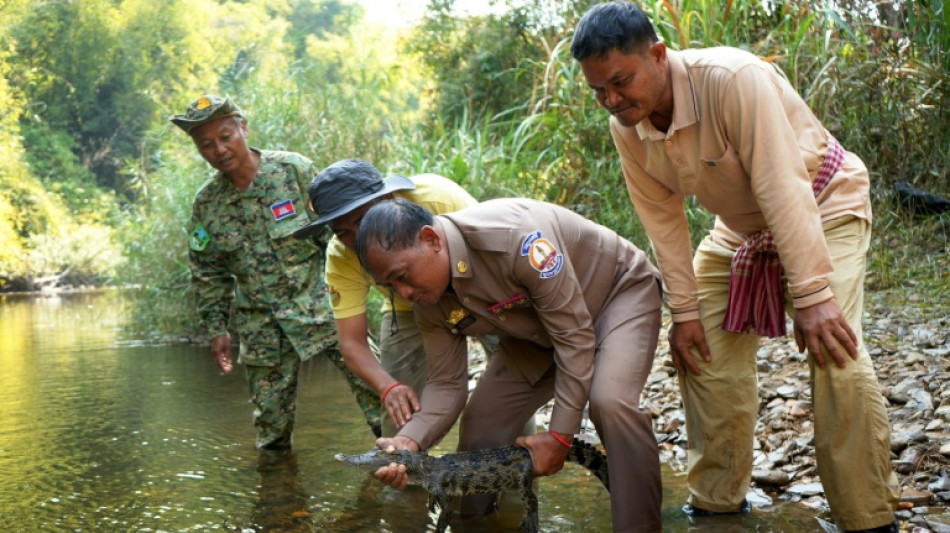
The reptile is one of 10 being released into the park in Cambodia's northeast for the first time -- part of a years-long effort that has brought the Siamese crocodile back from the brink of extinction in the wild.
"Often what we see is species are declining, species are disappearing," said Pablo Sinovas, Cambodia country director for the Fauna & Flora conservation group, which has led the conservation programme.
"In this case, we are seeing actually that the species seems to be recovering."
The crocodile, which can grow up to four metres (13 feet) long, is distinguished by dragon-like bony crests behind each eye.
Just 25 years ago, experts feared that the Siamese crocodile might no longer exist outside zoos and the crocodile farms that helped decimate its population.
But in 2000, a biodiversity survey led by Fauna & Flora uncovered a small number in the remote Cardamom Mountains in southwest Cambodia, kicking off a conservation effort that has given the species a 400-strong foothold in the country.
Discoveries and conservation elsewhere mean there are now up to 1,000 Siamese crocodiles in the wild globally, though in just one percent of its former range.
Cambodia has been central to that success, said crocodile expert Charlie Manolis, chief scientist at Wildlife Management International in Australia.
"There's an opportunity in Cambodia," he said, explaining that, unlike neighbouring Thailand and Vietnam, there are still "large tracts" of protected land.
- 'Best possible headstart' -
Key to Cambodia's effort is a programme to help the species -- which was once found all over Southeast Asia -- breed more successfully.
In the wild, fragmented populations might struggle to find a mate, and both eggs and juvenile offspring are vulnerable to predators.
For every 50 or so born in the wild, perhaps as few as three survive, said Joe Rose, captive breeding officer at the Phnom Tamao facility outside Phnom Penh.
"Breeding within a facility like this, we can ensure a 100 percent survival rate from hatchlings... and healthy young crocodiles to take out and release, to give them the best possible headstart", Rose said.
There are around 200 crocodiles at the facility at any one time, including 50 breeding adults, who produced nearly 200 eggs last year.
Eggs are taken into incubators, and hatchlings are raised in enclosures with progressive exposure to the fish and frogs they will one day catch in the wild.
After several years, they are ready for release.
Until now, that has meant heading to the Cardamom Mountains, where last year 60 crocodiles were recorded hatching in the wild -- the highest number in a century.
The growing population holds promise not just for the species but for its broader environment too.
Crocodiles are top predators which regulate their ecosystems, and there is evidence that fish diversity is higher in the rivers they inhabit.
The conservation effort's growing success has bred a need for new habitats, a challenge given that crocodiles need space, prey and enough distance away from humans to minimise conflict.
Virachey's rugged, remote terrain makes it ideal, with relatively untouched plant and animal life, and few residents.
"It's essentially protected mostly by the remoteness," said Sinovas.
- Ultrasound 'pings' -
Releasing the crocodiles into a new environment is still risky.
They could face predators or struggle to feed themselves -- and tracking their progress can be difficult and expensive.
"Often reintroduction programmes with crocodilians, you sort of hurl them all out there, and then everybody sort of walks away and hopes that they live and grow," said Manolis.
But Fauna & Flora will keep tabs using acoustic monitors, inspired by lessons from Australian crocodile conservation efforts.
In Phnom Tamao, each of the 10 crocodiles is fitted with a thimble-sized transmitter, placed beneath their dappled scaly skin.
These send ultrasound "pings" every time the creatures pass receivers placed along a 10-kilometre stretch of their new river home in Virachey.
The data will be recorded for several months and then collected and analysed for clues on the programme's success.
Reaching their new home was no easy task for the reptiles.
First, there was 18 hours of travel in cylindrical bamboo baskets transported by car, motorbike and boat. Next, they acclimatised in a temporary enclosure.
Receivers were installed and checked, and then it was time.
Electrical tape that had been wound around their snouts to prevent snapping was peeled away, and each creature was gradually lowered into the water.
They quickly splashed away, carrying great hopes on their scaly shoulders.
Conservationists credit part of their success to cooperation with local communities, who have protected crocodiles in the Cardamoms and helped document new hatchlings.
For Choub Srak Er, a resident and ranger at Virachey, the reptiles offer hope.
"These crocodiles disappeared a long time ago," he said. "We are so happy, we will preserve them together."
U.Feng--ThChM