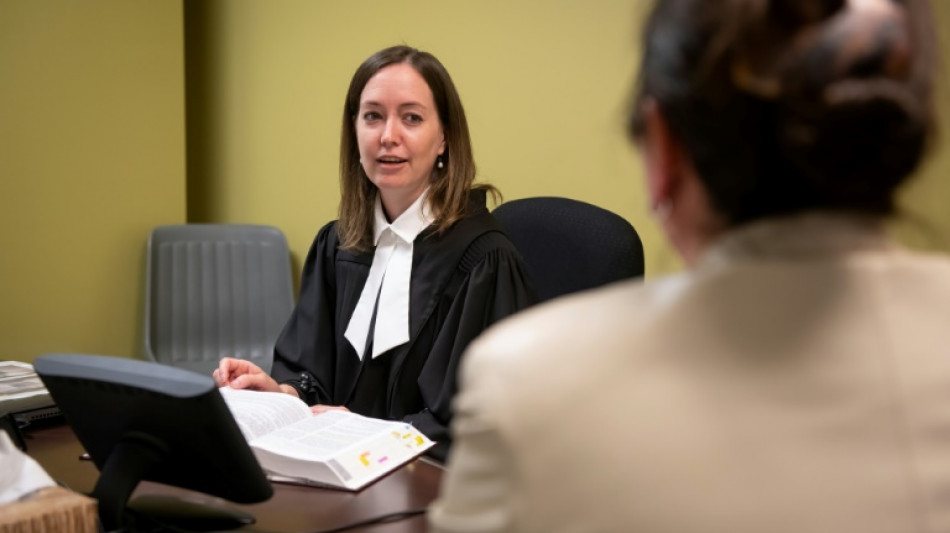
In Canada's Quebec, a new way to prosecute domestic and sexual assault / Photo: © AFP

Five years after the #MeToo movement sent shockwaves around the world with tales of unreported sexual harassment and assault, Canada's Quebec province is moving to ensure victims are heard in court.
The largely French-speaking province is working to set up the world's first specialized court for cases of sexual violence and domestic abuse, which experts hope will help build confidence that the legal system is not turning a blind eye to such incidents.
"Today, women are afraid they will not be believed. They are afraid of the questions they will face, and the curt nature of the attorneys interrogating them," says Julie Desrosiers, the co-chair of a committee of experts tasked with looking at the issue.
"Women must be reassured that they will not be hurt again during the legal process," said the law professor, who added that "the law must support changes afoot in society."
The US defamation case that pitted actor Johnny Depp against his ex-wife Amber Heard -- which aired sordid accusations of abuse from both sides -- has highlighted the issue once again, as Heard faced rampant online harassment over her claims.
Many experts feared the verdict, which was largely in Depp's favor, would serve to keep women from making formal accusations against their partners.
In Quebec, the process of change began in 2018, when a small bipartisan group of women politicians decided to attack what they called a systemic problem.
"After MeToo, I asked myself what we could do as elected officials, what concrete actions we could take," said Veronique Hivon, a provincial lawmaker from the independence-minded Parti Quebecois.
The experts' committee was put in place: they interviewed dozens of victims of sexual violence about their experiences in court, as well as judges, lawyers, police officers and social workers.
Their December 2020 report said trust needed to be rebuilt, and the group made about 190 recommendations for how complaints could be better handled, including the creation of a specialized court.
A little less than a year later, the Quebec legislature unanimously voted for create the judicial body.
- 'Strong message' -
The court is still in its nascent phases but its founders have a sprawling vision of what it could become: they hope it will employ more prosecutors to look at cases of sexual violence, have more funding for investigations and training for cops and judges.
Organizers also hope to be able to provide assistance to victims throughout the process, with the end goal being to ensure that the legal system no longer resembles an "obstacle course" for accusers.
"With the creation of this specialized tribunal, we are sending a strong message, a collective message: these crimes no longer have a place in our society," Quebec's provincial justice minister Simon Jolin-Barrette told AFP.
But that is no small task, given that as in numerous other countries, sexual assault remains underreported in Quebec -- it is in fact one of the least reported crimes in the province.
Only five percent of victims end up filing a formal complaint, even though there is no statute of limitations on such cases in Canada.
Of the few who have pursued their attackers, many say they have regrets.
"I understand it's a good thing for society that I filed suit, that I went through with the process to the end," Juliette Brault, who was assaulted at the age of 19, told AFP.
"However, despite the conviction of my attacker, I regret doing it. If I had to do it over, I would not have filed a complaint and I would not wish for anyone to live through what I experienced," she said, calling her trial a "very painful, violent" time.
- 'I couldn't breathe' -
Brault -- a former elite athlete who is now 24 and runs a day care center -- remembers that she initially thought filing the complaint would be the hardest thing she had to do.
"In the first police station where I went months after I was assaulted, the officer wanted to take my complaint in the middle of the office, in front of everyone. I left and it took me months to find the strength to go to another station," she recalled.
But then when Brault was cross-examined by her attacker's attorney, "I was crying so much that I couldn't breathe. I felt like a run-of-the-mill witness, with no one taking my condition into account," she said.
Many victims say the legal process forces them to relive their trauma in a searing way.
Lea Clermont-Dion, who was the victim of a sexual assault as a minor and made a documentary about her experience called "You just have to file a complaint," says she was "revictimized" during three days of questioning by lawyers for her attacker.
"For too many years, victims were mistreated by the legal system," says Clermont-Dion, who is now 31.
During questioning, she says, "I really felt at one point like I was the accused, that I was the attacker. The feeling of guilt is completely made worse by these interrogations," she added.
For Clermont-Dion, training will be key to the success of the new court, which officials hope will be up and running across the province within five years, including in Salaberry-de-Valleyfield, about an hour's drive south of Montreal.
She says everyone involved in the process needs to understand the concepts that arise in cases of sexual violence, including the idea that a victim could fall prey to the undue influence of a boss or another authority figure.
Indeed, training is already under way. Ten courts have been chosen for the initial pilot project for the special court, for a period of three years. The ultimate goal is to have a specialized court in each courthouse in the province.
In Salaberry-de-Valleyfield, the courthouse is being renovated to feature separate waiting rooms for victims of sexual assault, where they can meet with psychologists and social workers.
Separate entrances are being built so they do not bump into their accusers in the hallways, and screens are being put up in courtrooms and teleconference rooms so that victims can testify without having to look at their attackers.
- 'Scourge' -
For Elizabeth Pilote of the Center to Help Victims of Crimes, "clearly the biggest fear victims have is to be in the same room as the accused."
Having people from the center to provide assistance to victims from the moment they file their complaints could help "improve the response to victims' questions about each step of the process," says Pilote.
The chief prosecutor in Salaberry-de-Valleyfield, Pierre-Olivier Gagnon -- who is coordinating the implementation of the pilot project -- says in order to combat the "scourge" of sexual violence and domestic abuse, the justice system "must adapt."
Two countries have already tried to create special tribunals for cases of sexual violence: New Zealand and South Africa. As for domestic abuse, those courts exist in multiple forms, and already are in place in some Canadian provinces.
But Quebec is attempting to merge the two types of cases in one tribunal; officials argue that both stem from a patriarchal view of society -- and women are the primary victims.
Not everyone is on board for the experiment: some in legal circles say that creating a special court could result in an infringement on the presumption of innocence for any defendant, and could even affect the impartiality of the proceedings.
Jolin-Barrette counters that "the rules of the law remain the same."
"What we're doing is simply to make the legal process much more humane and victim-focused."
For Elisabeth Corte, who co-chaired the experts' committee with Desrosiers and is a former chief judge in Quebec, "improving trust will require us to say and explain exactly what we are doing."
In order to eradicate the dysfunctional nature of the old system, it's time to "grab people's attention," Corte says.
J.Liv--ThChM