Trump's global tariffs to face challenge before Supreme Court / Photo: © AFP/File

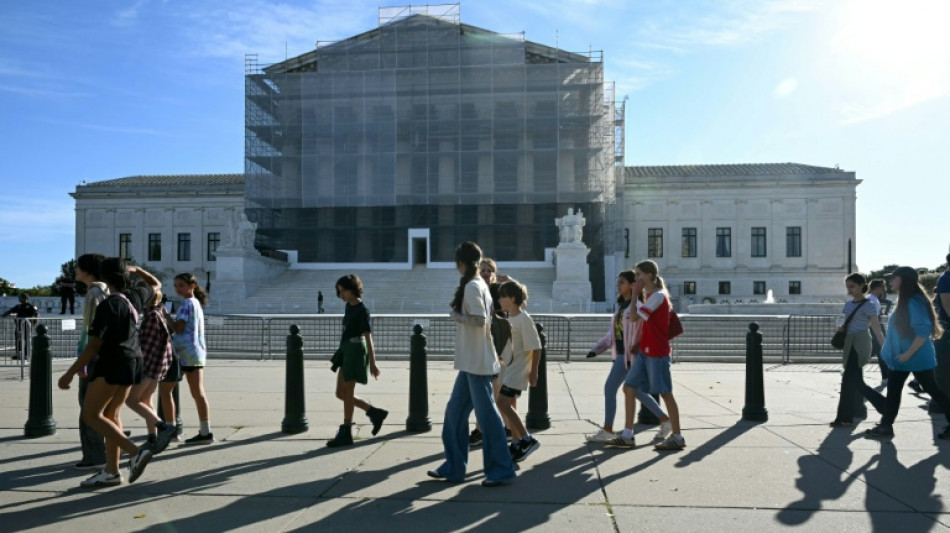
The US Supreme Court is set to hear arguments Wednesday on the legality of Donald Trump's unprecedented use of powers for sweeping global tariffs in a case striking at the heart of the president's economic agenda.
Since returning to the White House, Trump has invoked emergency economic powers to impose "reciprocal" tariffs over trade practices Washington deemed unfair, alongside separate duties targeting his country's biggest trading partners: Mexico, Canada and China.
But these tariffs, a key prong of his "America First" trade policy aimed at protecting and boosting US industries, swiftly faced legal challenges.
A lower court ruled in May that Trump exceeded his authority in imposing the duties, although the administration's appeal allowed them to temporarily stay in place.
The US Court of Appeals for the Federal Circuit ruled 7-4 in August that the levies were illegal -- affirming the lower court's finding -- prompting Trump to take the fight to the Supreme Court.
The top court's decision will have major ramifications, but this could take months.
The conservative-majority Supreme Court could find the tariffs illegal, blocking duties imposed on goods from countries worldwide. Or judges could affirm Trump's actions, opening the door to further levies.
Also at stake are billions of dollars in customs revenue already collected and Trump's efforts to leverage tariffs for favorable trade deals -- or other political priorities.
The Supreme Court's ruling, however, would not directly affect sector-specific tariffs Trump imposed, including on steel, aluminum and automobiles.
But even as Trump's tariffs have not sparked widespread inflation, US companies -- especially small businesses -- say they are bearing the brunt of additional costs.
- Existential threat -
"These tariffs threaten the very existence of small businesses like mine, making it difficult to survive, let alone grow," said Victor Schwartz, a lead plaintiff in this week's hearing.
"I was shocked that those with much more power and money did not step up," added Schwartz, the founder of a family-run New York wine company called VOS Selections.
Pointing to Trump's fast-changing tariff policies, Schwartz told reporters ahead of the hearing that small firms were "gambling with our livelihoods, trying to predict the unpredictable" as they set retail prices and stocked up on inventory.
Another New York-based business owner, Mike Gracie, who imports hand-painted wallpaper from China, said Trump's steep tariffs meant "hundreds of thousands of dollars" in new costs.
As Washington and Beijing engaged in a tit-for-tat tariff fight in April, US duties rocketed to 145 percent, an added bill that Gracie had to absorb.
"We didn't want to risk our business by raising prices," he told AFP. "But we can't continue indefinitely to absorb them."
Kent Smetters of the University of Pennsylvania noted that 40 percent of US imports are intermediate goods, meaning they are not for retail consumers. He warned that maintaining tariffs means US businesses "become less competitive."
- Possible outcomes -
Ryan Majerus, a former US trade official, told AFP that besides supporting or blocking Trump's global tariffs, the court could also allow their imposition with certain limitations.
The ruling could differentiate between "reciprocal" tariffs seeking to narrow trade gaps and others imposed to crack down on fentanyl entering the United States, added Majerus, a partner at law firm King & Spalding.
Even if the top court found Trump's global tariffs illegal, the administration could tap other laws to impose 15-percent tariffs for 150 days.
In the meantime, they could pursue investigations for more "durable tariffs" like those under Section 301 of the Trade Act, Majerus said, which also allows Washington to respond to conduct deemed unfair.
Because of these options, Majerus expects partners that have negotiated tariff deals with Trump might prefer to keep those terms rather than reopen talks.
Beyond deals, Smetters said the case has bearing on wider authorities.
"If the court really allows this to happen, then the question is, what else can the administration do without congressional approval?" he asked.
"That might spook capital markets a bit more."
B.Chan--ThChM