'Water police' patrol drought-hit Los Angeles streets / Photo: © AFP

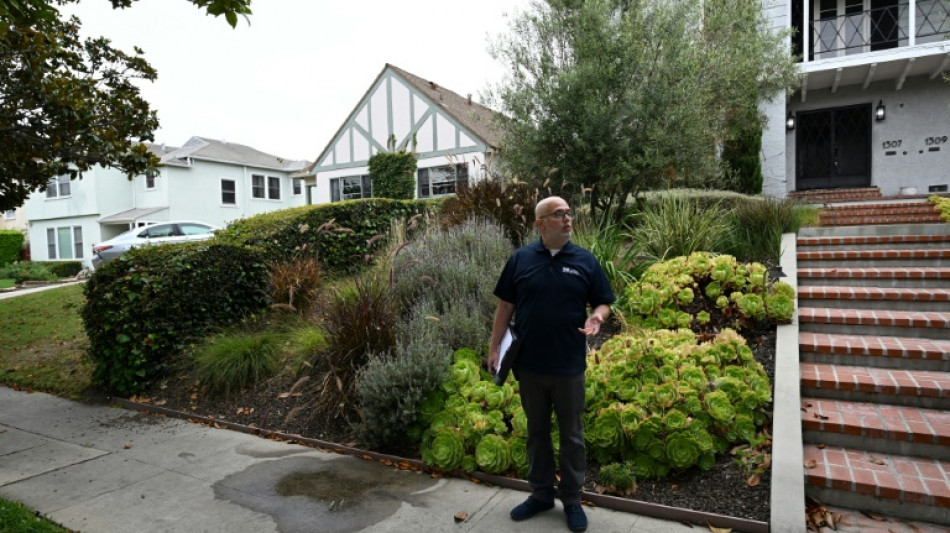
Damon Ayala patrols the streets of drought-stricken Los Angeles every day, inspecting the sidewalks. Each time he sees a puddle, he stops.
He is part of the city's Department of Water and Power team, which looks into hundreds of community complaints filed by neighbors each week about water waste.
"It's not extreme, but it's something that we want them to take a look at," he says of one pool of water.
"Looks like they have drip irrigation on this side. So there might be just a broken connector."
Ayala's patrol comes as California and the western United States are in the grip of a severe, years-long drought.
Scientists say global warming driven by human activity, including the unchecked burning of fossil fuels, is creating a greater number of extreme events.
With reservoirs and rivers at historic lows, Los Angeles authorities have brought in water restrictions, such as limiting lawn irrigation to as little as eight minutes, twice per week.
Ayala notes down the addresses of properties where he finds evidence of infringement. The first violation prompts a warning.
"A lot of times they don't know about the ordinance, and that's our job to educate them," he said.
Repeat offenders are fined between $200 and $600.
"We're not looking really for their money -- that doesn't get us more water. We're trying to get behavioral change," he said.
"So that way we can capture the water savings from making those changes."
After a fifth infraction, a device is installed which physically restricts a household's supply, although Ayala says that step has rarely been necessary.
"We've been in serious drought situations in the past in the city of Los Angeles, and its citizens responded," he said.
"And we expect them to respond this time around too."
- 'Obvious choice' -
The water department says it is beginning to see results.
Officials noted a reduction in residential water demand in June, compared to the same month last year.
But as the drought worsens, more permanent changes to the city's landscape could become necessary.
Famous for its rows of palm trees, Los Angeles has also traditionally been known for its lush, green lawns, maintained with automatic sprinklers.
Residents are increasingly replacing their thirsty lawns with plants native to this desert region.
"When we think of how much water gets used in a residential setting, over 50 per cent is actually used outdoors," said Pamela Berstler, executive director of urban landscaping firm G3 Garden Group.
She and her colleague Marianne Simon teach classes as part of a city program to encourage Angelenos to trade in their lawns for alternatives.
South Los Angeles residents Gabriel Golden and Danielle Koplinkase, joined the program a few years ago.
"The environmental impact of watering a lawn, not only in the midst of a draught but also living in a very dry climate, made this an obvious choice," they said.
"We also sought to inspire our neighbors and community by going to a drought tolerant and native garden."
Native plants such as California oak, and flowers that only require a few drops of water each week to thrive, now adorn the couple's garden.
"There are parts of southern California where they have cut the water down to one day of watering per week," said Simon.
"And the reality is that these kinds of gardens would be fine on that amount of water -- in fact, could do with less -- but our traditional lawns can't survive on that."
- 'Short-sighted' -
Other popular alternatives include artificial lawns or gravel, although Simon stresses the environmental benefits of maintaining some form of vegetation.
"The problem is that we are so short-sighted and so narrow in our vision that all we can see is saving the water," she said.
A planted area can be cooler by "easily 20 degrees" Fahrenheit (10 degrees Celsius) than a gravel replacement, and "there's the ability to hold on to rain when we do get it so that we can replenish aquifers."
As she speaks, a nearby sprinkler turns on under the blazing California sun, spraying a lawn during prohibited hours.
With the thermometer hovering around 97 degrees F, water falling on the wilted, uneven grass and trickling down the sidewalk evaporates within minutes.
"It's heartbreaking to see, but it's also a lesson," she said, pointing to the withered garden.
"That should be our past and this should be our future," Simon added, looking back at the native plants.
F.Jackson--ThChM