Ukraine's lost generation caught in 'eternal lockdown' / Photo: © AFP

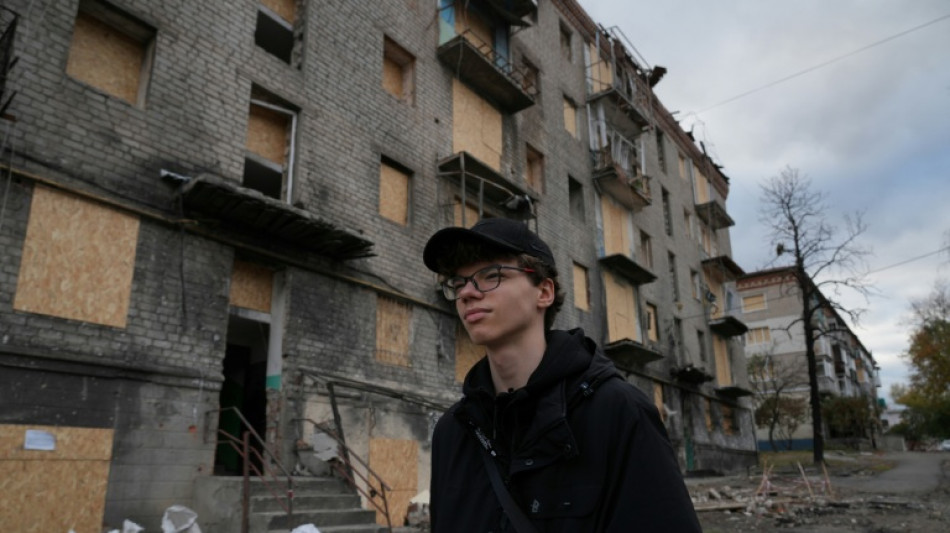
With his shadow of a moustache and baseball cap, Bohdan Levchykov would be your typical teenager anywhere if he didn't embody the tragedy of what has happened to a generation of young Ukrainians after nearly four years of war.
His father Stanislav, a career soldier, was killed defending the country's second city Kharkiv just weeks after Russia invaded in 2022. On top of all they have been through, his mother Iryna, 50, was recently diagnosed with stage-three cancer of the uterus.
Bohdan no longer knows anyone his age in his battered hometown of Balakliia, which was occupied by the Russian army from March to September 2022. It was later retaken by Ukrainian forces, but being only 70 kilometres (43 miles) from the front, is still regularly shelled.
"My mother and I came back a few days after the city was liberated, and there were no children left, no shops open, nothing," he recalled. Only a fraction of the pre-war population of 26,000 have trickled back, and most of them are old.
The skate park and the banks of the Balakliika River where young people used to hang out were mined by the Russians. They have been demined since, "but rumour has it it's still not safe," the 15-year-old said.
All Bohdan's schooling is online, his days punctuated by air raid alerts. The nine flights of stairs down to the basement is more than his sick mother can manage, so they lay a mattress in the small entry to their apartment, the only room without a window. "We've gotten used to getting by on our own. We're a tight team," Bohdan smiled.
"It's not just Bohdan. All the children adapted so quickly," his mother said. "This generation -- I don't know what to make of them..."
She is not the only one to wonder what the war has done to Ukraine's children.
Nearly a million young Ukrainians are still living in an eternal lockdown, doing either all or part of their lessons online. First there was the pandemic in March 2020, then the invasion -- six years of spending most of their time in front of the family computer to study and unwind.
This isolation is particularly felt in the Kharkiv region bordering Russia, which is the target of daily attacks.
A few bars and restaurants stay open until the 11 pm curfew before night brings the inevitable Russian drone and missile attacks. Mornings echo with the sound of volunteer teams repairing whatever can be salvaged.
Some 843 educational establishments have been either destroyed or damaged in the region -- a fifth of the national toll, according to the Ukrainian government's saveschools.in.ua. site.
The online investigative site Bellingcat -- with whom AFP journalists in Kyiv and Paris worked on this special report -- has logged more than 100 video or photo testimonies on social media of Russian strikes on or close to educational institutions or youth leisure facilities in and around Kharkiv.
Children in tears were evacuated when a city centre daycare was hit on October 22. "We're going to find your mother right away," a rescuer told a little girl he was carrying out of the smoke and debris, according to police footage.
- Underground schools -
More and more children are going to underground schools in the city. Yevenhelina Tuturiko has been attending one since September, several metres below the street with no natural light.
"I really love it," the lanky 14-year-old said, "because I can talk in person with my classmates again."
Ironically, Yevenhelina had to cross Europe to "meet most of my current friends" in Kharkiv after being invited on a "respite trip" organised by the city of Lille in northern France to give Ukrainian kids a taste of normality.
Kharkiv will have 10 underground schools open by the end of the year, the city hall said.
Priority is given to classes where most of the children remained in Kharkiv during the heaviest of the fighting at the start of the invasion, when Russian forces pushed into the suburbs of the city. Some 70 percent of the city's children were evacuated at one time or another, either abroad or to the west of Ukraine.
The children spend only half their school day in the bunkers to make room for others, finishing their classes online.
The school AFP visited was built to nuclear shelter standards, with a heavy armoured door. "We are probably one of the safest shelters in all of Ukraine," its principal Natalia Teplova said proudly.
- 'Children going mad' -
All outdoor school sports are banned in the Kharkiv region for fear of Russian strikes. But outside school it's a little more hazy.
"Official competitions are banned, but we're not state-run, so we make do on our own," said football coach and former soldier Oleksandr Andrushchenko as he roared on his young players.
The handful of well-wrapped up parents on the sidelines "understand that their children haven't developed at all (athletically) since the Covid years. And that it's better for them to play football... than stay glued to their phones," he said.
Inside Kharkiv's largest swimming pool complex, educator Ayuna Morozova agrees: "You can't live in constant fear."
The huge Soviet-era brutalist building shut after being hit in two heavy strikes in March 2022, then reopened in May 2024. Now when windows are blown out from the shock waves of nearby bombing, they are just boarded up with plywood or plastic.
"Water and swimming cure everything," Morozova firmly believes. "First two years of Covid, then four years of war -- children are going mad," she said. The complex is now also home to a water therapy space for amputee soldiers.
With her flame-red hair and warm manner, Ayuna lives up to her Tatar-origin first name, which means "Great Bear". But like almost everyone AFP met, the wounds of war surface quickly. She was buried under rubble after an airstrike on a public building in 2022. "I still have nightmares," she said. "I avoid confined spaces and lifts. And yes, I did see a psychologist."
Ukraine lacks the resources to measure the war's impact on the young.
"We don't have enough psychologists," admitted Oksana Zbitneva, head of the government's coordination centre for mental health. To try to make up for that, "130,000 frontline health professionals -- nurses, paediatricians, family doctors -- have received World Health Organization-certified training in mental health," she said.
While "some countries have been building their (mental health) systems for 50 years, we were the last to get started because of our Soviet legacy," she added.
The government has opened 326 "resilience centres" for children and parents across the country, and "300 more" should be built next year, according to Social Affairs Minister Denys Ulyutyn.
- Self-harm -
When AFP met psychologist Maryna Dudnyk amid the sunflower fields of Khorosheve, 15 kilometres south of Kharkiv, she had just led three hours of play workshops with around 50 children aged six to 11 to help them express their feelings.
As her team packed away the bulletproof vests -- security protocol demands they bring them -- she said "the war has had a huge impact on the emotional state of young people, we all live under stress."
In her consulting room, she hears "a lot of fear and anxiety in children... Teenagers suffer from self-harm, from suicidal thoughts."
Dudnyk, 50, who works for the Ukrainian NGO "Voices of Children", also carries her own wounds -- fleeing from her hometown Mariupol, which was occupied by the Russian army after a brutal siege. "We no longer have a home, nothing. Everything was destroyed."
Some teenagers have grown a kind of emotional armour. Illia Issaiev hated it when his family fled the fighting by crossing over into Russia. The months they spent there before returning made him even more of a Ukrainian nationalist.
The lean 18-year-old with steel-blue eyes claims to be a Kharkiv leader of the ultra-nationalist group Prav Molod ("The Right Youth").
We met him as he trained a group of young men in handling military drones, his speciality. "Hard times make people stronger. Our era is producing strong people who will build a good country," he declared.
It's not so simple for Kostiantyn Kosik, who is on medication for his tics, faintness and migraines. "I'm constantly nervous, on edge. It's because of the war. It has a huge effect on my health," said the bearded 18-year-old, who was dressed in black.
Kostiantyn is from the Donetsk region, which has been ravaged by fighting since a Russia-backed separatist revolt in 2014. He grew up in Avdiivka, a martyr city now in ruins which fell under Russian control after months of grinding battles.
"I have known war since the age of six. At first it was very interesting for a little boy -- the tanks, soldiers, automatic weapons. When I was old enough to understand, it became much less fun," he said.
He spent weeks sheltering in the basement of his house as it was rattled by explosions, all the neighbours gone.
"In one way it toughened me. But I would have preferred a normal childhood, with friends, with joy," he said, his room decorated with a large painting of his hometown.
- 'They continue to dream' -
Like most of the nearly four million displaced people within Ukraine, Kostiantyn's family are just about hanging on. They rent a house with no heating in Irpin near Kyiv. Kostiantyn's mother spends her days caring for his bedridden stepfather who has had a series of heart attacks linked to the conflict.
Kostiantyn is proud to be studying international law at Irpin University and -- despite his broken English -- wants to be able to work "protecting human rights, in Ukraine and elsewhere in the world".
Researchers for the WHO who questioned 24,000 young Ukrainians from 11 to 17 at the end of 2023 found a "deterioration in the psychological wellbeing" and "significant" decrease in the happiness they felt.
But there was also a "fairly high level of resilience... to wartime adversity".
So much so that a UNICEF study in August reported that exams were more a source of stress to them than air raid sirens, which "worryingly suggest that war has become part of everyday life for many children."
"Children have lost their parents, their friends and are sleeping in air raid shelters," said Social Affairs Minister Ulyutyn. "And yet they continue to live, to dream."
When Bohdan, the teenager from Balakliia, is not drawing he plays and chats with his "new friends", all online. He spends a lot of time chatting with a girl called Lana, with whom "he has many things in common".
Bohdan also has a dream. "I really want to meet up with Lana. I talked to my mother about it. Maybe our parents can arrange something." But Lana lives in Dnipro, more than 400 kilometres to the southeast, another world in wartime Ukraine.
In the meantime, Balakliia suffered another strike that killed three people on November 17, 300 metres from Bohdan's building.
P.Ho--ThChM