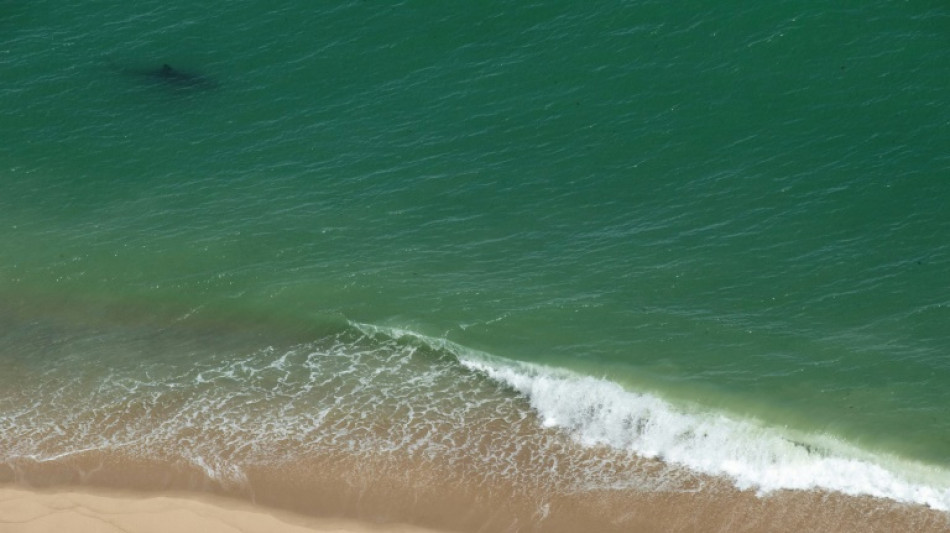
Why shark encounters are increasing along the US East Coast / Photo: © AFP/File

Sun lotion, insect repellant, and the Sharktivity app are this summer's must-have beach accessories along the US East Coast as human-shark encounters increase.
Ironically, conservation wins for vulnerable species might be behind the unfortunate uptick, say experts, while there might also be a link to climate as the apex predators' prey move to new waters.
Every summer, great whites move up the Atlantic coast of the United States, toward New England, their number peaking between August and October.
"There's a general increase in the population that we think is the population rebounding after being protected," Gregory Skomal, a senior fisheries scientist for the state of Massachusetts, told AFP.
Around 300 of the animals, the world's largest known fish, have been tagged over the years, with roughly a hundred or so passing through the waters around Cape Cod every year.
The iconic movie "Jaws" was shot in this region, and the creatures are a major tourism draw, adorning baseball caps and t-shirts. On the flipside, however, there have already been temporary beach closures this year after confirmed sightings close to shore.
A major part of the reason is their main prey, seals, are also rebounding thanks to increased protections.
"If you have more sharks feeding close to land and you have more people swimming, the chances for those kinds of negative interactions increases," said Skomal.
Enter the Atlantic White Shark Conservancy Sharktivity app, which was developed with input from Massachusetts wildlife officials to provide information on shark sightings from researchers, safety officials, and user reports.
- Surveillance patrols -
In New York state, the governor has just announced additional surveillance patrols, including via drones and helicopters.
On the tourist beaches of Long Island, half a dozen shark bites have already come to light, after three years of none at all.
Here, great whites are less likely to be the culprits than other species of shark that operate in the region, in particular tiger sharks, sand tiger sharks and bull sharks.
Nick Whitney, a senior scientist at the New England Aquarium, believes the increasing encounters here might be linked to the sharks' bait fish -- menhaden, also known as porgies or bunkers, recovering.
This might be because of cleaner waters off New York and New Jersey, "but it's tricky to figure out how much of it is increasing populations or just populations moving around as a result of changing ocean conditions from climate change."
But if things can thus vary greatly from one year to another on a local level, the global level remains steady at around 75 shark attacks recorded each year, said Gavin Naylor, director of a research program on sharks at the University of Florida.
This follows a brief drop to around 60 during the two first years of the Covid-19 pandemic.
Annual global deaths are around five. In the past twenty years, only two deaths have been reported north of Delaware in the United States, in Cape Cod in 2018, and in Maine in 2020.
But in the future, it is reasonable to think that the number of victims will increase.
"We are going to get more fatalities. There's more white sharks, the probability is going to increase," predicts Naylor, even though the trend isn't yet statistically significant.
Surfers, who venture farther into the water, accounted for half of unprovoked attacks in 2021. Farther south, Florida, with its many tourist beaches and tropical climate, is still where 60 percent of US and 40 percent of world attacks occur.
- Take precautions -
Sharks are far from the bloodthirsty beasts sometimes portrayed in movies.
Studies have shown that they can mistake surfers or swimmers for their usual prey -- notably white sharks, which have rather poor eyesight.
"With so many people on a global scale in the water, if sharks preferred to feed on prey upon humans, we would have tens of thousands of attacks each year," said Skomal.
With climate change, the expert expects that the increase in ocean temperatures will gradually lengthen the season during which sharks are present in the northern United States.
So what can be done to limit the risks? People should download the Sharktivity app to track sightings.
"Another thing we tell people is just to be aware of your surroundings," said Whitney. Look around for birds flying around schools of baitfish, for example.
Don't swim alone, stick to areas with cell phone coverage, and if bitten, the real danger is bleeding out, so it's important to get to shore and control the bleeding until help arrives.
C.Smith--ThChM