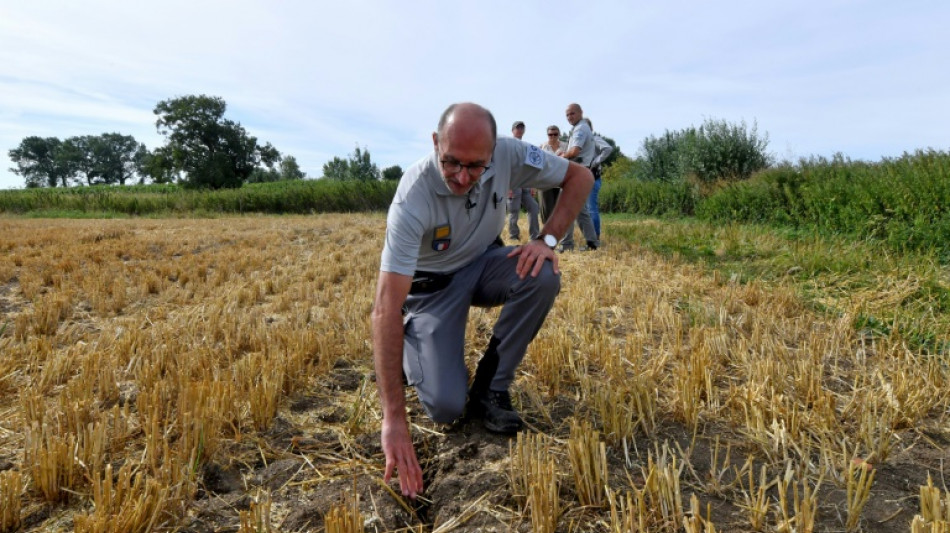
Driest July in memory imperils Europe's crops / Photo: © AFP/File

As much of Europe bakes in a third heatwave since June, fears are growing that extreme drought driven by climate change in the continent's breadbasket nations will dent stable crop yields and deepen the cost-of-living crisis.
The European Commission on Wednesday urged EU member states to re-use treated urban waste water as irrigation on the continent's parched farms, after France and parts of England saw their driest July on record.
In France, where an intense drought has hammered farmers and prompted widespread limits on freshwater use, there was just 9.7 millimetres (0.38 inches) of rain last month, Meteo France said.
That was 84 percent down on the average levels seen for July between 1991 and 2022, making it the driest month since March 1961, the agency added.
Farmers nationwide are reporting difficulties in feeding livestock because of parched grasslands, while irrigation has been banned in large areas of the northwest and southeast due to freshwater shortages.
Environment Minister Christophe Bechu said July's rainfall represented "just 12 percent of what's needed".
France is the forth-largest exporter of wheat and among the top five exporters of maize globally. Poor harvests due to drought may heap further pressure on grain supplies after Russia's invasion of Ukraine caused global shockwaves.
"Our food system has been under stress for a while, and with the supply issues from Ukraine, that has only gotten worse," said Shouro Dasgupta, environmental economist at the Euro-Mediterranean Center on Climate Change.
"These heatwaves are on top of droughts and will see crops wither faster."
Dasgupta said that extreme heat driven by climate change is also contributing to food price inflation for consumers and harsher conditions for producers.
"Droughts and heatwaves impact people's livelihoods. People will be less able to afford food," he told AFP.
"And during heatwaves outdoor workers are only able to work fewer hours, which brings cascading impacts for supply."
- 'Food systems not working' -
Britain's Met Office this week said much of southern and eastern England had their driest July on record.
Some water providers have already announced restrictions affecting millions of people, and fruit and vegetable producers have announced several crop losses such as beans and berries.
Britain's inflation surged to a 40-year high in June on rising fuel and food prices.
Elizabeth Robinson, director of the London School of Economics' Grantham Research Institute on Climate Change and the Environment, said that spiralling food costs -- worsened by heat-induced losses in Europe and Britain -- were a sign that "food systems aren't working for people."
"There are some long-term, difficult conversations that need to be had, particularly about food waste and the diversion of grains away from food for people to feed animals," she told AFP.
In Spain, already parched under a prolonged hot spell, temperatures will breach 40C in several areas this week.
The heat is worsening water shortages that have dogged Spanish agriculture since last winter, with local restrictions on water usage in the most affected regions.
The government said this week that Spain's reservoirs are at just 40.4 percent capacity.
Juan Carlos Hervas, from the COAG farmers' union, told AFP that Spains olive harvest from unirrigated land will come in at less than 20 percent of the average of the last five years.
Spain supplies nearly half the world's olive oil.
- 'Worst drought this century' -
Portugal, where temperatures yet again breached the 40C mark this week, is experiencing "the worst drought this century", environment minister Jose Duarte Cordeiro warned last month.
Portugal along with Poland has asked its citizens to cut down on water use to ease the pressure.
"Water authorities across Europe are unprepared for what scientists have been saying for three decades," said Dasgupta. "A high incidence of heatwaves will hit water supply ".
The European Commission in an updated assessment last month found that nearly half -- 44 percent -- of the EU and Britain was currently experiencing "warning" levels of drought.
It warned that exceptional low soil moisture levels meant several countries, including France, Romania, Spain, Portugal and Italy will experience reduced crop yield in 2022.
"The unfavourable forecasts for the coming months may compromise the water supply and will likely keep the competition for this resource high," it said.
A separate EU bulletin, also last month, said that EU yields of soybean, sunflowers and maize were already 9 percent below average.
On Wednesday Virginijus Sinkevicius, EU commissioner for the environment, fisheries and the oceans. urged EU nations to re-use more of its waste water.
"We need to stop wasting water and use this resource more efficiently to adapt to the changing climate and ensure the security and sustainability of our agricultural supply." he said.
M.Zhou--ThChM