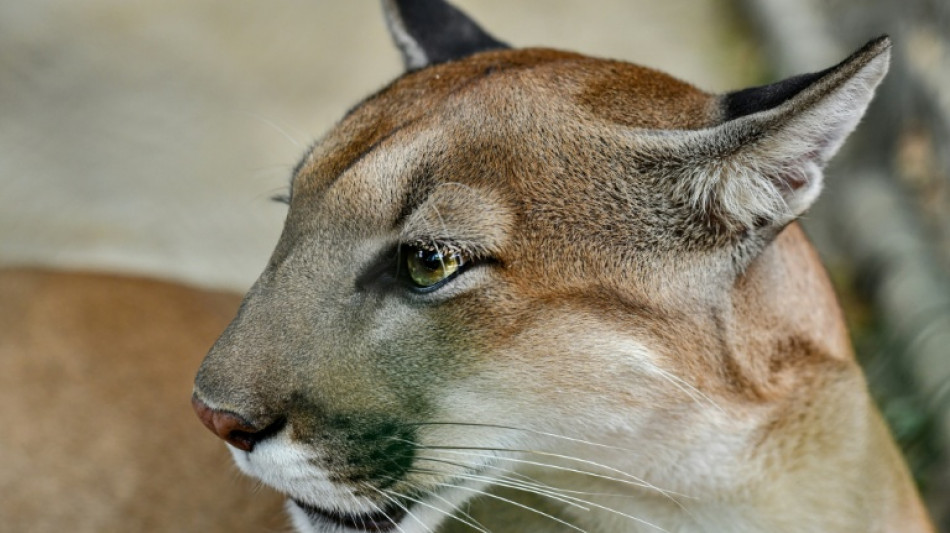
Where mountain lions roam, fewer deer in the headlights / Photo: © AFP/File

Living among apex predators could make you safer.
A new study published Wednesday in Current Biology found that on Washington state's Olympic Peninsula, vehicle collisions with deer fall by as much as 76 percent in areas highly frequented by mountain lions.
The reason isn't because the big cats are eating enough deer to thin the herds.
Rather, it is fear that makes deer avoid roadways and developed areas while cutting back on nighttime activity -- a clear example of the benefits large carnivores bring to the landscapes they share with humans, lead author Justin Suraci told AFP.
"You can put a dollar amount on how much a rancher loses when wolves kill their cows, and people are putting dollar amounts on those things," said the scientist, who works for California-based research group Conservation Science Partners.
"But if we don't put a dollar amount on the services -- or at least articulate those services -- they get perceived as not existing."
- Cameras and collars -
Earlier research modeled what would happen to deer-vehicle collisions if mountain lions recolonized the eastern United States, where they once roamed before hunting and habitat destruction left them largely confined to the West.
Another paper examined how the return of wolves to Wisconsin affected car crashes with deer.
Suraci and colleagues instead focused on the Olympic Peninsula, where mountain lions -- variously known as cougars, pumas or panthers -- have long been established.
Because the lions already live in a stable equilibrium with their deer and elk prey, the team could better isolate the effects of the predators on their prey's behavior, rather than the effects of predators simply killing and consuming the herds.
They drew on data collected from 503 camera traps and 59 collared mountain lions as part of a long-term research study by Panthera, the global wild cat conservation organization, in partnership with several Native American tribes and nations.
Where mountain lions were present, they found deer were more active by day than by night, 15 percent less likely to be in areas with a high density of roads, and 86 percent more likely to occupy remote habitat far from developed areas.
Dividing the peninsula into a grid of five-by-five kilometer cells and overlaying car crash data, they found there was a reduction of to 76 percent in the number of vehicle-deer collisions in areas with high mountain lion presence over a five-year span.
Traffic on the peninsula is light. Even so, state data for the 2020-2025 study period showed there were two human deaths, more than 80 injuries and $14.7 million in estimated health expenses and vehicle repairs from crashes with ungulates.
Suraci said it isn't yet feasible to work backwards and estimate how many deaths, injuries and economic damage the mountain lions have prevented.
"But it would be substantially higher if all the pumas were gone," he said, adding that in future work he hopes to capture the full extent of economic impacts, costs and benefits, in the counterfactual scenario that they were absent from the Peninsula.
- Economic value -
Senior author Mark Elbroch, puma program director for Panthera, told AFP the work was important given the grave threats facing cougars, with over 1,000 killed each year across the western US by state wildlife officials responding to attacks on livestock.
"Research like this...helps people want to live alongside cougars," he said.
Suraci stressed that large carnivores, like any species, have inherent value beyond the services they provide to human beings -- but said that failing to make the economic case would be a disservice to them.
"This quantification of the economic value that these things provide is only additive to the inherent intrinsic conservation value that all life on Earth has."
H.Au--ThChM