Colombia quake rescue efforts enter 'final phase' as toll hits 239 / Photo: © AFP

Colombia on Wednesday declared three days of mourning for victims of an earthquake that killed 239 people, as rescuers entered what officials called the final phase of the search for survivors.
Monday's magnitude 7.4 quake, the strongest to hit Colombia this century, devastated towns across the coffee-growing west, leaving at least 3,700 families homeless, according to the national disaster management agency.
The government said flags would be lowered to half-staff on official buildings and at Colombian embassies abroad "in honor of all the dead."
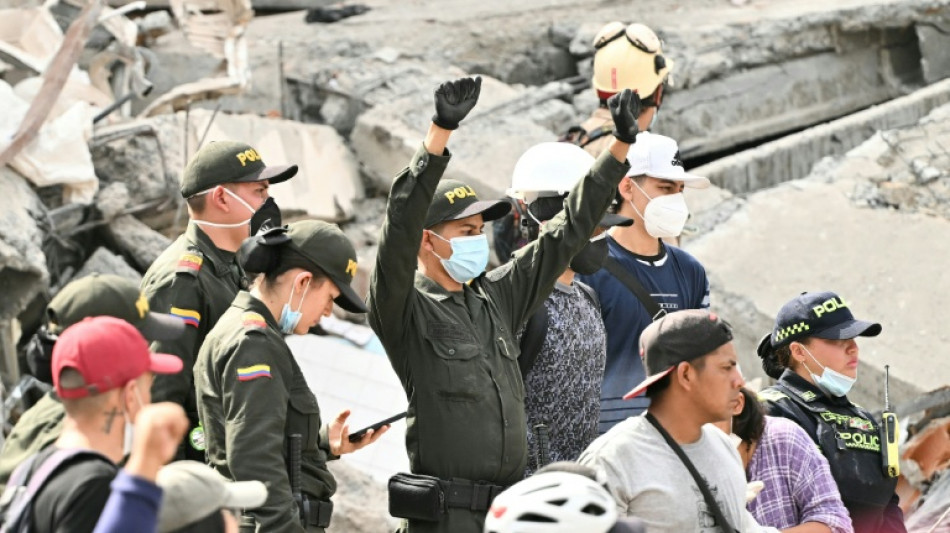
In the cities of Pereira and Cali, emergency crews labored through the night with cranes, dogs and heavy machinery in the hunt for survivors, while volunteers formed human chains to clear debris by hand.
Rescuers pulled 32-year-old Daniela Largo alive from the rubble of a Pereira hotel after 35 hours trapped, offering a rare sign of hope as the window for finding survivors narrowed.
"We were losing hope and then we received a call," her mother Sandra Milena Perez told AFP. A local resident heard cries for help beneath the rubble and joined neighbors in removing debris before professional rescuers arrived, she said.
"I thank him with all my heart because thanks to him today we are happy... a son is waiting for her at home," Perez said.
On Thursday morning rescue teams will approach a grim landmark.
"We're entering the final phase of the first 72 hours," Cali Mayor Alejandro Eder said Wednesday, referring to the period when survivors are most likely to be found alive beneath rubble.
"That doesn't mean there won't be survivors afterwards, but it is more difficult," he said.
Rescuers are not giving up hope just yet.
Veteran volunteer Julio Cesar Pineda said teams still believed survivors could be found beneath the rubble despite dwindling odds.
"These are critical hours because two days have already passed," he told AFP. "I know that today and tomorrow we will pull people out alive."
- 'Starting over' -
From the air, neighborhoods in Cali appeared flattened, with piles of rubble replacing entire blocks of homes and apartment buildings.
The quake overwhelmed parts of the health system, turning the rescue effort into one of Colombia's largest disaster responses in years.
Many survivors spent a second night outdoors, either because their homes were damaged or because they feared aftershocks.
One park in Pereira was transformed into a makeshift shelter with tents and mattresses.
"We lost everything, but we're alive," said 23-year-old John Tabasco, who was camped there with his wife and seven-month-old son.
In the mountain town of El Cairo, residents gathered at community kitchens while power outages persisted and many remained reluctant to return home.
"People don't want to go inside their homes, people don't want to sleep, people don't know what to do," resident Adriana Gonzalez told AFP.
In nearby Roldanillo, Yuliana Mendez picked through the wreckage of the beauty products store where she worked, one of many businesses damaged in the disaster.
"It's like starting over from scratch," she said.
- Bringing water, donating blood -
In Pereira's Providencia neighbourhood, residents hauled furniture and household items from damaged buildings. Among them was lawyer Ana Paulina Crosthwaite, whose apartment block was left unsafe by the quake.
"We're in a state of shock," she told AFP. "We're not prepared to tell our children that we have to pack whatever we can and start a new life."
Many Colombians have mobilized to help, bringing water, food and supplies to affected neighborhoods, while long lines formed outside blood donation centers.
"It's about wanting to help your community, your city and your country," said blood donor Ferney Cabrera.
President Abelardo de la Espriella, sworn in on Friday, declared a state of emergency and promised rent subsidies for affected families during a visit to Pereira on Tuesday.
The United States announced $15.5 million in emergency aid, while messages of support and offers of assistance arrived from around the world.
Q.Yam--ThChM