West Bank's violent settlers part of a new generation fuelled by ideology / Photo: © AFP

A mass attack by Israeli settlers on a Palestinian village in the occupied West Bank has placed new focus on the emergence of a generation of radicals in the territory.
A loosely connected movement of hardline Israeli settlers, most of them young and including school dropouts from outside the West Bank, known as the "Hilltop Youth", is behind the surging violence against Palestinians.
Inspired by religious-nationalist ideology, the movement seeks to expand the Jewish presence in the Palestinian territory by setting up unauthorised outposts -- usually makeshift tents or mobile homes -- on hilltops outside established Israeli settlements.
While groups of Israelis living off-grid in the West Bank have existed since the 1990s, the new generation has a clear agenda to take over Palestinian lands through violent means, said Dvir Warshavsky of Children of Abraham, a group of observant Jewish activists supporting Palestinian rights.
Early on Tuesday, more than 100 Israeli settlers attacked the village of Jalud, wounding three members of Israeli security forces, as the army accompanied a Palestinian family seeking to return to their home after being displaced by settler attacks.
The ramp-up in violence, including attacks on mosques and churches, had already prompted countries including Britain and the Netherlands to impose sanctions on settlement products, infuriating Israel.
A post published in a WhatsApp channel affiliated with the movement and seen by AFP recently claimed that over the past 12 months, the Hilltop Youth had carried out 635 attacks in 158 different Palestinian villages, and that 409 Palestinians were wounded and 436 cars were burned during the attacks. The figures could not be independently verified.
The perpetrators of such violence are rarely prosecuted by Israeli authorities.
Israeli Prime Minister Benjamin Netanyahu, addressing the UN General Assembly last week, dismissed settler attacks as the work of a "handful of juvenile delinquents, about 150 in number" and accused the rest of the world of ignoring violence by Palestinians.
Israel has occupied the West Bank since 1967. More than 500,000 settlers live in the territory which is home to some three million Palestinians.
About 140 settlements are recognised by the Israeli government while being illegal under international law, but farms and outposts that are also illegal under Israeli law now number around 400, according to the Peace Now watchdog.
- 'Minimum people on maximum land' -
Israeli rights experts who have tracked the Hilltop Youth for years said the movement gathered pace after Israel dismantled 21 settlements in the Gaza Strip and four in the West Bank as part of its unilateral "disengagement" in 2005.
The failure of the settler movement's old guard to prevent thousands of Israelis from losing their homes in the forced evacuations, combined with resentment toward the central government, ushered in a new phase.
More ideological settlers emerged, challenging "the traditional strategy of the settler movement, whose logic was to build more and more settlements with more and more people," Warshavsky said.
The "new generation" focused on building small illegal outposts and agricultural projects without permits from Israeli authorities -- a strategy known as "minimum people on maximum land".
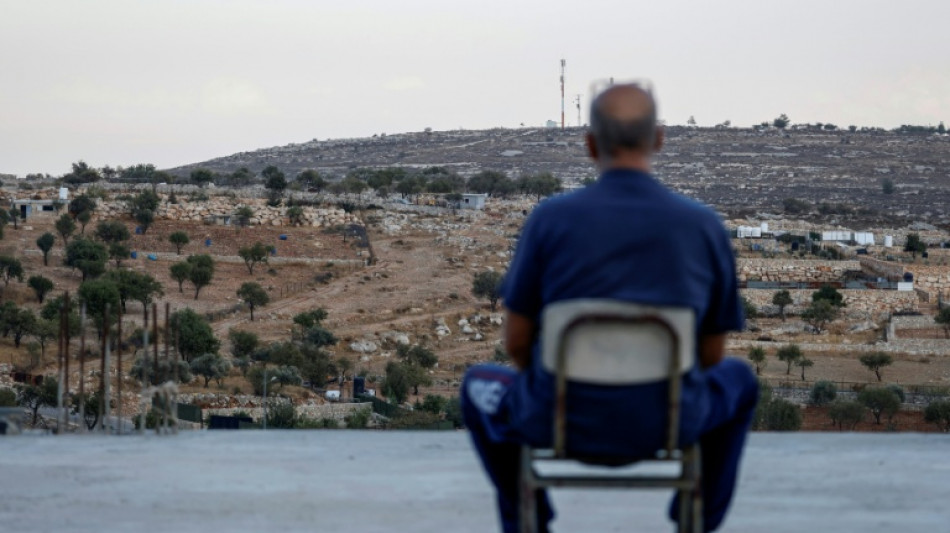
Grazing flocks of sheep and goats has allowed the hilltop youth to significantly expand control over rural areas which are under Israeli military authority.
With the rise of politicians representing the ideological settlers, such as Finance Minister Bezalel Smotrich, the communities have received growing legitimisation and financial support -- some of it channelled toward illegal farms and outposts, according to experts.
While the government cannot make direct transfers because of their illegal status, "they fund all the rest", said Hagit Ofran of the Peace Now watchdog, meaning roads, ranger cars, security cameras, solar panels and drones -- along with protection from the Israeli army.
Some funding also comes from private donations and crowdfunding, she added.
- Protected by the army -
Some settler leaders have sought to distance themselves from the movement. At the end of last year, the leaders of three Israeli local councils in the West Bank issued a joint statement urging law enforcement to adopt a "zero tolerance" policy towards the Hilltop Youth, saying they "do not represent" the broader settler movement.
Since Hamas's October 7, 2023 attack on Israel and the outbreak of war in Gaza and on other fronts, regular soldiers have been diverted away from the West Bank, with troops patrolling around the settlements now often reservists who are themselves settlers.
Such troops are much less likely than regular soldiers to dismantle illegal outposts, experts say.
"The army is not really fighting against them. They don't want to deal with them," Ofran said.
W.Tam--ThChM