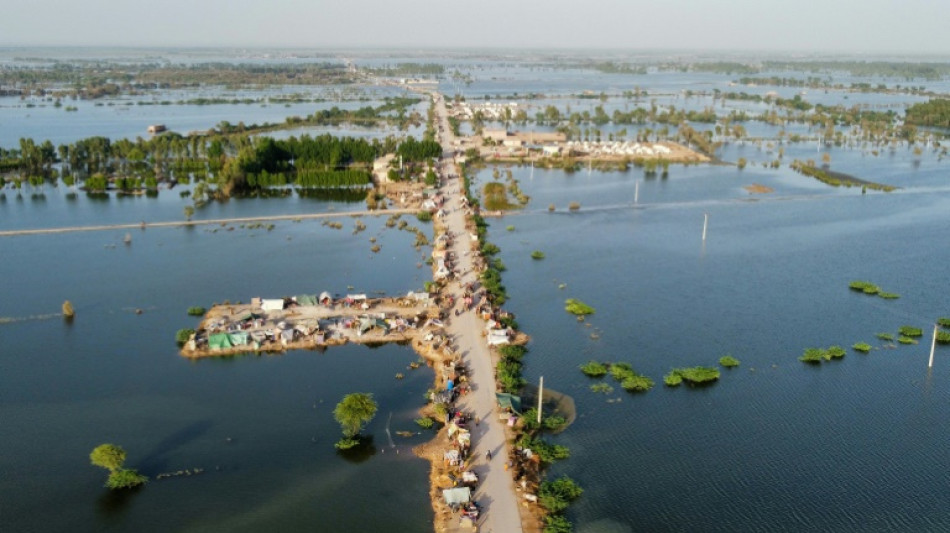
Engineers breach Pakistan lake as flood misery grows for millions / Photo: © AFP

Engineers breached Pakistan's biggest freshwater lake to drain water threatening nearby towns, officials said Monday, as heavy rain poured misery on millions affected by the country's worst floods in history.
Nearly a third of Pakistan is under water -- an area the size of the United Kingdom -- following months of record monsoon rains that have killed 1,300 people and washed away homes, businesses, roads and bridges.
Officials say the repair bill will top $10 billion for a country already in the grip of economic crisis, with hundreds of thousands homeless as the monsoon draws to an end and winter approaches.
"There is nowhere to shower or go to the bathroom," said Zebunnisa Bibi, sheltering near Fazilpur, in Punjab province, where 65 tents are now home to more than 500 people who fled their inundated villages for higher land.
Similar tent camps have mushroomed across much of the south and west of Pakistan, where rain has nowhere to drain because rivers are already in full flow as a result of torrential downpours in the north.
Sindh province Information minister Sharjeel Inam Memon told AFP Monday that engineers had to cut a channel into Lake Manchar to drain water that was threatening the towns of Sehwan and Bhan Saeedabad, with a combined population of nearly half a million.
- Lake Manchar bigger than ever -
Still, thousands had to be evacuated from smaller settlements submerged by the newly directed channel.
"The flood water was diverted but the threat is still far from over," Memon said.
"We are trying our best to stop the inundation of more villages."
Lake Manchar, which lies west of the Indus River, varies in size according to the season and rainfall, but is currently spread over as wide an area as anyone can recall.
Much of Sindh and parts of Balochistan have become a vast landscape of water, with displaced locals huddled miserably on elevated roads, rail tracks and other high ground.
Human and animal waste in the fetid water attracts swarms of flies, while outbreaks of dengue are being reported from mosquitos breeding in the swamplands.
One pregnant woman at a camp in Punjab said she was desperate for medical attention for a baby due any day now.
The mother-of-five knows it could be a difficult birth, as the baby has not shifted from the breech position.
"I need a doctor or a midwife. What if something happens to my child?" said Fahmidah Bibi.
The United Nations Population Fund said at the weekend there were at least 128,000 pregnant women in flood-hit areas who urgently need care -- with 42,000 expected to give birth in the next three months.
- Climate change blamed -
Pakistan receives heavy -- often destructive -- rains during its annual monsoon season, which are crucial for agriculture and water supplies.
But such intense downpours have not been seen for decades.
Pakistani officials blame climate change, which is increasing the frequency and intensity of extreme weather around the world.
A massive army-led relief operation is in full swing, but the country's leaders have admitted being overwhelmed by the scale of the crisis and appealed for international help.
The latest figures from the National Disaster Management Authority show nearly 6,000 kilometres (4,000 miles) of roads have been washed away, 246 bridges demolished, and 1.6 million homes either destroyed or badly damaged since June, when the monsoon started.
U.Chen--ThChM