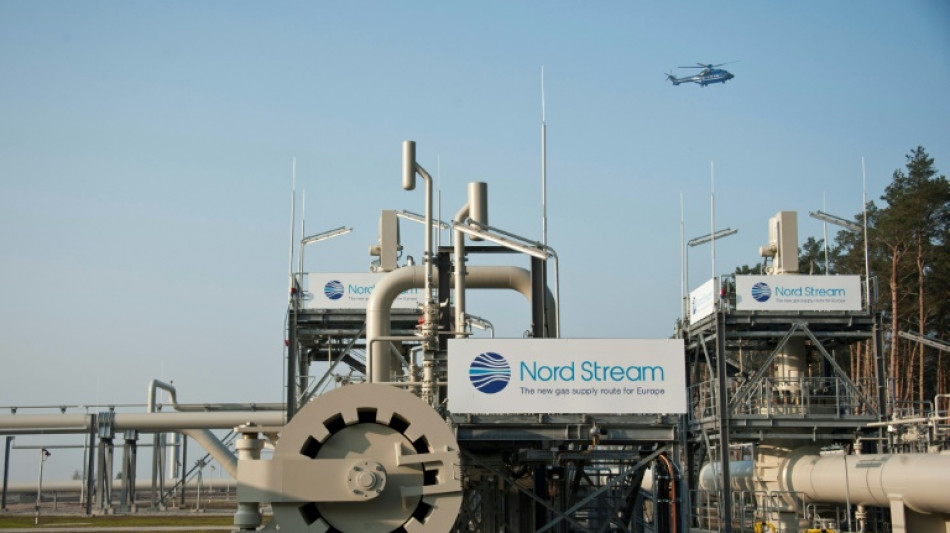
Sabotage suspected after leaks in Russia-Europe gas pipelines / Photo: © AFP/File

The two Nord Stream gas pipelines linking Russia and Europe have been hit by unexplained leaks, Scandinavian authorities said Tuesday, raising suspicions of sabotage.
The pipelines have been at the centre of geopolitical tensions in recent months as Russia cut gas supplies to Europe in suspected retaliation against Western sanctions following its invasion of Ukraine.
Russia said it was "extremely concerned" about the leaks. Asked by reporters whether it could be an act of sabotage, Kremlin spokesman Dmitry Peskov said that at the moment "it is impossible to exclude any options".
While the pipelines, which are operated by a consortium majority-owned by Russian gas giant Gazprom, are not currently in operation, they both still contain gas but the environmental impact appeared limited so far.
One of the leaks on Nord Stream 1 occurred in the Danish economic zone and the other in the Swedish economic zone, while the Nord Stream 2 leak was in the Danish economic zone.
A leak was first reported on Nord Stream 2 on Monday.
"Authorities have now been informed that there have been another two leaks on Nord Stream 1, which likewise is not in operation but contains gas," Danish climate and energy minister Dan Jorgensen told AFP in a statement on Tuesday.
"It is too early to say anything about the causes of the incidents," the Danish Ministry of Climate, Energy and Utilities said in a statement.
Denmark's energy agency has, however, called for "higher levels of preparedness in the electricity and gas sector" in the country, Jorgensen said.
- 'Not common' -
During a visit to Poland for the inauguration of the Baltic Pipe Project -- connecting Poland and Denmark to a North Sea pipeline -- Danish Prime Minister Mette Frederiksen also told Danish media "it's hard to imagine that it's accidental."
The EU Commission meanwhile stressed that it was too early to speculate on the causes of the leaks.
"We believe we do not have the elements in order to determine what is the reason for the leak. And obviously any act of sabotage on any infrastructure is something that we would condemn," EU commission spokesman Eric Mamer told reporters.
A Nord Stream spokesperson told AFP that they had not been able to assess the damage but conceded that "an incident where three pipes experience difficulties at the same time on the same day is not common."
The Danish energy agency told the Ritzau news agency that only the area where the gas plume is located will be affected by the leak, but methane escaping into the atmosphere has a "climate-damaging effect".
"Gas pipeline leaks are extremely rare and we therefore see a reason to increase the level of preparedness following the incidents we have witnessed over the past 24 hours," director of the Danish Energy Agency Kristoffer Bottzauw said in a statement.
Built in parallel to the Nord Stream 1 pipeline, Nord Stream 2 was intended to double the capacity for Russian gas imports to Germany.
But Berlin blocked newly-completed Nord Stream 2 in the days before the war.
Germany, which has been highly dependent on imports of fossil fuels from Russia to meet its energy needs, has since come under acute stress as Moscow has dwindled supplies.
Russian energy giant Gazprom progressively reduced the volumes of gas being delivered via Nord Stream 1 until it shut the pipeline completely at the end of August, blaming Western sanctions for the delay of necessary repairs to the pipeline.
- 'Targeted attack' -
Germany has rebuffed Gazprom's technical explanation for the cut, instead accusing Moscow of wielding energy as a weapon amid tensions over the war in Ukraine.
Meanwhile, German daily Tagesspiegel reported that "the Nord Stream pipelines may have been damaged by targeted attacks and leaked as a result".
According to a source close to the government and relevant authorities, quoted in the newspaper, "everything speaks against a coincidence".
"We cannot imagine a scenario that is not a targeted attack," the source said.
As a result of the leaks, navigational warnings have been issued for a distance of five nautical miles and a flight height of 1,000 metres (3,280 feet).
The incidents on the two pipelines have no impact on the supply of gas to Denmark, the Danish energy minister said.
L.Johnson--ThChM