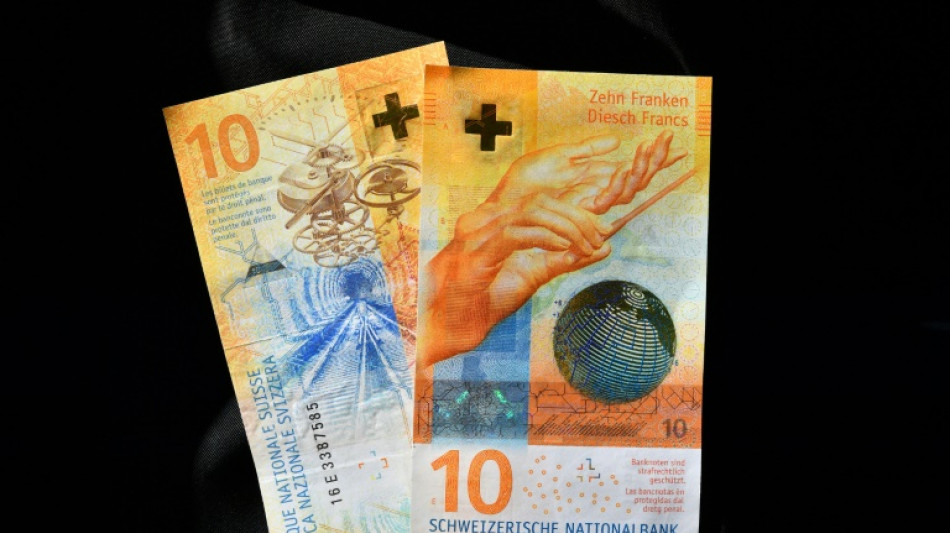
Swiss franc's surge against the euro a boon for business / Photo: © AFP/File

The Swiss franc is breaking records against the euro, giving the Swiss economy a temporary boost as central banks battle inflation -- although experts remain cautious about the months ahead.
Seen as a safe haven, the Swiss currency briefly hit a high of 0.94 francs to the euro on Monday following the Italian general election.
While it has since eased back a little, it is nevertheless at the highest levels since the launch of the single currency more than 20 years ago, outside a brief flash crash in 2015.
"It's more about the weakness of the euro than the strength of the Swiss franc," Credit Suisse economist Maxime Botteron told AFP, citing the franc's steadier performance against the US dollar.
"European growth is showing signs of running out of steam, even recession," he said, noting that "these indicators come in a context where the Swiss National Bank (SNB) has changed its monetary policy".
Switzerland's central bank has abandoned the negative rate it has imposed since 2015 to combat the overvaluation of its currency.
Like other central banks, the SNB seeks to prevent inflation from taking root. But in the midst of soaring energy prices, the franc's rise is providing it with welcome help in curbing price increases.
"In Switzerland, two-thirds of inflation is due to imports. An appreciation of the Swiss franc therefore reduces the rise of these goods a little," said Botteron, adding that the SNB "therefore has less need to tighten monetary policy" than other central banks.
In August, inflation rose to 3.5 percent, its highest level in 29 years, but far behind the 9.1 percent recorded last month in the eurozone.
- Tourism boost -
"There is a very clear strategy to shield Switzerland the against the rising inflation coming from the eurozone, the US and other trading partners," said Thomas Flury, UBS bank's global head of currency strategy.
The franc's rise has not triggered panic, unlike in 2015 when exporters feared their production costs and export prices would explode.
"High inflation in the eurozone makes the real appreciation much less dramatic than in the past," said Flury.
"Acceptance is coming because companies in Switzerland would rather have a stronger Swiss franc than discussions on wage rises that French or German companies will have to do, as well the cost pressures from imports."
If this rise in the franc eases somewhat the pressure on their imports, Swiss companies, with well-filled order books, also have some leeway to increase their prices, said Botteron.
In tourism, another sector sensitive to the exchange rate, the franc's rise has enabled Swiss hoteliers to increase their prices to a lesser degree than in neighbouring countries given the lower inflation, a spokesman for the Hotellerie Suisse hotel industry body told AFP.
"For hoteliers, this means that they should become even more competitive against foreign countries," he explained.
As Switzerland nevertheless remains an expensive destination, the group remains cautious, fearing that "consumer budgets will tighten".
However, this boost to the Swiss economy may only be short-lived.
"We'll have to see how this develops over the winter," said Flury.
Even if it is too early to guess how the exchange rate might develop, recession or weak growth in the European economy would hamper Swiss companies and the franc's value may become a much more sensitive subject.
M.Zhou--ThChM