Five facts about disaster-hit Tonga

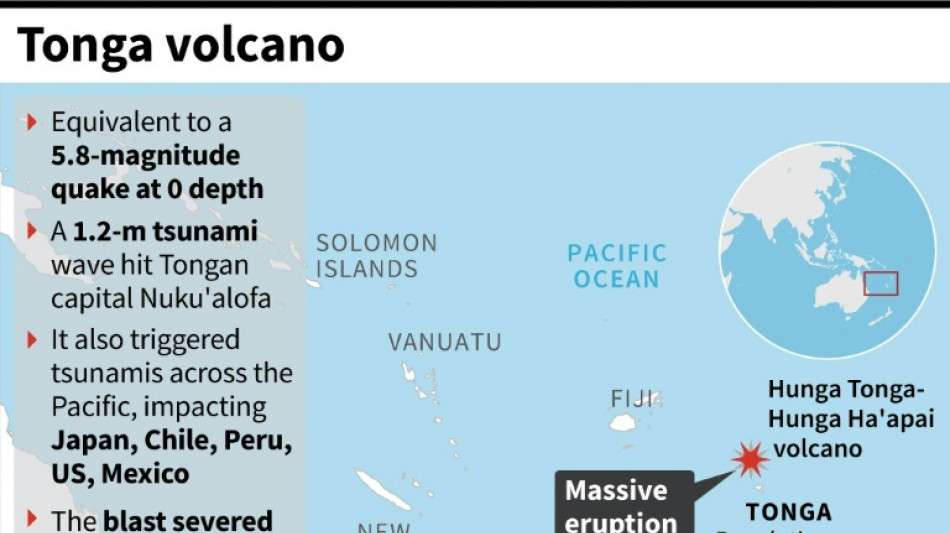
The Pacific island nation of Tonga has suffered widespread damage after a huge underwater volcanic eruption and tsunami on the weekend.
The disaster has virtually cut the country off from the rest of the world as neighbours and aid organisations try to organise assistance.
Here are five facts about Tonga:
- Remote archipelago -
Tonga is made up of 169 islands in the South Pacific, spread over 800 kilometres (500 miles) in a north–south line. Only 36 of them are inhabited.
The population is around 105,000. A similar number lives overseas -- mainly in New Zealand, Australia and the United States -- and their remittances prop up the economy.
The capital Nuku'alofa was less than 70 kilometres from the Saturday eruption, according to the US Geological Survey, which blanketed the city with two centimetres of volcanic ash and dust.
Tonga's remote location means it can get cut off from the world if there are problems with the undersea cable that links it to the internet through Fiji.
The latest eruption has severed that connection, reducing information from Tonga to a trickle.
The nation was previously isolated for two weeks in 2019 when a ship's anchor cut the cable. A small, locally operated satellite service was set up to allow minimal contact with the outside world.
- Ancient monarchy -
Tonga was settled around 1,500 BC, and claims to be the only remaining indigenous monarchy in the Pacific islands.
Its monarchy can trace its history back 1,000 years. By the 13th century, the nation wielded power and influence over surrounding islands, including Samoa, nearly 900 kilometres to the east.
Various islands had royalty until 1845 when they were united under King George Tupou I, who became known as the leader of modern Tonga.
It is the only Pacific island nation that was never formally colonised. Instead, it negotiated to become a protected state under a Treaty of Friendship with Britain in 1900 while maintaining its sovereignty.
Tonga became independent in 1970.
- Political changes -
Tonga was under feudal rule until 2010, when the monarchy boosted democratic representation in the wake of rioting four years earlier that razed Nuku'alofa's downtown area.
But a string of political scandals and perceptions of government incompetence have eroded faith in the fledgling democracy's institutions.
Siaosi Sovaleni was appointed prime minister after an election in November in which corruption and Covid-19 were on top of the agenda.
Tonga was one of the last remaining places in the world without Covid until November last year, when it detected its first coronavirus case.
- No business, no sport, no housework on Sunday -
King Tupou I converted to Christianity after coming under the influence of missionaries.
Christianity is a vital part of Tongan life and Sundays are devoted to church, family, feasting and rest.
Businesses and shops are closed by law, modest dress is required and even in the rugby-mad isles, the no-sport Sunday is strictly observed.
- Tin Can Island -
Niuafo'ou, a small island with an underwater volcano attached, is widely known in the world of stamp collectors as Tin Can Island.
The island achieved its nickname because it has no natural anchorage, and for decades the only way for mail to arrive and leave was for a strong swimmer to take a biscuit tin out to passing ships.
According to modern legend, the practice was abandoned in 1931 when a swimmer fell victim to a shark attack.
Mail and stamps postmarked on the island pre-1931 are much sought after by collectors.
S.Wilson--ThChM