The China Mail - Japanese rocket launch fails in blow for space agency

USD -
AED 3.672498
AFN 65.999833
ALL 79.215294
AMD 364.190372
ANG 1.789783
AOA 918.000272
ARS 1497.229699
AUD 1.399874
AWG 1.8
AZN 1.690189
BAM 1.673999
BBD 2.016468
BDT 122.344523
BGN 1.696366
BHD 0.37746
BIF 2975.481784
BMD 1
BND 1.272602
BOB 11.548864
BRL 5.194699
BSD 1.001168
BTN 95.766233
BWP 13.44135
BYN 3.045201
BYR 19600
BZD 2.013558
CAD 1.37638
CDF 2275.000334
CHF 0.799602
CLF 0.023437
CLP 922.410293
CNY 6.72325
CNH 6.721665
COP 3076.4
CRC 453.637013
CUC 1
CUP 26.5
CVE 94.377493
CZK 20.63275
DJF 178.279346
DKK 6.393115
DOP 58.502056
DZD 133.041971
EGP 50.877701
ERN 15
ETB 161.136401
EUR 0.85517
FJD 2.19495
FKP 0.735015
GBP 0.732925
GEL 2.604971
GGP 0.735015
GHS 11.138025
GIP 0.735015
GMD 73.000481
GNF 8797.284979
GTQ 7.639867
GYD 209.373984
HKD 7.842385
HNL 26.885017
HRK 6.442103
HTG 130.98351
HUF 311.301962
IDR 17710
ILS 2.99786
IMP 0.735015
INR 95.732903
IQD 1310.5
IRR 1374574.999868
ISK 121.450036
JEP 0.735015
JMD 158.399062
JOD 0.709012
JPY 158.876499
KES 129.440112
KGS 87.449098
KHR 4024.990372
KMF 422.000526
KPW 900.000294
KRW 1385.609898
KWD 0.30833
KYD 0.834343
KZT 456.235102
LAK 22553.269796
LBP 89531.568576
LKR 330.33051
LRD 181.710026
LSL 16.154047
LTL 2.95274
LVL 0.60489
LYD 6.340647
MAD 9.257066
MDL 17.190128
MGA 4319.999816
MKD 52.660185
MMK 2099.608389
MNT 3598.398104
MOP 8.088313
MRU 40.008559
MUR 46.596617
MVR 15.460009
MWK 1736.060291
MXN 16.93342
MYR 4.045396
MZN 63.90501
NAD 16.154047
NGN 1349.020081
NIO 36.697866
NOK 9.32563
NPR 153.227456
NZD 1.67503
OMR 0.384497
PAB 1.001164
PEN 3.352534
PGK 4.431975
PHP 61.770938
PKR 277.799176
PLN 3.69217
PYG 6028.236764
QAR 3.644992
RON 4.490699
RSD 100.358002
RUB 83.249683
RWF 1469.5
SAR 3.757226
SBD 8.025811
SCR 14.519005
SDG 601.498943
SEK 9.46447
SGD 1.27003
SHP 0.740866
SLE 24.649686
SLL 20969.499227
SOS 572.191575
SRD 37.690213
STD 20697.981008
STN 21.35
SVC 8.760255
SYP 13001.999906
SZL 16.090439
THB 32.729635
TJS 9.250692
TMT 3.51
TND 2.897008
TOP 2.40776
TRY 48.064304
TTD 6.784811
TWD 31.86901
TZS 2640.003033
UAH 44.658082
UGX 3724.087166
UYU 40.124791
UZS 11852.000117
VES 778.977299
VND 26060
VUV 118.216132
WST 2.729275
XAF 561.455601
XAG 0.014512
XAU 0.00022
XCD 2.70255
XCG 1.804347
XDR 0.707052
XOF 561.445989
XPF 102.493572
YER 237.095433
ZAR 16.07696
ZMK 9001.196702
ZMW 18.897058
ZWL 321.999592
  • CMSC

    -0.0799

    21.28

    -0.38%

  • GSK

    -0.9200

    51.96

    -1.77%

  • NGG

    -0.0400

    80.62

    -0.05%

  • BTI

    0.7200

    56.7

    +1.27%

  • CMSD

    -0.0300

    21.12

    -0.14%

  • BCE

    0.0800

    23.78

    +0.34%

  • BCC

    -1.3600

    81.77

    -1.66%

  • RIO

    1.7300

    102.17

    +1.69%

  • BP

    1.4100

    45.14

    +3.12%

  • AZN

    -0.4600

    164.49

    -0.28%

  • RBGPF

    -0.7900

    68.56

    -1.15%

  • RYCEF

    -0.3300

    20.5

    -1.61%

  • JRI

    0.0300

    12.41

    +0.24%

  • RELX

    0.2800

    35.38

    +0.79%

  • VOD

    -0.1600

    16.01

    -1%

Japanese rocket launch fails in blow for space agency
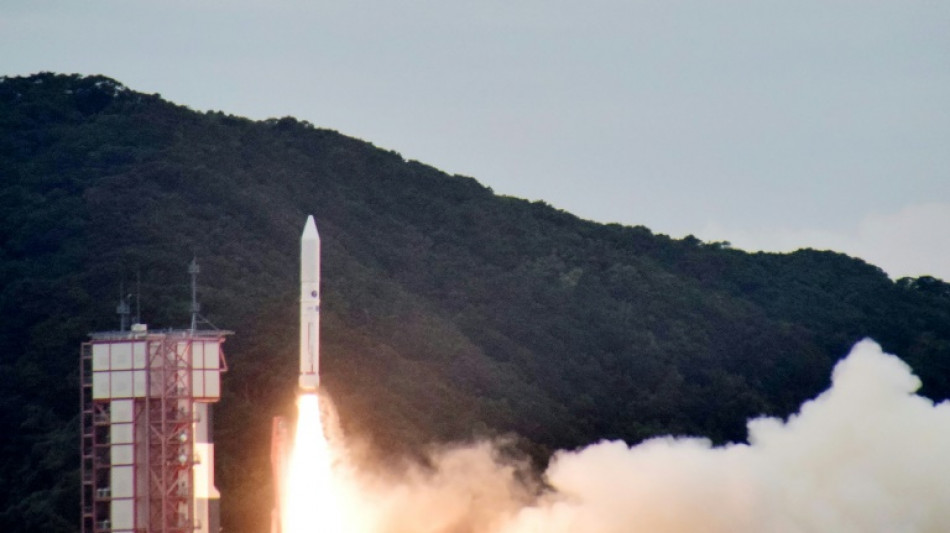
Japanese rocket launch fails in blow for space agency / Photo: © JIJI Press/AFP

Japanese rocket launch fails in blow for space agency

The launch of a Japanese rocket taking satellites into orbit to demonstrate new technologies failed after blast-off on Wednesday because of a positioning problem, the country's space agency said.

Text size:

It was Japan's first failed launch in nearly two decades, and the only one for an Epsilon rocket, a solid-fuel model that has flown five successful missions since its 2013 debut.

The unmanned craft took off from Uchinoura Space Center in the southern Kagoshima region, with its lift-off livestreamed by the Japan Aerospace Exploration Agency (JAXA).

But a self-destruct signal was sent to the rocket less than 10 minutes later because of "positioning abnormalities", said Yasuhiro Funo of JAXA, who led the project.

The livestream was halted and presenters wearing hard-hats told viewers there had been a problem with the launch.

Funo explained at a press conference that a technical issue was detected before the third -- and final -- stage of the launch, just as the last powerful booster was about to be ignited.

"We ordered the rocket's destruction because if we cannot send it into the orbit that we planned, we don't know where it will go," he said, leading to safety concerns about where the machinery could fall.

After the mission was aborted, the rocket's parts were assumed to have landed in the sea east of the Philippines, he added.

Japan's last failed space launch was of a pair of spy satellites to monitor North Korea in 2003, and the only other time JAXA has sent a destroy order to a rocket was in 1999.

- 'Pulsed-plasma thruster' -

The 26-metre (85-foot) Epsilon-6 rocket had been carrying a box-shaped satellite due to orbit Earth for at least a year to carry out experiments, as well as eight micro-satellites.

Researchers and private companies had engineered new technologies to be tried out in space as part of the agency's third Innovative Satellite Technology Demonstration programme.

Their gadgetry ranged from a "pulsed-plasma thruster" to an experiment in "harvesting energy with (a) lightweight integrated origami structure", according to a JAXA fact sheet.

JAXA describes Epsilon as "a solid-fuel rocket designed to lower the threshold to space... and usher in an age in which everyone can make active use of space".

It is smaller than the country's previous liquid-fuelled model, and a successor to the solid-fuel M-5 rocket that was retired in 2006 due to its high cost.

JAXA president Hiroshi Yamakawa apologised for Wednesday's failure, saying the agency was "terribly sorry that we couldn't meet the Japanese people's expectations".

"We will pour efforts into finding out the cause and will take counter-measures" to prevent a recurrence, Yamakawa said.

Japan's space programme is one of the world's largest, and last week JAXA astronaut Koichi Wakata flew to the International Space Station as part of the Crew-5 mission.

JAXA has also been in the spotlight after its mission to the asteroid Ryugu by a space probe named Hayabusa-2, which collected pristine material from the celestial body that is now being analysed for clues to the origins of life.

S.Wilson--ThChM