Ethiopia fractured and fragile after two years of war / Photo: © AFP/File

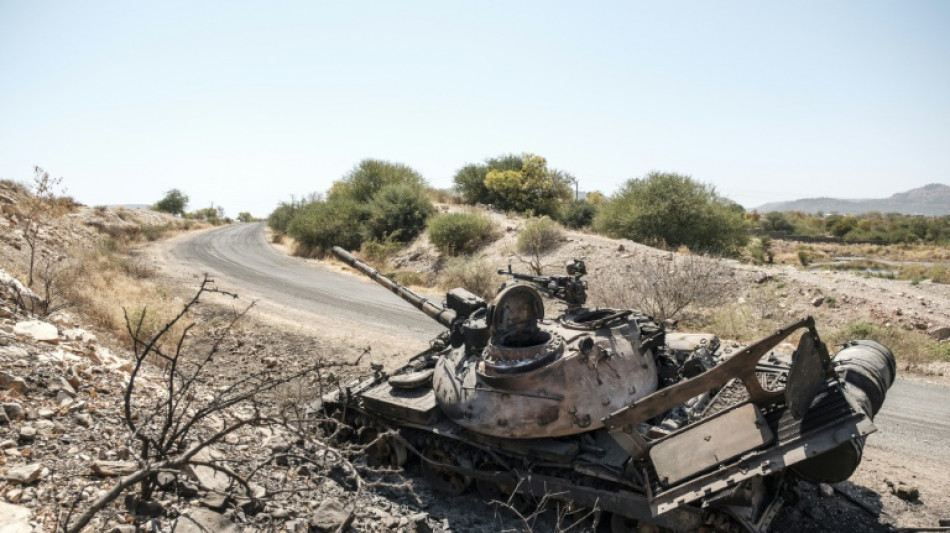
Two years after war broke out in northern Ethiopia between federal forces and Tigrayan rebels, the country remains in deep crisis, with its once-vibrant economy in ruins and a humanitarian disaster roiling Tigray.
A breakthrough agreement announced Wednesday between the federal government and Tigrayan regional authorities to cease hostilities has been hailed as "a welcome first step" by UN chief Antonio Guterres but crucial details remain unclear, with no mention of Eritrea, a key player in the conflict.
- 'Half a million dead' -
The war's toll is unknown, but the US envoy to the UN, Linda Thomas-Greenfield, recently said that the devastation and deaths "rival what we're seeing in Ukraine".
"Over two years of conflict, as many as half a million... people have died, and the United States is deeply concerned about the potential for further mass atrocities."
The war erupted on November 4, 2020, following tensions between the federal government and the Tigray People's Liberation Front (TPLF), which dominated Ethiopian politics for nearly three decades until the election of Prime Minister Abiy Ahmed in 2018.
The violence has drawn in regional militias from Amhara and Afar in northern Ethiopia as well as forces from Eritrea, whose leader Isaias Afwerki has a longstanding enmity with the TPLF.
Tigray has faced severe shortages of food and medicines and limited access to electricity, banking and communications, with UN warnings that hundreds of thousands of people were on the brink of famine.
UN investigators have accused Abiy's government of crimes against humanity in Tigray, including the use of starvation as a weapon -- claims rejected by the authorities.
The region of six million people has been largely closed off to the outside world for well over a year, making it very difficult to assess conditions on the ground.
"We will never know the real toll," said Patrick Ferras, a geopolitical researcher and president of Strategies Africaines, who told AFP that at least 300,000 people had likely lost their lives in the conflict.
A military source who spoke to AFP on condition of anonymity said it was impossible to count the fighters involved but analysts believe the number extends into several hundred thousand.
- A fractured country -
The war has exposed underlying fissures within Africa's second most populous nation, with both sides accused of abuses against civilians based on their ethnicity.
A mosaic of more than 80 ethno-linguistic communities, Ethiopia has long struggled to manage the diversity within its borders, with its most populated region Oromia witnessing constant clashes even as the war in Tigray dominates headlines.
Abiy, who was awarded the Nobel Peace Prize for engineering a rapprochement with Eritrea, now presides over a country fractured along ethnic lines.
The non-profit ACLED, which focuses on conflict, has pointed to "rising levels of violence in many areas throughout Ethiopia", singling out the regions of Oromia, Gambella and Benishangul-Gumuz.
With federal forces focused on northern Ethiopia, the risk of violence elsewhere flaring into prolonged instability poses yet another threat to the country of 120 million people.
- An economy in ruins -
When Abiy took the reins in 2018, Ethiopia's economy was growing at breakneck speed, expanding annually by nearly 10 percent from 2010 onwards.
Since then, the economy has encountered several roadblocks, including the war and the Covid pandemic, to name two.
This year GDP is projected to grow less than four percent, according to the International Monetary Fund.
"The economic situation is disastrous," said Ferras.
Annual inflation, which already averaged 13.5 percent between 2010 and 2018, exploded to around 33 percent this year, driven by rising food prices.
"This is largely due to the setbacks of Ethiopian agriculture," a diplomat told AFP on condition of anonymity, referring to a locust invasion, flooding and drought.
The situation will likely worsen as the war in Ukraine drags on, with the Ethiopian currency's value plummeting against the US dollar and the import-dependent nation's foreign exchange reserves drying up.
The IMF estimates that Ethiopia only has enough reserves to pay for about three weeks of imports as it struggles with a shortfall in development aid given by foreign nations.
"Since the beginning of the conflict, Ethiopia has lost half of its official development assistance," the diplomat said.
- Faint hopes for peace -
Even as peace talks opened in South Africa last week, observers were pessimistic, with fighting showing no signs of letting up after a resumption of combat in August shattered a five-month truce.
In recent weeks, federal forces -- backed by Eritrean soldiers -- captured a string of towns in Tigray, piling pressure on the TPLF.
Wednesday's surprise announcement of a deal to end hostilities was greeted with cautious hope, with the United States calling it an "important step towards peace".
But there are "too many unknowns" surrounding the agreement, said Benjamin Petrini, a research fellow at the International Institute for Strategic Studies in Washington.
"If someone wants to be sceptical you would say that solving it all in eight days of negotiations is not a serious effort," Petrini told AFP.
"You may have only scratched the surface."
F.Brown--ThChM