Iraq landslide disaster throws spotlight on informal shrines / Photo: © AFP/File

When a landslide buried part of an Islamic shrine in Iraq this summer, killing eight pilgrims, sorrow quickly turned to anger because the site was run without oversight from state or religious authorities.
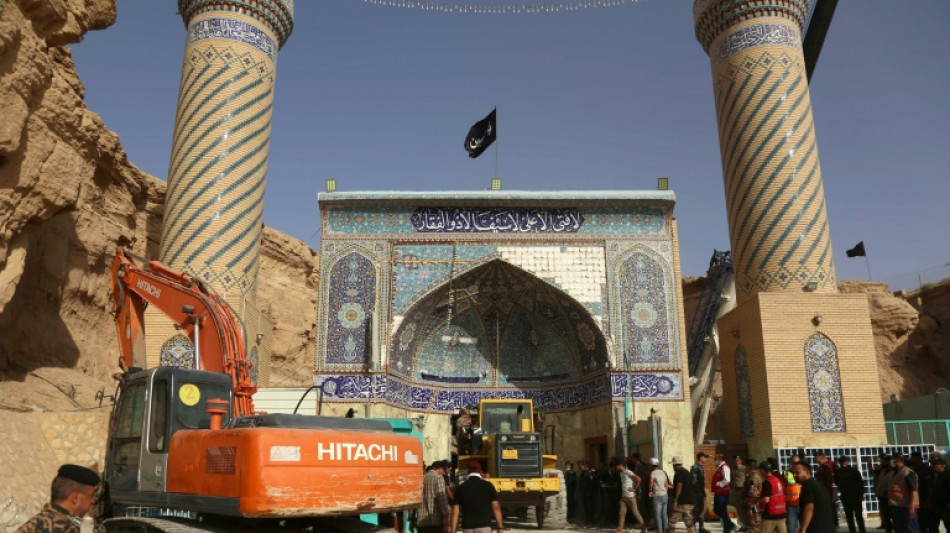
The deadly disaster struck in August near Karbala when tonnes of soggy earth and rock collapsed onto the Shiite shrine Qattarat al-Imam Ali, dedicated to the imam's journey on his way to battle in AD 657.
By the time the search-and-rescue effort was over, three trapped children had been brought out alive -- but the bodies of two men, five women and one child had also been pulled from the rubble.
The shared grief quickly gave way to public fury when Iraqi government and religious officials said they were not responsible for the site, or for policing its building and safety standards.
The shrine was one of hundreds that are being run privately and are therefore unregulated -- many of which, some critics charge, operate with profit rather than piety as the main motive.
Karbala resident Maitham Abbas lashed out at what he called a "fake shrine", dismissing it as a money-making scheme.
Since the tragedy, politicians, clerics and religious officials have acknowledged the need to better enforce building standards in a war-scarred country generally plagued by crumbling infrastructure.
Iraq's Waqf, the body in charge of managing Shiite mosques, tombs and other places of worship, reports that only 135 out of Iraq's 664 known sanctuaries are formally registered.
The others are beyond Waqf's remit and derive their legitimacy from the faith invested in them by flocks of visiting pilgrims, many of whom give what they can in donations.
There are "around 100 shrines dedicated to the daughters of Imam Hassan", who passed only briefly through Iraq, said Hashem al-Awadi, deputy head of the government department responsible for Shiite shrines.
"Where does all this offspring come from?" he asked incredulously.
- Informal pilgrimage sites -
Most Iraqis follow Shiism, a strand of Islam that was long suppressed under dictator Saddam Hussein, a Sunni Muslim, before his secular Ba'athist regime was toppled by the US-led invasion of 2003.
Under Saddam, "an informal approach was cultivated by the people, indeed by the Shiite institutions, to avoid being attached to the state", said Sabrina Mervin, a historian specialising in Shiism.
The post-Saddam years were marred by sectarian violence but also saw a Shiite revival as millions of faithful once more flocked to their holy sites, especially the Shiite shrine cities of Najaf and Karbala.
Hundreds of smaller shrines opened up -- many outside the purview of the religious authorities, which are often reluctant to proactively check building standards for fear of offending believers.
The Shiite revival was driven not by institutions but by "pilgrim practices which evolve from the grassroots, from the religiosity of the faithful", said Mervin, of the French National Centre for Scientific Research.
"If there are pilgrims... there is necessarily a foundation story that makes a place a holy place," she said.
"The religious authorities have no arguments to prevent pilgrims from showing their attachment and devotion to major Shiite figures, even in places that are unrecognised."
- Registration can be tricky -
Most such sites are dedicated to relatives or descendants of Imam Ali, the son-in-law of the Prophet Mohammed and the founder of the Shiite strand of Islam.
One is located on the side of a motorway south of Baghdad, dating back to the 1980s and not registered by the Waqf, where faithful offer chocolate snacks and small cash donations.
Pilgrim Kamel Rahim, 78, was praying to be healed from sickness at the graves of three distant descendants of Imam Ali -- Sayyed Ahmed, Sayyed Ali and their father Al-Mozher.
Rahim explained that local residents had "discovered stones on which their names were inscribed. They dug and found two graves."
Awadi, the state official, said more shrines should seek official recognition, which offers them "legal weight and stature" as well as state development funding, and grants their guardians the status of civil servants.
But the process of authenticating and approving a shrine is protracted, he said, as it involves an assessment of its founding story and "a lineage investigation" of the deceased who is revered there.
This, he explained, can be a sensitive subject, especially if the request is denied.
"If you report a fake shrine," he said, "how many people do you think will believe you, and how many will accuse you of straying from the path of religion?"
L.Johnson--ThChM