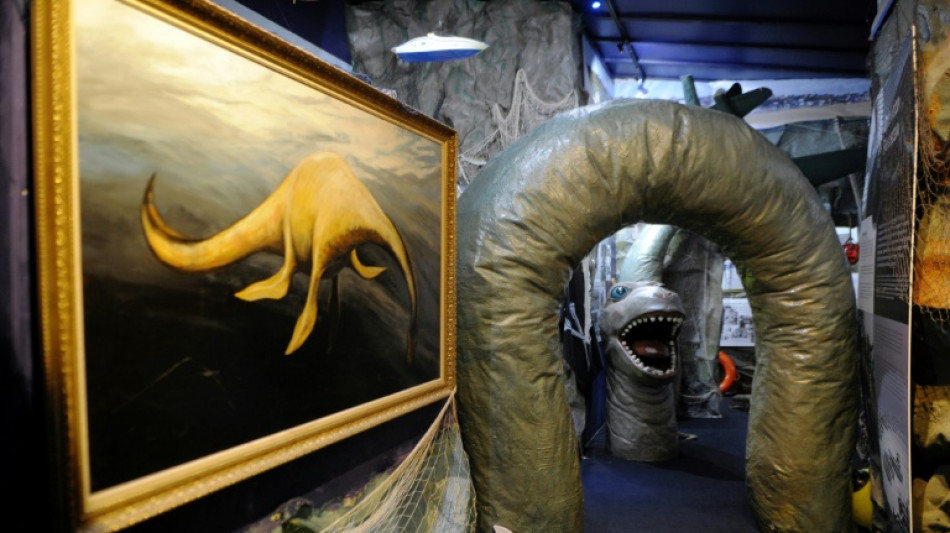
Loch Ness set for biggest monster hunt in decades / Photo: © AFP

The biggest search for the Loch Ness Monster in five decades takes place in the Scottish Highlands Saturday, as researchers and enthusiasts from around the world meet to try to track down the elusive Nessie.
The expedition will deploy drones with thermal scanners, boats with infrared cameras and an underwater hydrophone to try to unravel a mystery that has captivated the world for generations.
"It's always been our goal to record, study and analyse all manner of natural behaviour and phenomena that may be more challenging to explain," said Alan McKenna, of co-organisers Loch Ness Exploration.
The searchers believe the thermal scanners could prove crucial in identifying any strange anomalies in the murky depths.
The hydrophone will allow the searchers to listen for unusual Nessie-like underwater calls.
Stretching 23 miles (36 kilometres) and with a maximum depth of 788 feet (240 metres), the freshwater loch is the UK's largest lake by volume.
- Ancient monster -
Reports of an aquatic monster lurking in Loch Ness date back to ancient times, with stone carvings in the area depicting a mysterious beast with flippers.
The earliest written record of the creature dates back to AD 565 in a biography of the Irish monk, Saint Columba.
According to the text, the monster attacked a swimmer and was about to strike again when Columba commanded it to retreat.
More recently in May 1933, the local Inverness Courier newspaper reported a couple driving along a newly constructed lochside road seeing "a tremendous upheaval" in the water.
"There, the creature disported itself, rolling and plunging for fully a minute, its body resembling that of a whale, and the water cascading and churning like a simmering cauldron," the report said.
In December that year, British newspaper the Daily Mail recruited a South African big game hunter, Marmaduke Wetherell, to locate the sea serpent.
Wetherell found large footprints that he believed belonged to "a very powerful soft-footed animal about 20 feet long".
But zoologists at London's Natural History Museum determined that the tracks were made with an umbrella stand or ashtray that had a hippopotamus leg as a base.
In 1934, English physician Robert Wilson captured what came to be known as the "Surgeon's Photograph," seemingly depicting Nessie's head and elongated neck emerging from the water.
The photo, published in the Daily Mail, was later revealed to be part of a hoax, catapulted the Loch Ness Monster into international fame.
There are now more than 1,100 officially recorded Nessie sightings, according to The Loch Ness Centre in Drumnadrochit, near Inverness.
The monster brings in millions of pounds (dollars) in tourism revenue to the Scottish economy each year.
- Prehistoric reptile -
Over the years, scientists and amateur enthusiasts have tried to find evidence of a large fish such as a sturgeon living in the depths of the loch.
Some have suggested the monster could be a prehistoric marine reptile like a plesiosaur.
In 1972, the Loch Ness Investigation Bureau undertook the biggest search to date but returned empty-handed.
In 1987, Operation Deepscan deployed sonar equipment across the width of the loch and claimed to have found an "unidentified object of unusual size and strength".
In 2018, researchers conducted a DNA survey of Loch Ness to determine what organisms live in the waters.
No signs of a plesiosaur or other such large animal were found, though the results indicated the presence of numerous eels.
"The weekend gives an opportunity to search the waters in a way that has never been done before, and we can't wait to see what we find," said Paul Nixon, the general manager of the Loch Ness Centre.
H.Au--ThChM