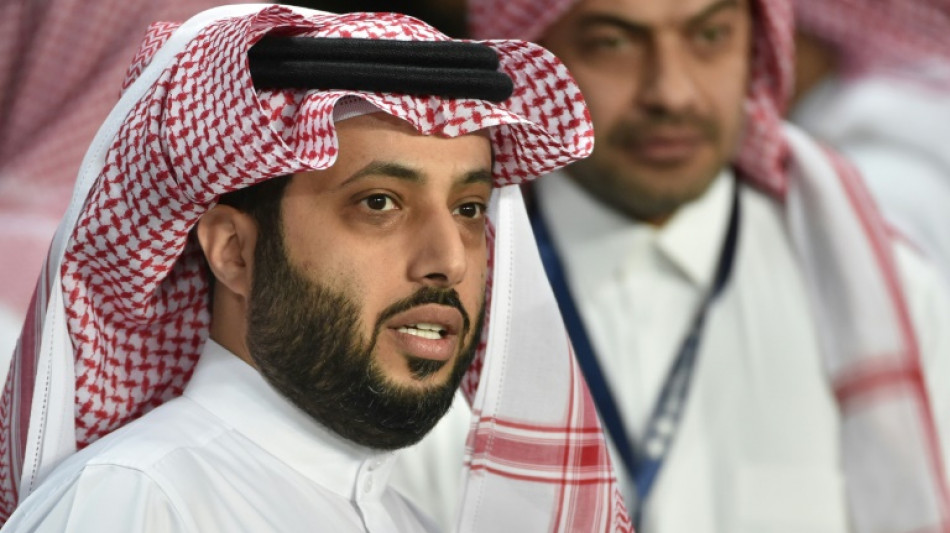
Patronage or conquest? Saudis move in on Egypt's culture / Photo: © AFP

Saudi largesse is flooding Egypt's cultural scene, but the reception is mixed. Some welcome new "cooperation" between two regional powerhouses, while others fear a hostile takeover by Riyadh.
In Cairo, historically the cultural capital of the Arab world, Culture Minister Nevine al-Kilany recently hosted Turki al-Sheikh, head of the Saudi General Entertainment Authority.
The deep-pocketed Sheikh has emerged as a Medici-like patron for Egypt's cultural elite, courted by Cairo's top talent to produce a slew of forthcoming films.
A new three-way agreement between Sheikh, Kilany and United Media Services -- a multi-media conglomerate linked to state intelligence that owns much of Egypt's media and entertainment industry -- will see "cooperation in an array of fields" including "theatre, cinema and music", the culture ministry said.
For culture critic Magda Khairallah, this is yet another example of "Saudi Arabia wanting to change the stereotype about its relationship with art".
On Egyptian television, Sheikh defended the agreement as benefiting everyone.
"Egypt is teeming with talent and professionals and Saudi Arabia is going through a major renaissance," he said.
"By complementing each other, we can take a great leap forward together."
The conservative Gulf kingdom has pivoted away from its forbidding reputation for several years, inaugurating mixed-gender music festivals and cinemas while easing social rules.
"But you can't create an art scene overnight," Khairallah told AFP, and that's where Egyptian talent comes in.
- Art 'for a price' -
For a century, Cairo has been known as the "Hollywood of the Arab World", its films much loved and stars recognised across the region.
But with Egypt facing the worst economic crisis in its modern history -- its media industry included -- Khairallah warns that Saudi beneficence is breeding an unequal power-dynamic of more buy-out than partnership.
"There's a difference between collaboration and financing; in a collaboration both sides are creating and producing art, but that's not what Saudi Arabia is doing," Khairallah said.
"They're getting our art, our stars and our music, for a price."
Already, Saudi Arabia's growing film festival circuit -- part of the kingdom's plan to attract 30 million tourists a year by 2030 -- has been studded with Egyptian artists, actors and musicians.
But despite Riyadh's rise as a new cultural Mecca for Arab talent, not everything has gone smoothly.
Last month, the first "Saudi-Egyptian Night" -- a musical event at the Cairo Opera House -- caused a stir among Egypt's cultural critics.
Headlined by Egyptian talent including maestro Omar Khairat and singers Mohammed Mounir and Sherine Abdelwahab, the evening was attended by Cairo's glitterati and their benefactor Turki al-Sheikh, who was guest of honour.
According to Hend Salama, who leads theatre news coverage at Egyptian magazine Rose al-Youssef, "there was no respect" for the opera house as an institution.
"It is a symbol of Egyptian art, not a private stage," she said, adding that "the Saudi Entertainment Authority alone was in charge of invitations, selecting celebrities. How can we call that collaboration?"
Egyptian critic Mohamed Abdelkhalek said the event also violated a de facto culture ministry moratorium to suspend all festivities and celebrations in solidarity with Palestinians under Israeli attack in the neighbouring Gaza Strip since October.
"We cancelled the Cairo Film Festival and we cancelled the Arab Music festival. What has happened now? Have the massacres stopped?" Abdelkhalek asked.
- 'Big Time' fund -
Riyadh has been accelerating its charm offensive as part of a strategy by de facto ruler Crown Prince Mohammed bin Salman to divert Saudi oil wealth into movies, sports, video games and tourism, while overseeing dramatic domestic social change.
In a rare move, the kingdom has already bestowed Saudi citizenship on a handful of celebrities including Egyptian comedy star Mohammed Heneidy and talk show host Amr Adib.
Sheikh has also announced his "Big Time" fund for Arab cinema, which is set to produce 10 Egyptian films this year.
The endeavour -- worth four billion Egyptian pounds ($84 million) -- is a major boost to an industry with a wealth of talent but an economic landscape that has hobbled production capacity.
In the 1950s, when the industry was nationalised in the early days of the republic, Egypt was the world's third largest film producer.
Now, despite having produced three quarters of all Arab movies, only 21 films were released in 2022.
As Saudi Arabia attempts to build a "cultural archive of its own", Abdelkhalek told AFP that "it's only natural for it to lean on Egyptian artists and technicians for the Saudi artistic renaissance".
And that flurry of Saudi-funded production is directly benefiting Egyptian artists -- including theatre directors and actors who now showcase plays in the kingdom.
But Khairallah warns this can also be a double-edged sword.
"Having funding is great, as long as that doesn't come with imposing ideas on the Egyptian artist," she said.
"Then it's just a way to exert control."
O.Tse--ThChM