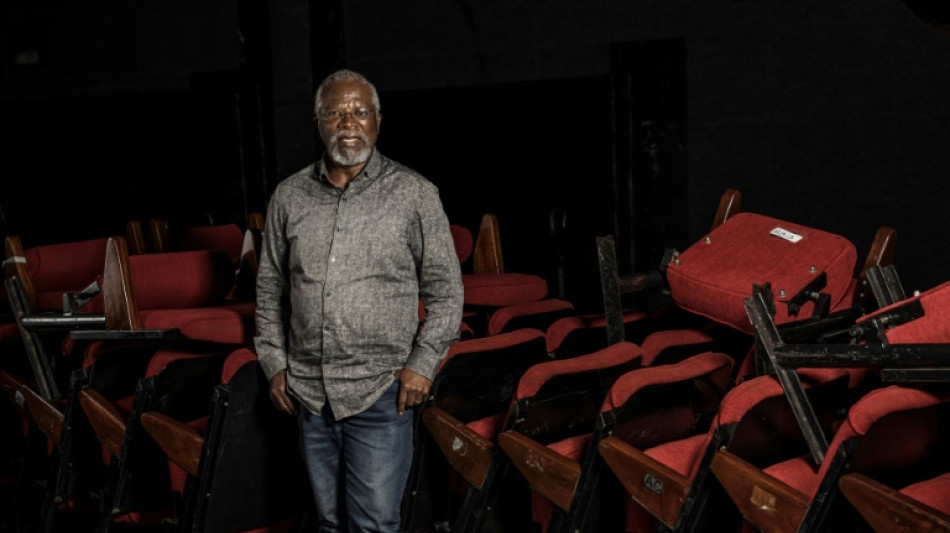
Theatre legend Kani turns eye to modern South Africa / Photo: © AFP

When John Kani launched his acting career in the 1960s, the only stage he could find was an empty snake pit at a shuttered South African museum.
His latest production, "Kunene and the King", opened with the Royal Shakespeare Company and played on London's West End.
It's now resuming a South African tour that was interrupted by the pandemic's theatre closures.
"In 2018, I had the idea that the following year, we are going to celebrate 25 years of South Africa's democracy since the dawn of the new, non-racial, non-sexist rainbow nation," Kani told AFP.
The play he wrote tasks Lunga Kunene -- an older, black, male nurse -- with caring for an older white actor dying of liver cancer but desperate to survive long enough to accept the role of Shakespeare's "King Lear".
"I wanted to create something that would force the one not able to live without the other one," Kani said.
He's definitely created a theatre about theatre, with Shakespeare running through its veins.
"I suddenly found myself engrossed in the history of these two men, from opposite sides in one country, who see South Africa differently, but the only thing that would bring them together is their love of Shakespeare," he said. "And that's how King Lear got inter woven into the story."
The two characters run lines from Shakespeare's tragedy, accentuating Lear's grappling with death.
And they recite lines from "Julius Caesar", both from the original play and a translation into Kani's mother tongue of Xhosa, which he remembers performing in high school in 1959.
On the current tour, Kani performs with the prolific South African actor Michael Richard, who said the story uses King Lear's evolution to show how South Africa is also changing.
"Lear learns humanity in the play. And in this play, my character learns humanity, in a way of coming to terms with South Africa," Richard said.
- Theatre about theatre -
The tragedies in Kani's play unexpectedly started appearing in real life.
His co-star in the British productions was South African-born actor Anthony Sher, a knighted Shakespearean performer. Sher died in December of liver cancer, the same disease that kills his character in Kani's play.
And his younger brother also died of liver cancer in 2019, as the play was taking shape.
For all the sadness, the play is also very funny, and perhaps a revelation for younger fans who may know Kani best for playing the Black Panther's father in the Marvel films, or voicing the shaman mandrill Rafiki in the 2019 "Lion King" remake.
In South Africa, Kani is a legendary figure of protest theatre. His 1960s plays in the snake pit brought him into collaboration with Athol Fugard, widely regarded as one of the nation's greatest playwrights.
They defied the apartheid-era segregation laws by meeting in secret, and staging rehearsals in classroooms and garages, under the constant harassment of the feared police.
They adopted the name the Serpent Players, and performed classics like "Antigone" in the snake pit at an under-loved museum.
"It was a museum, an amusement place with the museum," Kani said. "On the other side, you would see the dolphins, and when Port Elizabeth was economically really down, everybody would say, would someone please let the dolphins out before you lock up the place."
By the early 1970s, Kani, Fugard and fellow performer Winston Ntshona were writing new plays that exposed the harsh realities of life under apartheid.
Kani and Ntshona won a Tony in 1975 for their New York performance of "Sizwe Banzi is Dead".
All three also wrote "The Island", a seminal play about prison conditions on Robben Island, where Nelson Mandela and other leader activists were jailed.
Today theatre in South Africa is struggling, with audiences still limited to 50 percent occupancy under Covid regulations.
After the pandemic inflicted so much illness and death on the world, Kani said the play is now received somewhat differently.
Now bringing the play post-Covid, people "understand the process" of illness and dying, he said. "Africans have a great reverence for death and life. And they understand the process and the journey, but they see it as a continuation of life."
C.Fong--ThChM