'Private rebellion': Hong Kong's anglophone poets gain recognition abroad / Photo: © AFP

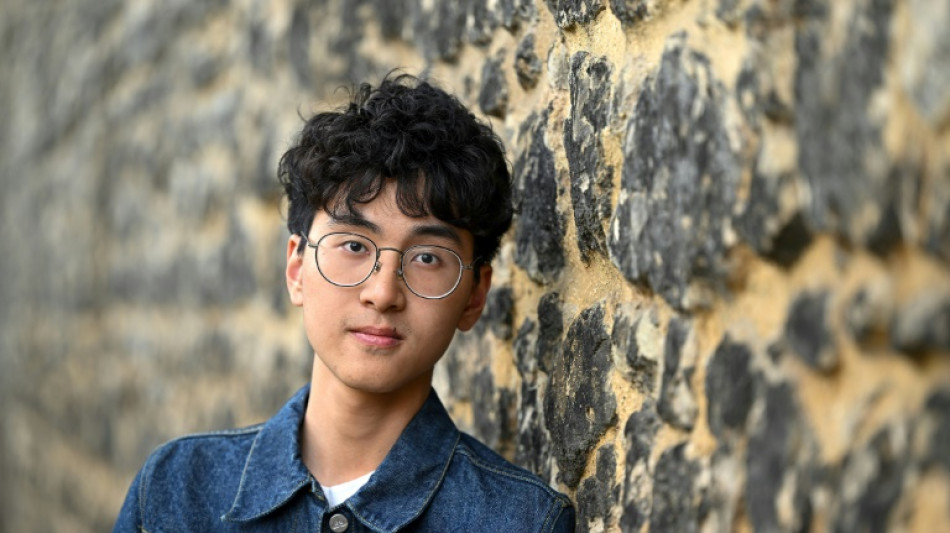
As a teenager stuck in Hong Kong's pressure-cooker school system, Eric Yip found his escape in writing poetry -- never dreaming that one day his work would go on to win a top prize halfway across the world.
In March, at the age of 19, he became the youngest ever winner of the United Kingdom's National Poetry Competition.
He beat more than 7,000 contenders from 100 countries and placed himself squarely among a cohort of Hong Kong poets writing in English that has found increasing recognition over the past decade.
Now an economics undergraduate at Cambridge, Yip recalled the "liberating" feeling of reading material that had nothing to do with high-school English classes taught according to a strict syllabus.
"Writing poems was a private rebellion against this regimented approach," Yip told AFP.
His award-winning "Fricatives" begins with the narrator taking English lessons as a "spectacled boy with a Hong Kong accent" and opens up to explore issues of language, race, sex and migration.
A former British colony, Hong Kong has developed its own literary tradition in both Chinese and English, although anglophone poets remain a minority and receive little establishment support.
"There's always a certain estrangement one feels when writing in a second language", Yip said, but English has now become his "private language" in which words flow more naturally.
"What matters to me is the emotional truth of writing. If English is what will get me closer to that, then I'll keep using it."
- Queer poetry in spotlight -
Anglophone poets who spoke to AFP agreed their output was hardly mainstream, but said writing from the margins allowed them to challenge Hong Kong's norms.
Yip's win caused a stir in Hong Kong media, though most newspapers were silent on the poem's description of a gay encounter -- mirroring the mixed reactions of some local readers.
"The sexual element and the poem's queerness are absolutely essential," Yip said.
"I was thinking about the parallels with oracy and colonialism, how it all ties back to submission."
Other Hong Kong poets who have found success in tackling LGBTQ themes include Nicholas Wong, whose collection "Crevasse" won one of the best-known prizes for queer literature worldwide in 2016.
His latest collection was a finalist for the same Lambda Literary Awards' gay poetry prize this year.
Wong said his writing tapped into themes about "everyday desire" in a way he found immediate and spontaneous.
In a recent poem, the speaker imagines inviting his father to his wedding held in Taiwan -- the only jurisdiction in Asia where gay marriage is legal.
Wong, 43, who teaches at a local university, said he had witnessed Hong Kong's community of poets grow into something "more substantial, less fragile".
Having been a published poet for over a decade, Wong said he felt emboldened to experiment with language in a way that might feel obscure to Western readers.
"Maybe because it's my second language, I don't assume it will love me back. So I can do whatever I want with it and to it," he told AFP.
- Poetic dissent -
Academics have shown "growing interest" in Hong Kong poetry to understand how residents feel about the city's social and political transformation, according to scholar and poet Jennifer Wong.
The massive citywide democracy protests three years ago -- and Beijing's subsequent crackdown --proved a watershed.
The movement included violence that some experts say left many quietly traumatised, while solidarity between protesters gave rise to outbursts of creativity.
Last year anonymous poets behind the US-based Bauhinia Project published "Hong Kong Without Us", which they described as a crowdsourced "found poetry" book.
During the protests, they translated snippets of Hong Kongers' voices -- from social media, graffiti, news articles and public submissions -- and distributed them on postcards in the United States.
"We were especially interested in... how the urgency of the politics holds out the potential for a vulnerable, emotional voice," one of the poets told AFP.
"We were just trying to articulate the voice that we imagined to be the best of Hong Kong."
The project blossomed into a book and has become an access point for US readers to "engage emotionally" with Hong Kongers beyond news headlines, the poet said.
"Hong Kong Without Us" concludes with a postscript saying the book is contraband.
In 2020, Beijing imposed a sweeping national security law in Hong Kong that has criminalised most dissent, and many protest-themed literary works have been taken off bookstore shelves.
The poet said he was worried that the repressive political climate would seal shut the "narrow crack" for Hong Kongers to express emotional vulnerability.
"I don't know... what's going to happen in the future when that already slim crack might be gone."
L.Kwan--ThChM