Russian SVR spy agency took over Wagner 'influence' ops in Africa: report / Photo: © FILES/AFP

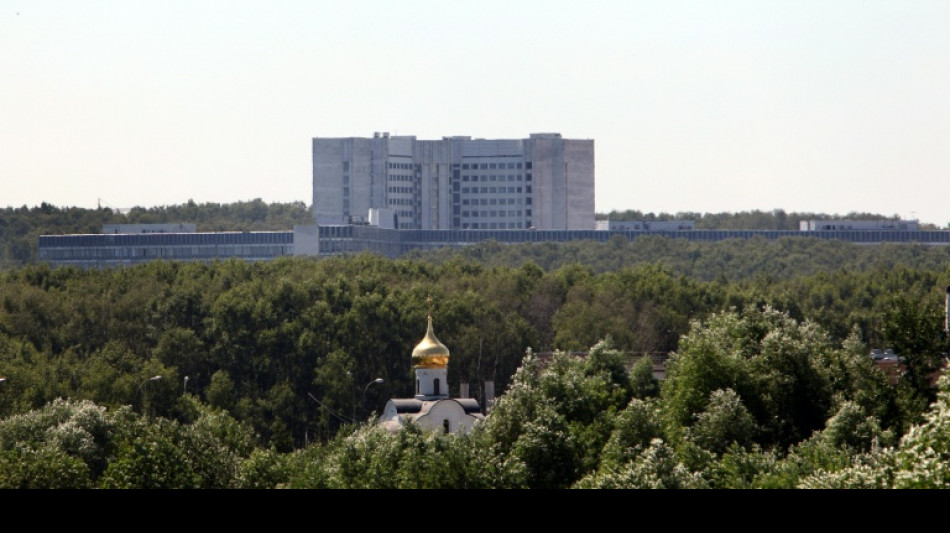
Russia's SVR foreign intelligence agency has taken over mercenary group Wagner's influence operations in Africa after the death of its founder Yevgeny Prigozhin, according to a new investigation.
Wagner, whose brutal methods have been denounced by rights organisations, was Russia's best-known mercenary group.
It had a widespread presence in Africa, deploying fighters alongside the armies of countries including Libya and Mali, and also conducted vast disinformation and destabilisation campaigns.
After Prigozhin died in a plane crash in 2023 following a short-lived mutiny against Moscow, the Russian defence ministry has sought to replace Wagner in Africa and coordinate security operations through an umbrella group known as the Africa Corps.
But it is the SVR that has taken over Wagner's influence operations, aimed at pushing Moscow's political and economic interests, conducting disinformation campaigns and eliminating competition in Africa and beyond, according to an investigation by a consortium of investigative and media outlets, including Forbidden Stories and All Eyes On Wagner.
"The SVR has now taken over the most effective tool of the Wagner Group," said the investigation, which also involved Dossier Center, openDemocracy and iStories.
Nearly 100 consultants work for Wagner's influence branch, called Africa Politology or The Company, the investigative outlets said.
Between 2024 and 2025, the outfit deployed teams across numerous countries, including Angola, Argentina, Bolivia, Burkina Faso, Chad, Ghana, Libya, Mali, Niger and Sudan, the investigation said.
Teams have also been active in Madagascar, Zimbabwe, Egypt, Cameroon, Benin and Namibia.
- 'Influence and disinformation' -
"The SVR provides a layer of intelligence with information on specific topics, recruits sources, opens access and places key agents of influence in strategic roles," the consortium said.
The investigation was launched after internal documents from the network were anonymously sent to the editor-in-chief of the award-winning pan-African media outlet The Continent.
These files -- comprising more than 1,400 pages in Russian -- include strategic plans, staff biographies, operational reports, accounting records and summaries of disinformation campaigns carried out between January and November 2024.
The investigation confirmed the authenticity of the 76 documents and their content.
"The documents show that these operations combine political influence, disinformation and close ties to security services, going far beyond the usual practices in the sector," it said.
Sometimes, the SVR intelligence service competes with the Russian defence ministry, which oversees the GRU military intelligence, or has to coordinate with it, according to the investigation.
While the Russian defence ministry took over Wagner operations in countries such as Mali, it did not bring the Russian private military contractors under its control in the Central African Republic.
"In the Central African Republic, the SVR is called upon to help the defence ministry avoid hindering the activities of Wagner," investigators said.
- 'Political win' -
The investigators reveal the nearly systematic involvement of the SVR across Africa.
"In Mali, the SVR is tasked to provide intelligence to Africa Politology regarding the military and political plans of France and the United States in the Sahel," the consortium said.
"It is also missioned to provide diplomatic support for the creation of a new military-political union to Mali, Burkina Faso, Niger and the Republic of Guinea."
After successive coups in 2021, 2022 and 2023, junta-run Mali, Burkina Faso and Niger have turned their back on former colonial power France, drawing closer to Russia.
They broke ties with west African regional bloc ECOWAS and launched a rival group, the Alliance of Sahel States, or AES, in 2023.
"Russia's strategy manifested with the creation of the Alliance of Sahel States," the investigation said.
"That's a significant political win," Lou Osborn, co‑author of the investigation, told AFP, adding that Russians were particularly successful in the "unstable, vulnerable" Sahel countries.
She said she found the network's lobbying efforts in Africa "fascinating".
"They have so many lawyers, and they really try to influence laws," she added.
The journalists identified a network of companies used to send funds from the SVR to The Company.
According to their calculations, the budget for the influence operations between January and October 2024 amounted to nearly $7.3 million, or about $750,000 per month.
Despite their budget and efforts, Russia did not have much to show for its efforts, the investigators said.
"Russia is playing the long game but the results are not always quick to materialise," they said.
"On the African continent, Russia is signing a lot of memorandums of understanding but fails to convert these non-binding agreements into money-making businesses."
O.Yip--ThChM