Hungary music festival basks in post-Orban freedom / Photo: © AFP

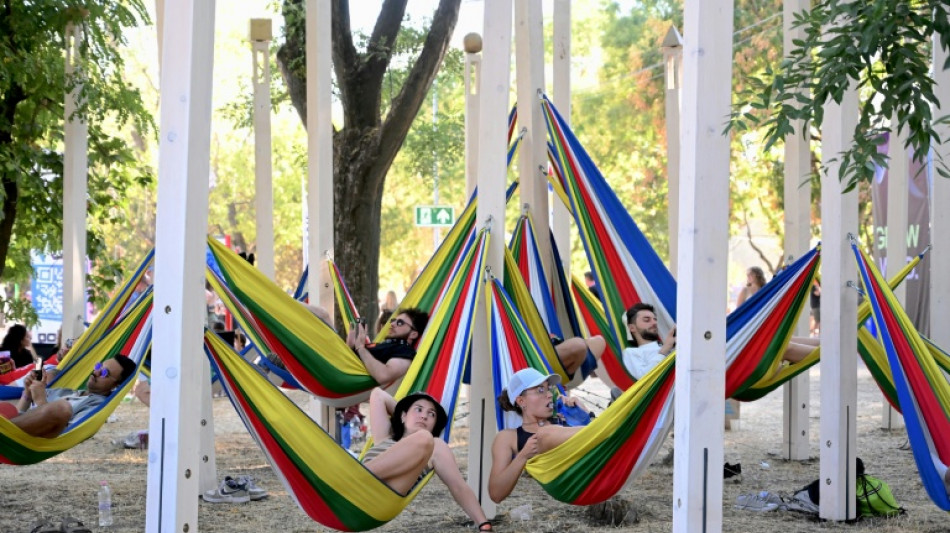
Drifting between concert stages and chilling on hammocks, revellers partied in Hungary this year at one of Europe's largest outdoor festivals, with organisers saying they no longer felt "headwinds" under the country's new government.
The Sziget Festival, held on a Danube island in Budapest known as the "Island of Freedom", has long had a reputation for openness, diversity and self-expression. That sometimes put it at odds with the "illiberal" vision of the central European country's former leader.
This year's edition came just months after pro-EU conservative Peter Magyar won April's vote by a landslide -- with many young Hungarians dancing in the streets of Budapest on election night -- ending nationalist Viktor Orban's 16-years in power.
"It's as if everything that's happened over the past six months comes to a climax here," 27-year-old student Greta Racz, who volunteered at a local pro-democracy NGO's tent, told AFP at the festival.
"Foreigners came to us, talking about how they are proud of us, and asking what it was like, how we experienced this change," she added.
Organisers said unlike in past years, ministers consulted with them on practical issues ranging from transport to healthcare services and visited the grounds during the festival.
"We were able to do our job without headwinds blowing against us. That is a huge thing in itself," Tamas Kadar, who heads the organization behind the festival, told AFP.
- 'Sziget's DNA' -
Established in 1993, Sziget has drawn about 400,000 visitors in recent times.
This year, attendance of the week-long festival fell to around 350,000, with organisers blaming a scorching heatwave as one of the reasons for the drop.
The line-up included Twenty One Pilots, Florence + the Machine, Lewis Capaldi and Sombr.
Beyond the music, the festival also hosted, as every year, venues for advocacy, including promoting LGBTQ rights.
Kadar said it was exactly the values within "Sziget's DNA" that had made it a target under Orban.
He lamented that the festival -- one of Hungary's largest tourism events -- had received zero support in the past decade, even after it was forced to skip two years due to the Covid pandemic.
A 2021 anti-LGBTQ law banning the "promotion of homosexuality" to minors also forced organisers to implement ID checks at long-time Sziget venue Magic Mirror to ensure only adults could attend some events.
"This is a measure that is beneath a festival and completely absurd; there's been something like this every year," Kadar said.
The restriction ceased this year, after the EU's top court ruled that the legislation was with the bloc's law.
According to Kadar, tensions culminated last year, when Orban's government prevented Irish rap group Kneecap from performing at Sziget, imposing a three-year entry ban on the band after accusing it of "antisemitic hate speech".
"You can judge a band's political position one way or another. But the fact that artistic freedom could be treated with such disregard in a country clearly made the island's situation even more difficult," he added.
- 'It's summer' -
Ruling Tisza party lawmaker Ildiko Eva Sopov pledged the new government would not bring politics and ideology into areas where the state "does not have a role".
"This is a festival; it is about recreation, it is about culture, and it must be treated within that context," she told AFP after participating in a panel discussion at Sziget.
Hungarian festival-goers told AFP they enjoyed the festival's vibe.
"Sziget was always a political bubble with everyone being nice and lib(eral)," said finance worker Marton Szabo, 25, who was attending the festival for the fourth time.
But other attendees admitted they have already tuned out of politics.
"Now that there has been a change (of government), I'm much less interested," said Niki Liptak, 24, a university graduate. "It's summer."
I.Ko--ThChM