How a Dongbei Livestream Meme Became a Hit Indie Game

A staged-looking 2016 feud between northeastern Chinese livestreamers evolved into “Once Upon a Time in Dongbei,” then found a new audience through the free Steam game A Summer in Northeast China.
A decade-old livestream feud from Northeast China has completed an unusual journey from Kuaishou clips to Bilibili meme culture and, eventually, a highly rated game on Steam. The project shows how a regional online joke can be remade for a new medium while retaining the language, characters, and locations that gave it its identity.
The source material began in 2016, when two groups of grassroots livestreamers led by Brother Hu and Captain Shamate traded accusations, insults, and challenges on Kuaishou. Their exchanges were loud and theatrical, drawing on Dongbei dialect, local bravado, and the unruly style associated with early livestreaming on a platform popular in rural areas and lower-tier cities.
Many viewers believed the conflict was staged and coordinated for entertainment. That did not reduce its popularity. Audiences recorded the broadcasts, reposted them, and separated memorable lines and gestures from their original context. On Bilibili, the clips were remixed and quoted so frequently that followers jokingly treated them as a body of classics under the title “Once Upon a Time in Dongbei.”
The phenomenon grew from a region already central to Chinese comedy and discussions of postindustrial identity. Northeast China was once a center of heavy industry, but decades of decline gave it a reputation as the country’s Rust Belt. Cultural works have turned that history into both tragedy and humor. Television drama The Long Season drew on nostalgia for the industrial era, while the phrase “Dongbei Renaissance” came to describe renewed interest in the region.
Northeastern performers had long been nationally influential. Zhao Benshan’s television sketches made the accent familiar across China, and Kuaishou later turned regional speech and slang into a constant source of internet humor. The Brother Hu–Captain Shamate saga entered that tradition while remaining tied to a specific period of online video culture.
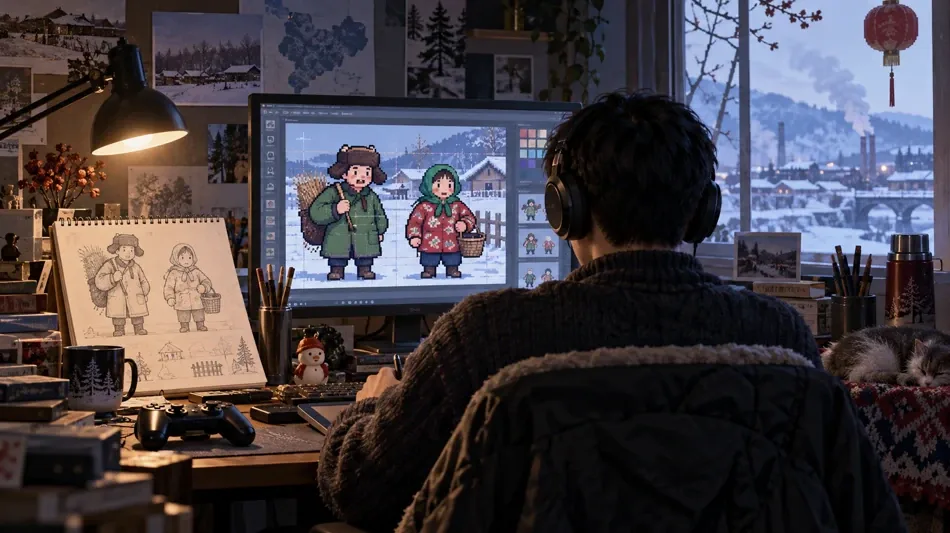
Seven years after the original broadcasts, Bilibili creator Zhuangbuchun converted the memes into A Summer in Northeast China, or DongBeiZhiXia. His Zhuangbuchun Studio released the game free on Steam on Jan. 9, 2023. It has since collected more than 12,000 positive reviews and an “Overwhelmingly Positive” rating, despite supporting only Simplified and Traditional Chinese.
The game belongs to the “gal game” genre, which generally centers on relationships and conversations with female characters. Its story takes place years after the Kuaishou incidents and follows Xiaoliang as she tries to recover her memories with help from a group of companions. Those women are loosely based on people from “Once Upon a Time in Dongbei.”
Gender-swapping is the adaptation’s most visible device. Men at the center of the original feud become female characters who keep recognizable names, visual features, and personality traits, but are redesigned to fit gal-game conventions and the wider aesthetics of anime, comics, games, and novels.
That choice shifts the material between cultural styles. The original videos relied on masculine confrontation, regional performance, and rough livestream authenticity. The game uses a softer, character-driven structure and a first-person linear narrative. Familiar incidents return as references for established fans, while the new format gives players with no knowledge of the clips a route into Xiaoliang’s story.
Zhuangbuchun also combined Dongbei culture with other subcultures familiar to his audience. These include shamate, a Chinese youth style known for flamboyant hair and clothing, and otaku fandom associated with Japanese anime, manga, and games. Northeastern dialect anchors those influences in the region and supplies much of the humor.
Development followed a model common among small Chinese studios. Zhuangbuchun financed much of the work himself, supplemented by crowdfunding on the domestic creator-support platform Afdian. He directed and designed large parts of the project, outsourced selected tasks, and recruited voice actors for the female cast.
Working publicly became as important as the financing. In April 2022, almost a year before release, Zhuangbuchun posted a video announcing the gender-swapped interpretation. It received more than 1.5 million views, 71,000 likes, 23,000 saves, and 11,000 reposts, giving the unfinished game a substantial audience.
He continued posting designs, asking viewers to assess voice acting, and explaining delays. When followers objected to an accent or proposed a different character appearance, he sometimes revised the game. The eventual players therefore did more than receive marketing material; parts of the product were shaped through their responses.
Research trips reinforced the connection to place. Zhuangbuchun visited Shenyang, the capital of Liaoning province, several times to document sites connected with the original Kuaishou episodes. During a return visit after release, he encountered fans of the game. Videos from those trips presented the project as an engagement with both the memes and the local culture behind them.
Frequent updates kept the title visible on Bilibili, where Zhuangbuchun already had more than 2 million followers. The original streamers also posted reaction videos and interacted with his updates, connecting the finished game with the people whose online performances inspired its cast.
A Summer in Northeast China is not the first game to adapt a meme or mix regional Chinese culture with international fan aesthetics. Its distinctiveness lies in the combination: a free gal game, gender-swapped characters, a Dongbei setting, a prominent Bilibili creator, and source material drawn from early Kuaishou’s chaotic livestream scene.
For a low-budget independent developer, the same online ecosystem supplied nearly every part of the project: original material, a ready audience, feedback, crowdfunding, publicity, and community participation. Zhuangbuchun did not merely reproduce an existing joke; he used the participatory culture around it to transport the story between platforms and generations.
The result still carries tensions. A polished character game inevitably changes the coarse energy of the livestreams, and broad internet appeal can sit uneasily beside claims of local authenticity. Yet the game continues to speak in regional language and return to regional places. Zhuangbuchun, who has said he loves Dongbei despite not being from there, became an outsider helping reshape the culture for new viewers.
From Kuaishou to Bilibili and then Steam, the material changed form at every stage without abandoning Northeast China as its center. Zhu Siheng, a University of Rochester doctoral candidate, and Han Yisong, a postdoctoral researcher at City University of Hong Kong, contributed to the research on which the account was based.
D.Pan--ThChM