The China Mail - Bird flu kills almost 14,000 pelicans, seabirds in Peru

USD -
AED 3.672502
AFN 64.000558
ALL 80.906293
AMD 358.057859
ANG 1.789785
AOA 918.000371
ARS 1550.745304
AUD 1.426361
AWG 1.8025
AZN 1.668877
BAM 1.740036
BBD 2.003559
BDT 123.852313
BGN 1.747831
BHD 0.375489
BIF 2986.971974
BMD 1
BND 1.274158
BOB 12.010284
BRL 5.4658
BSD 0.994627
BTN 94.291535
BWP 13.758962
BYN 2.955771
BYR 19600
BZD 2.000463
CAD 1.39526
CDF 2312.501301
CHF 0.81644
CLF 0.0248
CLP 976.049842
CNY 6.6809
CNH 6.67095
COP 3246.5
CRC 451.369275
CUC 1
CUP 23.871582
CVE 98.090062
CZK 21.606204
DJF 177.122067
DKK 6.639825
DOP 59.93942
DZD 135.847196
EGP 54.650801
ERN 15
ETB 163.249788
EUR 0.88844
FJD 2.24275
FKP 0.745268
GBP 0.741505
GEL 2.603955
GGP 0.745268
GHS 11.593068
GIP 0.745268
GMD 73.999821
GNF 8810.408095
GTQ 7.60417
GYD 208.500872
HKD 7.845645
HNL 26.733444
HRK 6.76901
HTG 130.391459
HUF 322.841019
IDR 18134.1
ILS 3.16285
IMP 0.745268
INR 94.59815
IQD 1507.908268
IRR 1883408.501455
ISK 121.550039
JEP 0.745268
JMD 157.767152
JOD 0.709012
JPY 158.342497
KES 129.929812
KGS 87.449949
KHR 4062.751587
KMF 441.000411
KPW 899.999961
KRW 1338.860263
KWD 0.31069
KYD 0.8289
KZT 450.213523
LAK 22401.124415
LBP 89543.21849
LKR 330.928532
LRD 169.096028
LSL 16.579341
LTL 2.95274
LVL 0.60489
LYD 6.382657
MAD 9.775113
MDL 17.99331
MGA 4515.451812
MKD 54.686008
MMK 2099.52083
MNT 3598.087189
MOP 8.038145
MRU 40.373975
MUR 47.090284
MVR 15.455027
MWK 1724.696212
MXN 18.649725
MYR 4.064802
MZN 63.909852
NAD 16.579341
NGN 1345.040372
NIO 36.606575
NOK 9.226345
NPR 150.864442
NZD 1.77678
OMR 0.384499
PAB 0.994823
PEN 3.447319
PGK 4.462633
PHP 63.691982
PKR 275.144822
PLN 3.908595
PYG 5942.170819
QAR 3.625947
RON 4.749102
RSD 104.497018
RUB 81.84855
RWF 1471.080115
SAR 3.762939
SBD 8.051718
SCR 13.77558
SDG 601.497618
SEK 9.746098
SGD 1.27812
SHP 0.745545
SLE 22.910165
SLL 20969.504398
SOS 568.442122
SRD 37.542033
STD 20697.981008
STN 21.797153
SVC 8.703542
SYP 13001.999685
SZL 16.563773
THB 33.649498
TJS 9.14122
TMT 3.51
TND 2.972103
TOP 2.40776
TRY 50.022335
TTD 6.742932
TWD 32.8525
TZS 2650.002985
UAH 45.412048
UGX 4202.39832
UYU 39.987723
UZS 11861.722948
VES 890.0366
VND 25704.5
VUV 119.472328
WST 2.779309
XAF 582.778308
XAG 0.019297
XAU 0.000247794321
XCD 2.702549
XCG 1.79257
XDR 0.707052
XOF 582.778308
XPF 106.091876
YER 236.174966
ZAR 16.469789
ZMK 9001.198682
ZMW 20.156742
ZWL 321.999592
SSP 5745.96484
MXV 2.099241
  • RYCEF

    0.4000

    19.71

    +2.03%

  • CMSC

    0.0000

    20.4

    0%

  • BTI

    0.4200

    56.05

    +0.75%

  • BP

    0.2800

    44.43

    +0.63%

  • RBGPF

    1.6000

    67

    +2.39%

  • RIO

    -0.1500

    94.41

    -0.16%

  • AZN

    -0.4300

    166.15

    -0.26%

  • GSK

    0.4600

    49.7

    +0.93%

  • BCE

    -0.4100

    20.56

    -1.99%

  • NGG

    -0.2500

    75.24

    -0.33%

  • VOD

    -0.0400

    16.58

    -0.24%

  • RELX

    -0.4500

    33.07

    -1.36%

  • BCC

    -0.5500

    76.59

    -0.72%

  • CMSD

    -0.0300

    20.27

    -0.15%

  • JRI

    -0.2500

    10.77

    -2.32%

Bird flu kills almost 14,000 pelicans, seabirds in Peru
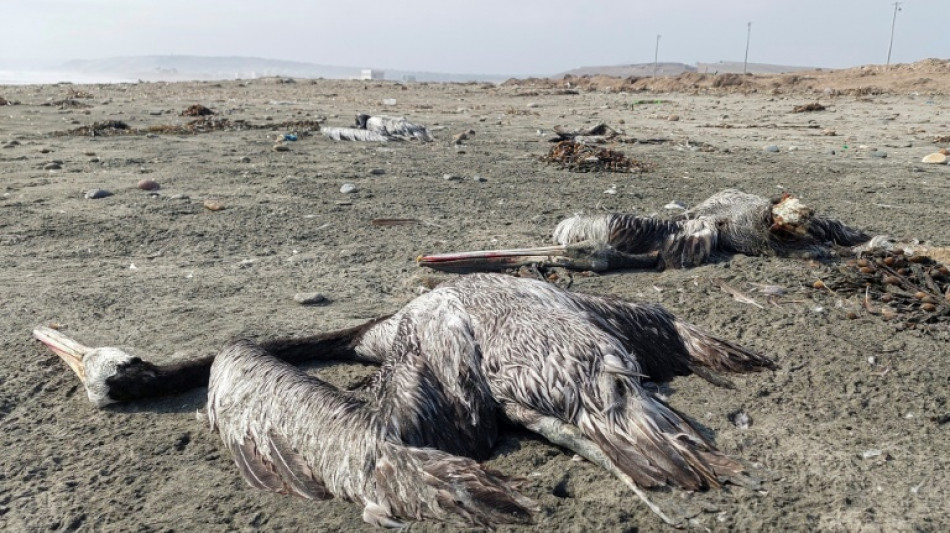
Bird flu kills almost 14,000 pelicans, seabirds in Peru / Photo: © AFP

Bird flu kills almost 14,000 pelicans, seabirds in Peru

The highly contagious H5N1 avian flu virus has killed thousands of pelicans, blue-footed boobies and other seabirds in Peru, according to the National Forestry and Wildlife Service (SERFOR).

Text size:

The current bird flu outbreak began in Canada and spread to the United States, which has seen a record 50 million avian deaths, according to the US Centers for Disease Control and Prevention.

Peru first issued a health alert last Thursday after confirming three cases of H5B1 in pelicans, and since then thousands have been found dead in coastal areas.

"The latest official report carried out at a national level shows more than 13,869 wild seabirds killed by the dangerous H5N1 avian flu virus," said a SERFOR statement released late Tuesday.

This number includes 10,257 pelicans, 2,919 sea boobies and 614 blue-footed boobies, among other species.

Meanwhile, the national agricultural health agency SENASA said it had quarantined the town of Gallito in the northern coastal Lambayeque region to control the first bird flu outbreak on a poultry farm.

SENASA said the health alert was a precaution because the virus arriving from North American migratory birds could spread to "backyard birds," such as ducks and chickens, as well as to commercial farms.

The United Nations' Food and Agriculture Organization (FAO) earlier this year warned countries in South and Central America to be on "high alert" for the virus spreading via migratory birds.

There is no treatment for bird flu, which spreads naturally between wild birds and can also infect domestic poultry. Avian influenza viruses do not typically infect humans, although there have been rare cases.

D.Pan--ThChM