
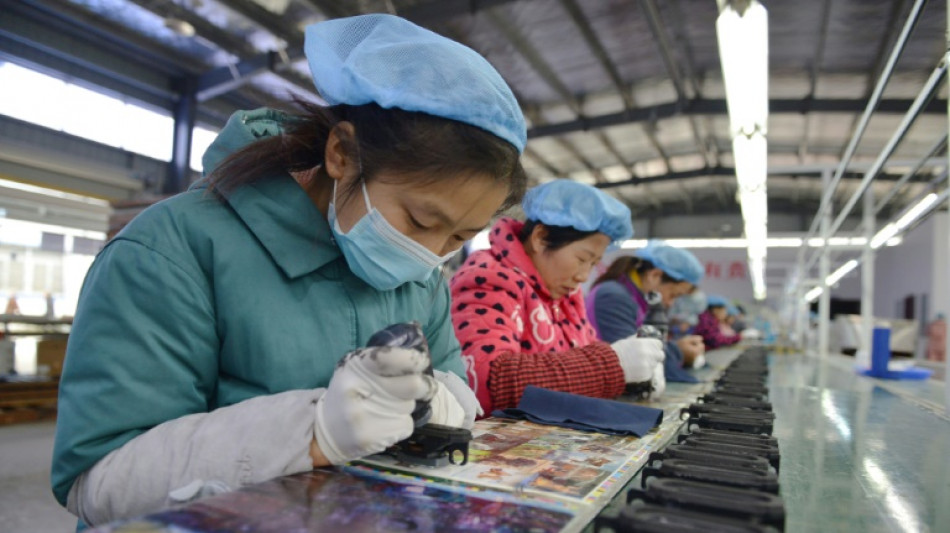
China's 2022 growth seen as its lowest in 40 years / Photo: © AFP/File

China's economic growth for 2022 is expected to have been among its weakest in four decades after the twin crises of the pandemic and property woes, analysts said ahead of Tuesday's GDP announcement.
Ten experts interviewed by AFP forecast an average 2.7 percent year-on-year rise in gross domestic product (GDP) for the world's second-largest economy, a sharp plunge from China's 2021 growth of more than 8 percent.
It could also be China's slowest pace since a 1.6 contraction in 1976 -- the year Mao Zedong died -- and excluding 2020, after the Covid-19 virus emerged in Wuhan in late 2019.
Beijing had set itself a growth target of around 5.5 percent for 2022 but this was undermined by the government's "zero-Covid" policy, which put the brakes on manufacturing activity and consumption.
Strict lockdowns, quarantines and compulsory mass testing prompted abrupt closures of manufacturing facilities and businesses in major hubs -- like Zhengzhou, home of the world's biggest iPhone factory -- and sent reverberations across the global supply chain.
Beijing abruptly loosened pandemic restrictions in early December after three years of enforcing some of the harshest Covid measures in the world.
- 'Growth is slowing' -
China is battling a surge in Covid cases that has overwhelmed its hospitals and medical staff.
This is likely to reflect in 2022's fourth-quarter growth, which will also be announced on Tuesday alongside a series of other indicators such as retail, industrial production and employment.
"The fourth quarter is relatively difficult," said economist Zhang Ming of the Chinese Academy of Social Sciences in Beijing.
"No matter whether it's by the metrics of consumption or investment, the growth is slowing."
China's exports took their biggest plunge since the start of the pandemic in December, contracting 9.9 percent year-on-year, while consumption was in the red in November and investment has slowed.
"The three horse carriages of the Chinese economy are all facing a relatively evident downward pressure in the fourth quarter," Zhang said.
Rabobank analyst Teeuwe Mevissen echoed Zhang, saying the final quarter will "almost certainly show a decline because of the fast spread of Covid" after the loosening of health restrictions in December.
"This will affect both demand and supply conditions for the worse," he said.
Problems in the property sector are also still weighing on growth, Mevissen said.
This sector, which along with construction accounts for more than a quarter of China's GDP, has been suffering since Beijing started cracking down on excessive borrowing and rampant speculation in 2020.
This regulatory tightening marked the beginning of financial worries for Evergrande, the former Chinese number one in real estate that is now strangled by huge debt.
Real estate sales have since fallen in many cities and many developers are struggling to survive.
However, the government appears to be taking a more conciliatory approach to reviving this key sector.
Measures to promote "stable and healthy" development were announced in November, including credit support for indebted developers and assistance for deferred-payment loans for homebuyers.
- 'Worst is over' -
Some analysts took these measures as a reason for optimism.
"The transitional phase will likely be bumpy as the country may need to grapple with surging cases and increasingly stretched health systems," warned analyst Jing Liu of HSBC, predicting a slowdown in the near term.
But, after three years of health restrictions, "China's reopening process has started", she said.
The World Bank forecast China's GDP will rebound to 4.3 percent for 2023 -- still below expectations.
Economist Larry Yang declared 2023 as "the year of returning to certainty".
He said he expected growth to accelerate quarter by quarter in 2023, forecasting 5 percent GDP for the full year -- a prediction in line with other analysts interviewed by AFP.
"The worst period of the economy itself has already passed," Yang said.
D.Wang--ThChM



