
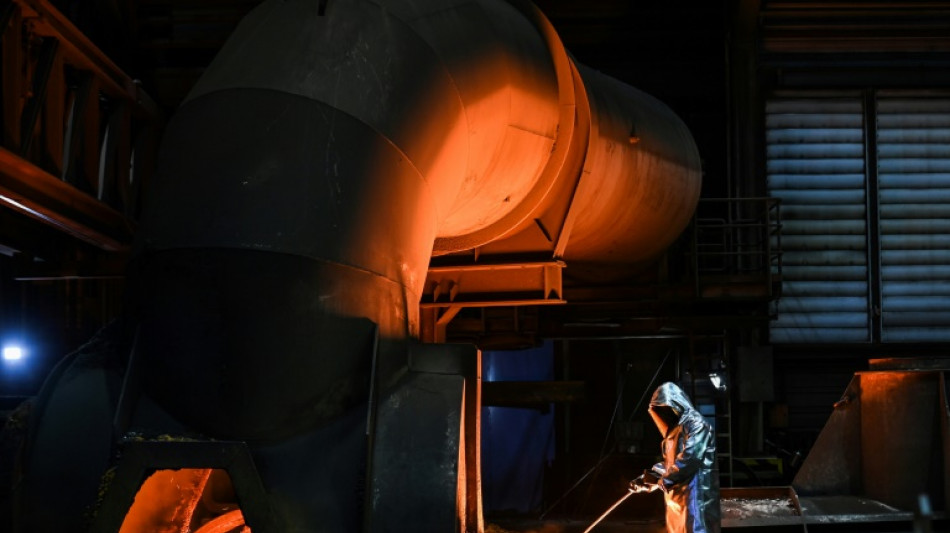
On climate, most corporations more talk than action / Photo: © AFP/File

The world's biggest and richest companies are failing to deliver on their climate pledges, according to an in-depth analysis released Monday that calls on governments to crack down on corporate greenwashing.
Under growing pressure from shareholders, governments and consumers, companies are racing to roll out strategies to reduce the carbon emissions of their operations, along with their products and services.
Twenty-four multinationals examined have all endorsed the Paris treaty target of capping global warming at 1.5 degrees Celsius, and aligned themselves with UN-backed campaigns to ensure that business plays its part in decarbonising the global economy.
Staying under that critical temperature threshold will require slashing global greenhouse gas emissions 45 percent by 2030, and reaching "net zero" -- with any residual emissions balanced by removals -- by mid-century, the UN's IPCC science advisory panel has said.
But the 2030 pledges of the 22 companies that made them would only slice 15 percent off their collective emissions, the report found.
And net zero targets adopted by all 24 multinationals -- if met -- would barely remove a third of their current emissions.
"The overwhelming majority of these corporations are simply not delivering the goods they promised," the 2023 Corporate Climate Responsibility Monitor concluded.
Climate think tanks Carbon Market Watch and NewClimate Institute did a deep-dive into sectors ranging from the auto, shipping and aviation industries, to retail fashion, high tech and food, to steel and cement. No oil or gas companies were included.
- Vague 'net zero' pledges -
With combined earnings of more than $3 trillion, the two dozen companies under the microscope account for some four percent of all global emissions -- two billion tonnes of CO2 or its equivalent each year.
Analysts assessed the integrity of each corporation's climate plan, looking at the accuracy of self-reported emissions, targets set for reducing them, progress to date, and how heavily pledges depend on questionable compensation schemes known as carbon offsets.
"At a time when corporations need to come clear about their climate impact and shrink their carbon footprint, many are exploiting vague and misleading 'net zero' pledges to greenwash their brands while continuing with business as usual," said Carbon Market Watch executive director Sabine Frank.
Earning the best overall marks was shipping giant Maersk, whose plan for erasing its carbon footprint by 2040 was deemed to have "reasonable integrity".
The climate plans of eight corporate giants -- including Apple, Google, Microsoft and steel-conglomerate ArcelorMittal -- were judged to have "moderate integrity".
Swedish fast-fashion retail giant H&M, also in this tranche, has very ambitious emissions reduction targets, but parts of its green strategy could undermine them, the report found.
"The company’s plans to switch to biomass and renewable electricity credits (RECs) in the supply chain could severely undermine those targets," NewClimate Institutes's Silke Mooldijk told AFP.
Biomass is associated with deforestation and CO2 emissions, and the purchase of RECs "allows companies to report emission reductions that are not real," according to a recent study in Nature Climate Change.
- Junk carbon credits -
When asked to comment, H&M "welcomed" the new report and outlined steps it is taking to achieve its "100 percent renewable electricity goal for our and our supplier’s operations", but sidestepped the question of biomass and RECs.
The climate claims of another 11 companies were found to have "low integrity," and four -- American Airlines, Samsung Electronics, retail food giant Carrefour, and JBS, the largest meat processing company in the world -- were all tagged with "very low integrity".
Carrefour objected to the ranking, saying the company had set emissions reduction goals across its entire value chain, and was the only large French food retailer ready to cut off suppliers lacking their own climate strategies.
JBS said the report had not taken into account written clarifications provided to the authors, but did not say what they were.
American Airlines and Samsung did respond when contacted by email.
"Regulations are needed requiring companies to reduce their emissions, and regulating what they can -- and cannot -- say to consumers," Carbon Market Watch policy lead Gilles Dufrasne told AFP.
"The short term action that's needed is to ban carbon neutrality claims," he added. "If the company wants to buy junk carbon credits that don't represent anything, they're free to do so, but they're not free to make false and misleading statements."
D.Pan--ThChM



