Brazil exits recession, but faces tough year

Brazil exited recession in the fourth quarter, the government said Friday, though weak growth and high inflation still dog Latin America's biggest economy as President Jair Bolsonaro gears up to seek re-election in October.
Gross domestic product (GDP) grew 0.5 percent for the period from October through December, reversing its 0.3-percent and 0.1-percent contractions in the previous two quarters, said the national statistics institute, IBGE.
That brought GDP growth for 2021 to 4.6 percent on the year, erasing the economy's painful contraction in pandemic-battered 2020, which was revised to 3.9 percent.
But the economy remains a headache for far-right leader Bolsonaro, with growth still weak and inflation hitting Brazilian households hard.
Uncertainty fueled by Bolsonaro's expected election showdown with leftist ex-president Luiz Inacio Lula da Silva and international turmoil around Russia's invasion of Ukraine will likely weigh heavily on the Brazilian economy this year, analysts say.
"2022 is a difficult year due to both internal and external factors," said economist Gilberto Braga of business school IBMEC in Rio de Janeiro.
"Uncertainties around the country's political future are making things unpredictable and will delay strategic decisions on the economy... And external issues will weigh down global GDP, and Brazil's along with it," he told AFP.
"The current scenario is 'stagflation.'"
- 'Weak momentum' -
The rebound was driven by Brazil's key agricultural sector, which grew 5.8 percent quarter-on-quarter -- though it contracted 0.2 percent on the year, hit by the country's worst drought in nearly a century.
The services sector grew 0.5 percent quarter-on-quarter and 4.7 percent year-on-year, while industry contracted 1.2 percent for the quarter but grew 4.5 percent for the year.
The return to growth "was mainly a result of turnaround in the agricultural sector, which is unlikely to be sustained," William Jackson, chief emerging markets economist at consulting firm Capital Economics, said in a note.
"In the meantime, high-frequency indicators for the services and industrial sectors point to weak momentum in the first quarter of 2022."
His team maintained a forecast of GDP growth of 0.8 percent for 2022, "making Brazil the worst performer in the region this year."
Economists polled by Brazil's central bank currently forecast GDP growth of 0.3 percent for 2022.
Brazil's annual inflation rate came in at 10.06 percent last year, crashing through the central bank's target of 3.5 percent.
The central bank has responded with one of the most aggressive tightening cycles in the world, rapidly raising the key interest rate to 10.75 percent from an all-time low of two percent in March 2021.
The hawkish monetary policy is in turn weighing down growth, sapping the economy's recovery from Covid-19.
Brazil has been among the countries hit hardest by the pandemic, with more than 650,000 deaths -- second only to the United States.
Even with 72 percent of Brazil's 213 million people now fully vaccinated against Covid-19, high inflation and weak growth have combined to keep the economic recovery tepid.
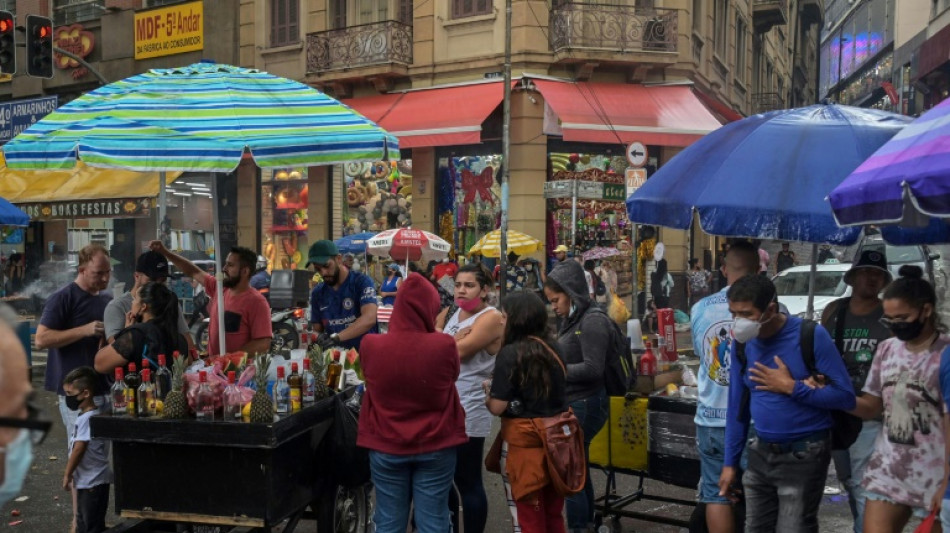
With prices soaring and wages stagnant, the average Brazilian's purchasing power fell by seven percent last year.
G.Tsang--ThChM